speech
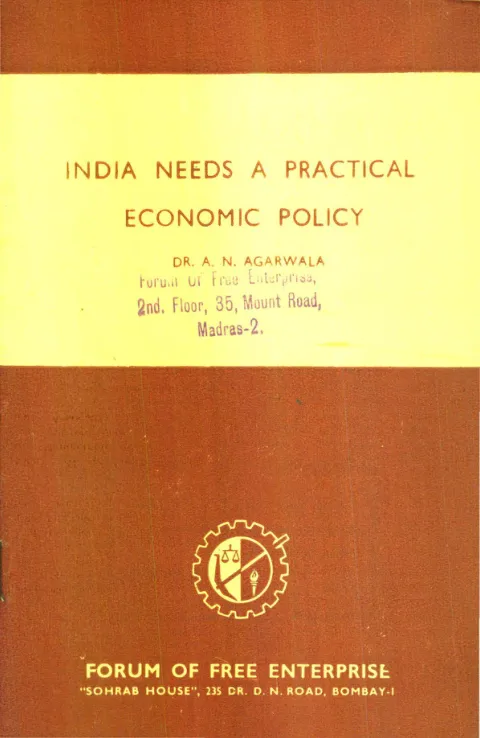
India Needs A Practical Economic Policy
Published by M. R. Pai for the Forum of Free Enterprise, 235, Dr. Dadabhai Naoroji Road, Bombay 1, and Printed by S. J. Patel, at Onlooker Press. (Prop. Hind Kitabs Ltd.), Sassoon Dock, Colaba, Bombay-5. · Bombay · 1965
20 pages
Summary
Dr. A. N. Agarwala’s presidential address to the XVIII session of the Indian Commerce Conference (Poona, January 1965), issued as a Forum of Free Enterprise booklet on 10 May 1965, diagnoses a worsening food and price crisis and argues that India needs a pragmatic — not doctrinaire — economic policy. Agarwala opens with hard numbers: a foodgrain production shortage of 8–14 million tons depending on the standard used, a market shortage projected at 14–20 million tons in 1964-65, an internal rupee value already down to 17 paise, and roughly 7% annual inflation since the start of the Second Plan. He insists that imports cannot close the gap, that government expenditure must be cut by about 10%, and that the Defence Budget be separated from the regular Revenue and Capital Budgets so that defence does not cannibalise development.
Agarwala then aligns himself with Prime Minister Lal Bahadur Shastri’s New Economic Policy — welfare of the common man, manageable plan size, urgency of food output, quick-yielding projects — and frames a broader thesis: the inter-war certainties of doctrinaire Capitalism vs Socialism have dissolved. The five leading capitalist economies are booming, communist countries are quietly adopting profit incentives and marketing techniques, and the result is a converging “Neo-Capitalism” of private enterprise, selective state intervention and welfare functions. Citing Schumpeter, Fortune, J. K. Galbraith, Douglas McGregor, Douglas Jay, John P. Lewis and S. S. Khera, he argues that India’s planners suffer less from a shortage of ideas than from a shortage of “implementation input” and a national habit of substituting words and slogans for action.
The booklet’s analytical core is a value-free test for the public-vs-private question: operational efficiency, measured as lower cost per unit. By this yardstick Agarwala finds the public sector wanting. The Central Government Audit Report for 1964 covering 46 Government companies showed only 11 declared a dividend (Rs 1.54 crores, 6.4% of their own paid-up capital but 0.2% of the total), interest-holidays and loan moratoria of hundreds of crores, and an estimated social cost of Rs 211 crores in 1962-63 — about Rs 4 per capita of foregone national income. He rejects the conventional monopoly framing too: India’s problem is not single-seller monopoly but a “dominant firms situation” largely engineered by licensing, foreign-exchange allocation and technological scale, and “to invoke the whole ethics of monopoly to meet a simple situation is like using a sledge hammer to break a nut.”
Agarwala closes by insisting that, whatever ideological label is attached, the operative criterion must be efficiency and cost reduction — both to protect consumers and to widen export markets — and that many current policies would look very different if those goals were taken seriously. He disclaims any doctrinaire bias for private ownership, allowing that if public ownership could rapidly relieve poverty he would back it; but if private enterprise is to continue, it must be brought under social discipline rather than driven away by hostility to bigness.
Key points
-
Quantifies India’s 1963-64 foodgrain crisis as an 8–14 million ton production shortage and a 14–20 million ton projected market shortage in 1964-65, with imports capped near 6 million tons by world supply and Indian port capacity.
-
Documents rupee depreciation to 17 paise and roughly 7% annual inflation since the Second Plan, calling anything beyond 4% “monetary recklessness” and citing W. Arthur Lewis on 3–4% as an upper safe limit for developing economies.
-
Demands the Defence Budget be separated from Revenue and Capital Budgets and government expenditure cut by ~10% to prevent defence from eroding development.
-
Endorses PM Lal Bahadur Shastri’s New Economic Policy and its emphasis on the common man’s welfare, a manageable Fourth Plan, quick-yielding projects, and better implementation machinery.
-
Argues capitalism and communism are converging into a pragmatic “Neo-Capitalism” — private enterprise plus social welfare and selective state intervention — and that doctrinaire ideology is being displaced by technology-driven, measurable gains.
-
Proposes operational efficiency (cost per unit) as a value-free criterion for choosing between public and private ownership, treating inefficiency as no less anti-national than the profit motive is alleged to be.
-
Marshalls Audit Report data — only 11 of 46 Government companies declared dividends in 1962-63, with interest holidays on Rs 357 crores of Hindustan Steel loans and a social cost of roughly Rs 211 crores — to argue that India is paying a heavy ideological price for public ownership.
-
Reframes the monopoly debate as a “dominant firms situation” largely produced by government licensing, raw-material rationing and foreign-exchange allocation, and warns against treating it with anti-monopoly punitive machinery.
Metadata and summary are AI-extracted from the source PDF and reviewed for editorial accuracy. The original work is available via the Read PDF tab above (where present); paragraph-level citation inside the PDF is deferred to a future engagement.