edited volume · anthology
A Review of Current Economic Problems
By B. R. Shenoy
Published by M. R. Pai for the Forum of Free Enterprise, 235, Dr. Dadabhai Naoroji Road, Bombay 1, and Printed by S. J. Patel, at Onlooker Press, (Prop. Hind Kitabs Ltd.), Sassoon Dock, Colaba, Bombay-5. · Bombay · 1965
11 pages
Summary
A slim Forum of Free Enterprise booklet dated 10 September 1965, collecting three short pieces that together amount to a classical-liberal post-mortem on the first decade and a half of Indian planning. Sir H. P. Mody opens with a polemic against the planning apparatus itself; Prof. B. R. Shenoy diagnoses the food crisis as the product of deficit financing and the misdirection of public-sector resources rather than hoarding; and P. S. Narayan walks through the country’s foreign exchange crisis, arguing that ad-hoc controls and devaluation are no substitute for getting at the fiscal and monetary fundamentals. The shared frame is that India’s troubles are self-inflicted by ever-larger plans, expanding public expenditure, and bureaucratic controls, and that consolidation, fiscal discipline, and a serious rehabilitation of private enterprise are the only honest remedies.
Key points
-
Sir H. P. Mody’s address ‘Whither Indian Planning?’ argues that each Five-Year Plan has been required to grow larger than its failed predecessor, faulting large-scale public enterprises for aggravating shortages rather than relieving them.
-
Mody cites Ashok Mehta’s own admission that India is the most heavily taxed country in the world as evidence that the burden imposed by planning has become indefensible.
-
Prof. B. R. Shenoy’s essay rejects the theory that hoarders and traders caused the food crisis, tracing it instead to deficit financing by the Planning Commission, Finance Ministry, and Reserve Bank.
-
Shenoy notes that only 6.7 per cent of plan investment went to agriculture even though 70 per cent of investment resources were raised through public appropriation, calling this the structural distortion behind food scarcity.
-
Shenoy argues that anti-usury legislation stripped tenant farmers of access to money-lender credit without providing a working substitute, worsening rather than improving their overall creditworthiness.
-
P. S. Narayan surveys the foreign exchange crisis, noting reserves fell from Rs. 188 crores in March 1964 to Rs. 116 crores in March 1965 while an IMF standby credit was consumed within a year.
-
Narayan criticises measures such as the raised Bank Rate, a ten per cent regulatory duty surcharge, and compulsory import deposits as piecemeal steps that squeeze credit for small industries while leaving inflationary government spending untouched.
-
Citing A. D. Shroff, Narayan rejects devaluation and moratorium in favour of consolidation, completion of projects already underway, and a Fourth Plan outlay set with realism rather than gigantism.
Essays
Whither Indian Planning?
By Sir H. P. Mody
Mody’s address ‘Whither Indian Planning?’ arraigns the entire mechanics of the Five-Year Plan regime. He notes that since 1951 the country has lived under a succession of plans whose targets, resources and production schedules have proved ‘hopelessly wrong’, yet each new plan is required to be larger than the last. He argues that planning, far from being questioned in principle, has been corrupted in practice: large-scale public enterprises have aggravated shortages, agricultural productivity remains low, the Centre blames the cultivator instead of itself, and the tax burden — by Ashok Mehta’s own admission — has reached staggering proportions. Mody warns that unless the obsession with ‘gigantism’ is abandoned in favour of consolidation and realism, the Third Plan target of food self-sufficiency by 1981 will be a fresh casualty of the same mindset.
- Frames Indian planning as a self-perpetuating ritual where each plan must be larger than its predecessor regardless of how badly the prior one failed.
- Blames large-scale public enterprises and bureaucratic interference for accentuating, not relieving, shortages across foodgrains, water, housing, transport and telecommunications.
- Argues the State has used the cultivator as a scapegoat while remaining itself the ‘all-powerful Government’ responsible for low agricultural productivity.
- Cites Ashok Mehta’s admission that India is the most heavily taxed country in the world as evidence that the tax burden is no longer defensible.
- Calls for ideology and reckless experimentation to give way to realism, and for the Third Plan’s gigantism to be replaced by consolidation.
India’s Food Problem
By B. R. Shenoy
Shenoy’s ‘India’s Food Problem’ refuses the then-fashionable explanation that the food crisis is the work of hoarders and traders. Rains and physical shortages, he argues, are the symptoms; the underlying cause is the misdirection of resources, the neglect of agriculture, and above all the inflation generated by deficit financing — the Planning Commission, Ministry of Finance and Reserve Bank inflating monetary circulation while traders and farmers are scapegoated. He distinguishes short-term remedies (PL-480 imports already in train) from the long-term task of raising domestic farm output through better seeds, fertilisers, irrigation, storage, marketing and, crucially, restoring the credit-worthiness of farmers and tenants whose access to the money-lender has been legislated away without a working substitute. Without redirecting public-sector investment funds away from steel mills and ‘so-called infra-structure industries’ towards agriculture, he warns, no permanent solution to the food problem is possible.
- Rejects the ‘unholy alliance’ theory of traders and farmers as the cause of high food prices; locates the real cause in physical shortages plus monetary inflation.
- Names the Planning Commission, Ministry of Finance and Reserve Bank as the agents ‘inflating monetary circulation’ while farmers and traders are blamed.
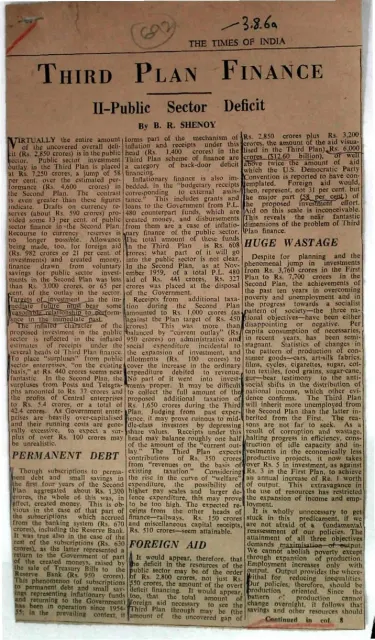
- Identifies neglect of agriculture — only 6.7 per cent of plan investment, even as 70 per cent of investment resources come through public appropriation — as the structural distortion.
- Argues anti-usury legislation has crippled tenant credit-worthiness, pushing money-lenders out without functioning replacements, and inflating effective interest on farm credit.
- Concludes no lasting solution is possible without redirecting public-sector investment away from steel and ‘infra-structure industries’ towards agriculture.
The Foreign Exchange Crisis
By P. S. Narayan
Narayan’s ‘The Foreign Exchange Crisis’ surveys the deficit in India’s balance of payments and rejects palliatives. Foreign exchange scarcity, he writes, should not cause alarm unless it persists and leads to stringency and a critical situation — which is precisely where India now is, with reserves down from Rs. 188 crores in March 1964 to Rs. 116 crores in March 1965 and an IMF gain and standby credit consumed within a year. He surveys recent measures (raising the Bank Rate, ten per cent regulatory duty surcharge, compulsory deposits on imports) and finds them piecemeal and counter-productive: credit squeeze hits small and medium industries hardest while inflationary government expenditure goes untouched, and import-substitution drives are pushed through under conditions where domestic costs cannot match imports. He argues for genuine export promotion (including tourism), serious cuts in Government expenditure, and rejection of devaluation and moratorium in favour of long-term funding of obligations. Citing A. D. Shroff, he concludes that the wise course is consolidation, completion of projects in hand, and a Fourth Plan outlay framed with realism rather than gigantism.
- Quantifies the crisis: reserves fell from Rs. 188 crores (March 1964) to Rs. 116 crores (March 1965); standby credit of 200 million dollars from the IMF largely consumed in a year.
- Argues piecemeal credit and import controls hurt small and medium industries while leaving inflationary public expenditure untouched.
- Rejects devaluation and moratorium: devaluation will not solve the deficit because exports are price-inelastic and imports inelastic in quantity; moratorium would damage credit standing.
- Calls for serious export promotion (including tourism — citing France, Switzerland and the U.A.R. as commercial-tourism models) and full utilisation of installed capacity through fiscal incentives.
- Endorses A. D. Shroff’s prescription: halt new expansion programmes, consolidate, and finance the Fourth Plan from realistically available resources.
Metadata and summary are AI-extracted from the source PDF and reviewed for editorial accuracy. The original work is available via the Read PDF tab above (where present); paragraph-level citation inside the PDF is deferred to a future engagement.