edited volume · anthology
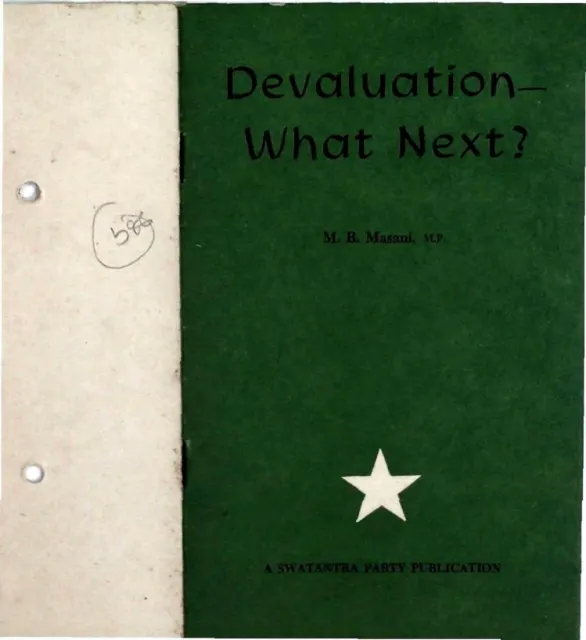
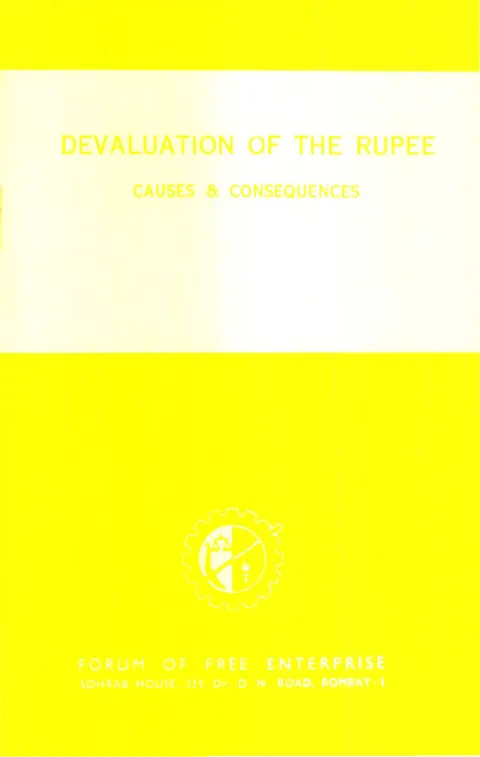
Devaluation of the Rupee
Causes & Consequences
Published by M. R. PAI for the Forum of Free Enterprise, "Sohrab House", 235, Dr. Dadabhai Naoroji Road, Bombay-1, and printed by H. NARAYAN RAO at H. R. MOHAN & CO. (PRESS). 9-B, Cawasjee Patel Street, Bombay-1. · Bombay · 1966
16 pages
Summary
A 1966 Forum of Free Enterprise booklet collecting three responses to the June 1966 devaluation of the rupee. The constitutional lawyer N. A. Palkhivala opens with a talk delivered to the Forum on 27 June 1966 framing devaluation as the legal recognition of an economic fait accompli and listing seven disciplines without which the measure will fail. A pseudonymous columnist ‘S. M.’ follows with a piece reproduced from the Hindustan Times of 22 June 1966 that defends devaluation against the charge of foreign coercion and ties its success to renewed fiscal restraint and a deferred Fourth Plan. Dr. Kersi D. Doodha, an economist in a commercial bank, closes with a primer on what devaluation actually is, how the IMF’s Articles of Agreement frame ‘fundamental disequilibrium’, and the supply-side conditions under which a change in par value can correct a payments imbalance.
Key points
-
Palkhivala frames the June 1966 devaluation of the rupee as the government’s de jure recognition of a de facto position economics had already imposed, warning its benefit is more confessional than remedial.
-
In the same talk, Palkhivala contrasts a French and Yugoslav path of disciplined post-devaluation recovery with an Indonesian path of hyperinflation, arguing devaluation alone only opens the choice.
-
The talk also rejects the charge that the United States and the World Bank coerced India into devaluing, calling such blame a sign that economic distress has not cost Indians their sense of humour.
-
Seven concrete prescriptions follow, including removing the new 10 per cent industrial surcharge, granting depreciation on debt-revalued fixed assets, and ending frequent changes in export duty.
-
Writing pseudonymously in the Hindustan Times of 22 June 1966, “S. M.” treats International Monetary Fund pressure on India as advice a borrowing country must judge on its merits rather than as imposed coercion.
-
The same piece argues that Manubhai Shah’s system of selective export incentives already amounted to an undeclared devaluation, so making the change official ends the smuggling premium and revives remittances from abroad.
-
“S. M.” insists devaluation succeeds only if joined to four disciplines: fiscal restraint, abandoning production-restricting controls, using installed capacity first, and deferring the Fourth Plan by at least a year.
-
Dr. Kersi D. Doodha’s closing essay explains that devaluation targets the rupee’s external par value to restore equilibrium between internal and foreign prices, rejecting the popular conflation with falling domestic purchasing power.
-
Doodha walks through the International Monetary Fund’s Articles of Agreement definition of “fundamental disequilibrium” and its distinction between temporary and fundamental balance-of-payments disturbances.
Essays
Devaluation Brings India to Crossroads
By N. A. PALKHIVALA
Palkhivala welcomes the Government’s decision to acknowledge de jure a de facto devaluation but insists that devaluation by itself can only put India at a crossroads: it can lead either to the disciplined recovery seen in France and Yugoslavia, or to the Indonesian descent into soaring prices. He defends India’s foreign creditors as the natural beneficiaries of devaluation and warns that to blame the United States and the World Bank for the decision is unintentionally comic. The bulk of the talk lays out seven concrete measures to extract maximum benefit: private-sector price restraint even at the cost of margins; an absolute priority for price stability over Fourth Plan tonnage targets; an attack on stifling controls and the ‘pen-and-pencil armies’ of bureaucrats; an end to deficit financing and to living beyond the nation’s means; a hard accounting from a Rs. 2,000 crore public sector returning only 0.6%; removal of the new 10% surcharge on industry coupled with proper depreciation on revalued fixed assets; and an intensified, stable export-duty regime.
- Devaluation is presented as the de jure recognition of a de facto position the law of economics had already imposed; its virtue is less remedial than confessional.
- Palkhivala contrasts a French/Yugoslav road of disciplined recovery with an Indonesian road of post-devaluation hyperinflation; devaluation only opens the choice.
- He rejects the populist charge that the United States and the World Bank coerced India into devaluation, calling such blame a sign that economic distress has not cost Indians their sense of humour.
- Stifling bureaucratic controls are named as the central cause of stagnation, with the Economic and Scientific Research Foundation cited that India’s rate of growth is the lowest in Asia barring Indonesia.
- Sustaining the gains requires Centre and States to abandon deficit financing (last year’s deficit ran to Rs. 435 crores) and to force a real return out of a Rs. 2,000 crore public-sector investment whose 60 Corporations average only 0.6%.
- Seven concrete prescriptions are listed, including removal of the 10% industrial surcharge, depreciation on debt-revalued fixed assets, and an end to frequent changes in export duty.
Devaluation Points Up the Need for Discipline
By S. M.
Writing in the Hindustan Times of 22 June 1966 (reproduced here with permission), the anonymous columnist S. M. defends the devaluation against the political backlash building inside Congress on the eve of the elections. He concedes the discomfort in the Cabinet — including warnings to Mrs. Gandhi and the publicised reservations of Kamaraj — but argues that the IMF was created precisely to regulate par values, and that India’s long-running system of selective export incentives championed by Manubhai Shah had already been an undeclared partial devaluation. The piece then pivots to the discipline that devaluation now demands: Centre and States must stop taking a share of the national cake faster than the cake is growing; production-restricting controls must be abandoned; installed capacity should be sweated before new plants are built; and the Fourth Plan must be deferred for at least a year while aid discussions with the World Bank are concluded around a Centre-led plan. The closing political note defends the Government’s earlier proposal to separate Central and State elections as a legitimate parliamentary instrument.
- The columnist treats foreign ‘pressure’ from the IMF as advice the borrowing country must judge on its merits, not as imposed coercion.
- Selective export incentives identified with Manubhai Shah amounted to an undeclared devaluation; making it official ends the smuggling premium and revives remittances from Indians abroad.
- Devaluation is only a short-term corrective; it works only if joined to four neglected disciplines — fiscal restraint, abandonment of production-restricting controls, prior use of installed capacity, and a one-year Plan deferral.
- Drafting a detailed Fourth Plan now is dismissed as ‘whistling in the dark’; better to negotiate a Central plan with the World Bank and postpone State-level projects.
- The piece defends the proposal to separate Central and State elections as constitutionally proper, arguing a parliamentary government has the right to choose when to seek a fresh mandate.
What Is Devaluation?
By DR. KERSI D. DOODHA
Doodha, writing as an economist in a commercial bank, offers a careful primer on what devaluation actually is and is not. He rejects the popular conflation of devaluation with a fall in the rupee’s domestic purchasing power: the measure targets the external par value in order to restore equilibrium between internal prices and those prevailing in foreign markets. The bulk of the essay walks through the IMF’s notion of ‘fundamental disequilibrium’ as set out in Article I of the Articles of Agreement, the Fund’s distinction between temporary and fundamental disturbances, the cumulative 10% rule and the 72-hour notice requirement for changes in par value, and Harry G. Johnson’s working definition framed around the U.S. dollar. The essay closes with the supply-side conditions under which a devaluation can actually work — demand-elastic exports, available exportable supplies, an elastic domestic supply structure, substitutes for items currently exported away — and warns that devaluation undertaken in inflationary conditions will be neutralised by the expectation of rising prices.
- The popular reading that the rupee has lost 36.5% of its purchasing power is rejected; devaluation acts on the external par value, not the internal one.
- The IMF’s Article I notion of ‘fundamental disequilibrium’ is unpacked through three signals: persistent payments deficits, repeated reliance on Fund credit, and book-keeping repurchases rather than genuine repayments.
- Procedural mechanics are spelled out: cumulative changes up to 10% need only notification to the Fund; larger changes require Fund advice, plus a 72-hour notice rule.
- Devaluation works only when four supply-side conditions hold — demand elasticity of exports, sufficient export supplies, an elastic domestic supply structure, and substitutes for goods being exported away.
- The essay’s central warning is that devaluation undertaken in inflationary conditions is self-defeating, because expectations of rising prices neutralise the corrective effect on relative prices.
Metadata and summary are AI-extracted from the source PDF and reviewed for editorial accuracy. The original work is available via the Read PDF tab above (where present); paragraph-level citation inside the PDF is deferred to a future engagement.