speech
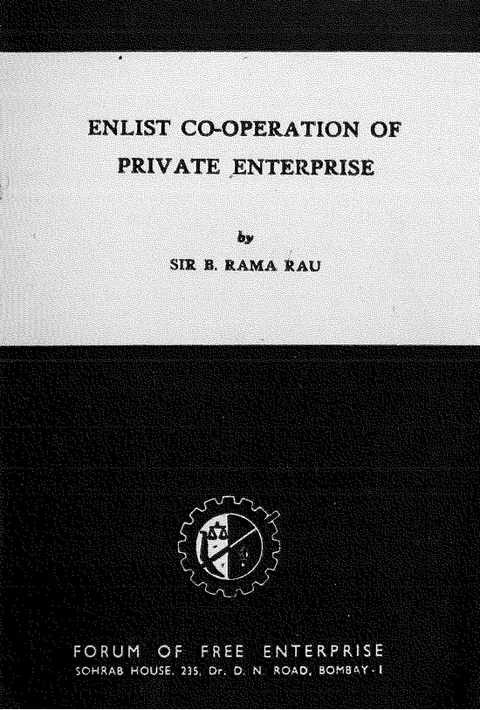
ENLIST CO-OPERATION OF PRIVATE ENTERPRISE
Published by M. R. Pai for Forum of Free Enterprise, "Sohrab House", 235, Dr. Dadabhai Naoroji Road, Bombay 1, and printed by Mr. S. Krishnamoorthy, for Western Printers & Publishers, 15123, Hamam Street, Bombay 1 · Bombay · 1959
8 pages
Summary
Sir B. Rama Rau’s short address to the Rotary Club of Bombay (June 23, 1959), published as a Forum of Free Enterprise booklet, opens with a diagnosis of India’s Parliamentary system: the absence of an effective democratic opposition has bred a public culture in which ‘even honest businessmen, who have to depend on Government for licences and concessions in a rigidly controlled economy’ are afraid to speak publicly on wider political issues, and the Press has only lately found its voice. He treats this nervousness as ‘characteristic of a developing totalitarian regime’ that only a serious opposition can cure. From this opening he welcomes Rajagopalachari’s announcement of a new independent democratic party (with Jayaprakash Narayan’s qualified blessing and Nehru’s recognition that constructive criticism would serve Congress), and positions himself as a detached observer of recent economic and political developments.
He credits the Congress with substantial achievements: the secular handling of Hindu–Muslim relations after Partition, the integration of the princely states, foreign-policy non-alignment, and a fiscal-and-monetary stance — ‘Development with Stability’ — praised by the World Bank and the IMF, with a stable banking system and rapid expansion of banking facilities laying the ground for industrial growth. But he turns sharply against the Avadi formulation of a ‘Socialistic Pattern of Society’, calling it vague and nebulous, and argues that the Beveridge-style Welfare State that Congress invokes has, in fact, been substantially built in Britain, the United States, and Erhard’s West Germany ‘without any departure from’ capitalist and individualistic foundations, by giving ‘the fullest encouragement to private enterprise and the competitive principle’. The capitalism Karl Marx attacked, on his reading, no longer exists in the older democracies; socialism has receded to the background.
In the closing pages he addresses the Congress’s lingering suspicion of the private sector. Profit, he insists, is not the worst appetite in public life — ‘there is something worse than craving for profits, and that is craving for power’ — and the politician’s power, unlike the businessman’s profit, is hard to tax or restrain, especially when dressed in austerity or patriotism. The cure is co-operation: the idealism of the politician married to ‘the enterprise, the creative urge, the practical outlook and the organising capacity’ of private industry. He uses the prohibition policy, with a reported annual revenue loss of a crore of rupees and ten thousand teachers’ worth of forgone employment, as a case of Congress pursuing ‘quick results’ through constitutional directive without weighing administrative feasibility. Finally, anticipating Nehru’s eventual retirement and the consequent splintering of Congress, he urges the immediate organisation of a progressive democratic opposition lest the Communists capture government, arguing that even short of victory such a party would do the country a great service by forcing Congress ‘to concentrate on practical programmes rather than on slogans’.
Key points
-
Frames the absence of an effective democratic opposition as the central pathology of post-independence India, with businessmen silenced by their dependence on Government licences in a ‘rigidly controlled economy’.
-
Welcomes Rajagopalachari’s announcement of a new independent democratic party; cites Jayaprakash Narayan’s qualified blessing and Nehru’s recognition that constructive opposition would benefit Congress.
-
Credits the Congress with the secular handling of Partition, integration of the princely states, foreign-policy non-alignment, and a ‘Development with Stability’ macro-policy praised by the World Bank and IMF.
-
Attacks the Avadi ‘Socialistic Pattern of Society’ as ‘vague and nebulous’, arguing Western Welfare States in Britain, the United States and Erhard’s West Germany were built without departing from capitalist and individualist foundations.
-
Reads Karl Marx’s nineteenth-century capitalism as defunct: the democratic Welfare State has absorbed its critiques without revolution, and the concept of socialism has receded to the background.
-
Rejects Congress moralism against the ‘profit motive’, insisting the politician’s craving for power is the more dangerous appetite and far harder to curb than profit.
-
Uses prohibition (annual revenue loss of one crore of rupees, employment forgone for ten thousand teachers) as a worked example of Congress prioritising slogans over administrative feasibility.
-
Warns that Nehru’s eventual retirement will splinter Congress and open the door for the Communists, making the immediate organisation of a progressive democratic opposition imperative.
Metadata and summary are AI-extracted from the source PDF and reviewed for editorial accuracy. The original work is available via the Read PDF tab above (where present); paragraph-level citation inside the PDF is deferred to a future engagement.