pamphlet
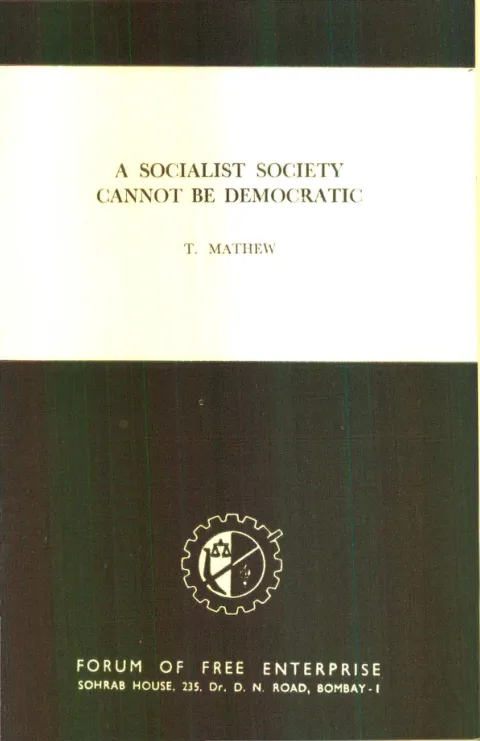
A Socialist Society Cannot Be Democratic
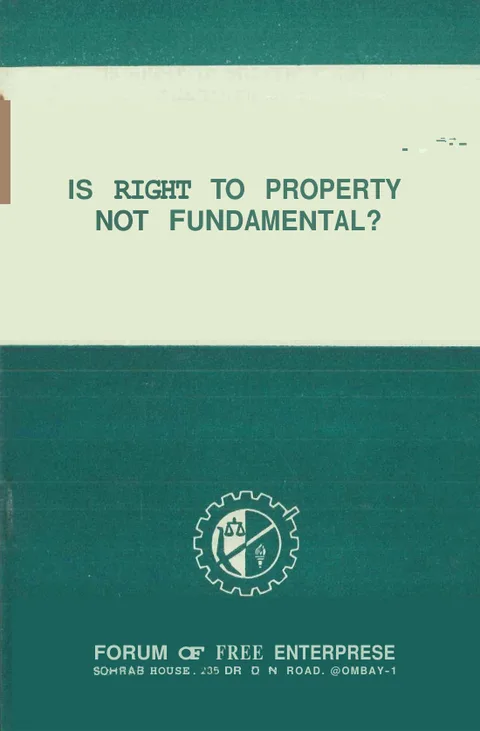
By T. Mathew
Published by M. R. Pai, for Forum of Free Enterprise, "Sohrab House," 235, Dr. Dadabhai Naoroji Road, Bombay 1, and printed by S. Krishnamoorthy at Western Printers & Publishers, 15/23, Hamam Street, Bombay 1 · Bombay · 1960
20 pages
Summary
T. Mathew’s prize-winning essay — awarded the second prize in a Forum of Free Enterprise public competition on “Democracy in India” — argues that the socialist programme being pursued by the Congress Party is logically and historically incompatible with the democratic ideals enshrined in the Indian Constitution. Mathew, a lecturer in economics, first reconstructs democracy from first principles: it is not majoritarian quantity but a society of “living selves” whose moral and material progress depends on liberty, equality, justice, education, and the rule of law. Each of these is then turned into a yardstick against which planned socialism is measured and found wanting.
A long central section anchors liberty in the right to private property. Citing Hilaire Belloc, Max Eastman, and Marx’s own logic, Mathew argues that diffused control of the means of production is the precondition of every other freedom, and that the Fourth Amendment of 1955 — which removed judicial review of compensation in property acquisition — has made the constitutional guarantee illusory and put “the mansion of democracy” in a precarious condition. Equality, in turn, is reframed as a spiritual claim about the unique personality of every individual, against which India’s caste system and a centralising state apparatus are equally corrosive. Education must therefore be free of state regimentation, and political parties must be programmatic and national rather than communal, linguistic, or sectional — the Hindu Mahasabha, Jan Sangh, DMK and Muslim League are named as failing this test.
Mathew then turns to party competition itself, claiming Indian democracy lacks a real opposition because Congress, having absorbed first the Praja Socialist and then the Communist programme at its Nagpur session, has reduced parliamentary debate to “a huge joke” — a state of affairs the newly formed Swatantra Party is welcomed as the corrective for. The argument culminates in the rule-of-law section, where, drawing on Dicey, Hayek and Tocqueville, Mathew contends that planning’s necessary discretion is constitutive of arbitrary government, that “discretionary authority of the government” is contradictory to the rule of law, and that a planned socialist economy cannot coexist with the certainty under known rules that allows individuals to pursue their lives in freedom.
The essay closes by quoting Tocqueville’s line that democracy seeks equality in liberty while socialism seeks equality in restraint and servitude, endorsing W. M. Chamberlin’s view that democratic socialism belongs “to the world of utopias,” and appealing to India’s “centuries-old tradition of ‘Dharma’” not to be “disowned” in the “fashionable craze after material mirages.” The booklet is rounded out by A. D. Shroff’s signature dictum on free enterprise and Eugene Black’s epigraph that private enterprise must be accepted “not as a necessary evil, but as an affirmative good.”
Key points
-
Democracy is defined morally rather than numerically: it is a society of “living selves” requiring liberty, equality, justice, education and the rule of law as its operating conditions.
-
Private property is treated as the foundational right that secures all other liberties; the 1955 Fourth Amendment is criticised for hollowing out the constitutional guarantee by removing judicial review of compensation.
-
Equality is reframed as a spiritual recognition of the unique personality of each individual, against which both India’s caste system and centralised state planning are corrosive.
-
Free, non-”nationalised” education is presented as essential to democratic citizenship and to national unity, with criticism of linguistic-state regimentation and politicised education ministries.
-
Communal and regional outfits — Hindu Mahasabha, Jan Sangh, DMK, Muslim League — are disqualified as democratic parties because they appeal to sectional rather than national constituencies.
-
Congress is faulted for absorbing the Praja Socialist and (at Nagpur) the Communist programmes, eliminating real opposition until the formation of the Swatantra Party.
-
Drawing on Dicey, Hayek and Tocqueville, the essay argues that the discretionary authority required by central planning is structurally incompatible with the rule of law.
-
The closing appeal invokes the Indian tradition of “Dharma” against the “material mirages” promised by socialism “or any other ‘ism’.”
Metadata and summary are AI-extracted from the source PDF and reviewed for editorial accuracy. The original work is available via the Read PDF tab above (where present); paragraph-level citation inside the PDF is deferred to a future engagement.