
speech
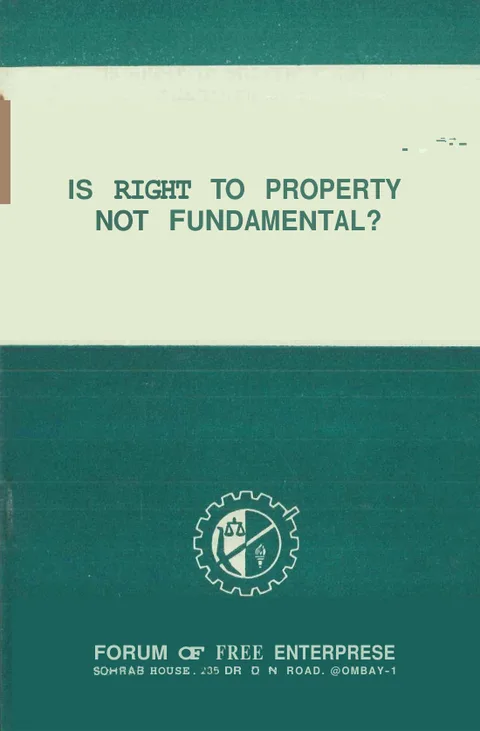
IS RIGHT TO PROPERTY NOT FUNDAMENTAL?
Published by M. R, PAI for the Forum of Free Enterprise, "Sohrab House", 235 Dr. Dadabhai Naoroji Road, Bombay-1, and printed by H. NARAYAN RAO at H. R. MOHAN & CO. (PRESS), 9-B, Cawasjee Patel Street, Bombay-1. · Bombay · 1970
12 pages
Summary
This April 1970 Forum of Free Enterprise booklet, titled ‘Is Right to Property Not Fundamental?’, bundles three essays defending the place of the right to property within Part III of the Indian Constitution at a moment when the Congress government was preparing to dilute or remove Article 31. C. K. Daphtary, former Attorney-General of India, opens with a speech he delivered at the Forum’s New Delhi Centre on 6 February 1970 that traces the constitutional history of property from the Round Table Conferences through the Fourth Amendment and the Supreme Court’s compensation jurisprudence. He is followed by the constitutional commentator A. G. Noorani (reprinted from the Indian Express, 29-30 December 1969) and by A. G. Mulgaokar (reprinted from Freedom First, December 1969). All three contributors converge on the argument that property is the foundation of every other liberty, that judicial review of compensation is what stops ‘just equivalent’ from collapsing into ‘illusory’, and that removing the right from the Fundamental Rights chapter would license confiscation and weaken the Rule of Law.
Key points
-
This April 1970 Forum of Free Enterprise booklet bundles three essays defending the constitutional right to property in Part III just as the Congress government prepared to dilute or remove Article 31.
-
C. K. Daphtary, former Attorney-General of India, delivers a speech at the Forum’s New Delhi Centre on 6 February 1970 tracing property’s constitutional history from the Round Table Conferences through the Fourth Amendment and the Supreme Court’s compensation rulings.
-
Daphtary cites Nehru’s own 1949 Constituent Assembly speech to argue the judiciary was always meant to intervene against ‘a fraud on the Constitution’, warning that removing the right entirely ‘opens the flood-gates of confiscation and expropriation’.
-
A. G. Noorani’s essay, reprinted from the Indian Express of 29-30 December 1969, traces the campaign to strip property from the Fundamental Rights chapter to Communist origins now embraced by Congress ministers such as K. V. Raghunatha Reddy.
-
Noorani draws on Granville Austin’s history of the Fourth Amendment and Justice Hidayatullah’s reasoning in Golak Nath to argue the framers deliberately made fundamental rights, including property, subject to judicial review.
-
He compares Article 15 of the 1949 West German Basic Law, which preserves judicial recourse over compensation, with the 1965 International Commission of Jurists conference in Bangkok, which endorsed nationalisation only with fair compensation set by an independent tribunal.
-
All three contributors converge on treating property as the foundation of every other liberty and judicial review of compensation as the safeguard preventing ‘just equivalent’ from collapsing into ‘illusory’.
Essays
Essay 1
Daphtary argues that the right to property has been treated as a vital and essential human right in every country and every age, but that scientific and industrial progress in the late 1800s gave property a new, potentially dominating dimension which justified regulation in the public interest. He recounts how the framers of the Indian Constitution, after long debate at the Round Table Conferences and in the Constituent Assembly, deliberately placed property and its acquisition (Sections 30 and 31, later Articles 30 and 31) among the Fundamental Rights, with judicial review built in ‘because that power was considered to be that the Constitution expressly provided for a direct approach to the Supreme Court itself for relief.’ He then walks through the Supreme Court’s struggle with the word ‘compensation’ after the zamindari laws, the 1955 Fourth Amendment, Mrs. Bela Banerjee’s case, and the Court’s ruling in State of Gujarat v. Shantilal Mangaldas that compensation principles must not be illusory or arbitrary.
Daphtary closes by re-reading Nehru’s own Constituent Assembly speech of 10 September 1949, in which Nehru insisted the judiciary should come in ‘to see if there has been a fraud on the Constitution.’ On that authority Daphtary concludes that the right to property is ‘fundamental in another sense’ because it is the foundation of every other right, that the Courts should still look upon the Judiciary kindly and prefer to do without it only if absolutely necessary, and that removing the right altogether without compensation ‘only opens the flood-gates of confiscation and expropriation.’
- Property has historically been treated as a vital and essential right because it secures personality, status, comfort and old-age protection, and is the foundation of every other right.
- The framers of the Indian Constitution decided after the Round Table Conferences to place property and its acquisition expressly in the Fundamental Rights chapter so that Supreme Court review was guaranteed.
- Successive Supreme Court rulings (zamindari cases, the Fourth Amendment, Bela Banerjee, State of Gujarat v. Shantilal Mangaldas) preserved a justiciable floor against compensation principles that are illusory or arbitrary.
- Daphtary cites Nehru’s own 1949 Constituent Assembly speech to argue that Article 31 was always meant to be patrolled by the judiciary against ‘a fraud on the Constitution’.
- Removing the right to property altogether, he warns, would open ‘the flood-gates of confiscation and expropriation’ and is no real obstacle to genuine social welfare legislation.
Essay 2
Noorani’s essay (Section II, reprinted from the Indian Express of 29 and 30 December 1969) argues that the campaign to strip the right to property from the Fundamental Rights chapter began in Communist quarters but has now been picked up by the Congress government and even endorsed by ministers like K. V. Raghunatha Reddy. He treats the proposal as transparently wrong: the demand mistakes retention of the right for a transfer of power from judges to Parliament over the quantum of compensation, when in truth the Directive Principles of State Policy already make implementation impossible if property is also retained. He draws on Granville Austin’s account of the Fourth Amendment and on Justice Hidayatullah’s reasoning in Golak Nath to show that the framers expected the courts to police arbitrary expropriation.
Noorani then turns to comparative material — Article 15 of the West German Basic Law of 1949 (which expressly provides for compensation recourse to the ordinary courts and which, contrary to claims made on the Supreme Court bench, allows judicial review in ‘socialisation’ cases) — and to the 1965 International Commission of Jurists conference in Bangkok, whose theme of ‘Economic and Social Development within the Rule of Law’ concluded that nationalisation should proceed by democratic procedures and on payment of fair and reasonable compensation determined by an independent tribunal. His verdict is that the present campaign represents ‘not social progress but the abolition of the Rule of Law’.
- The demand to remove property from Fundamental Rights originated in Communist quarters but is now being pushed by the Congress government and ministers.
- Noorani uses Granville Austin’s history of the Fourth Amendment to argue the framers deliberately made the fundamental rights justiciable.
- Justice Hidayatullah’s reasoning in Golak Nath is invoked to show that property’s protection is not unique but part of a constitutional architecture of justiciable rights.
- Comparative reading of Article 15 of the West German Basic Law shows that even modern democratic socialist constitutions preserve compensation recourse to the ordinary courts.
- The 1965 ICJ Bangkok conference on Economic and Social Development within the Rule of Law concluded that nationalisation requires democratic process and independent-tribunal compensation.
Essay 3
Mulgaokar’s essay (Section III, reprinted from the December 1969 issue of Freedom First) re-frames the property debate around what ‘fundamental’ can possibly mean if a fundamental right can be restricted away by ordinary legislative process. He surveys the moral, legal and economic case for retaining the right, observing that the Supreme Court has already conceded Parliament’s amending power, so the move to abridge property rights is gratuitous rather than necessary. The deeper risk, he argues, is precedent: if property can be peeled off the Fundamental Rights chapter on the whim of the moment’s majority, no other right is safe — ‘the right to move to any place in the union territory given to every citizen’ could be the next to go.
He then makes a procedural-constitutional argument addressed directly to President V. V. Giri. Citing the 1910 British precedent in which Asquith was compelled, after Edward VII’s death, to fight a second general election within months before George V would create peers to pass the Lloyd George Budget and the Parliament Act, Mulgaokar contends that no government should be allowed to amend the Constitution in ‘such a major way’ without a clear electoral mandate, and that it is the President’s ‘bounden duty’ to warn the Prime Minister accordingly.
- Mulgaokar’s central question: what does ‘fundamental’ mean if a right can be restricted or taken away by ordinary legislation at the fancy of legislators?
- He warns that abridging property would set a precedent reaching to other rights, citing the freedom of movement guarantee as the next plausible casualty.
- Surveying twenty years of legislative haste, blind adherence to slogans and ‘illusory immediate satisfaction’, he argues that judicial review is what protects against oppressive laws.
- Mulgaokar invokes the 1910 Asquith/Lloyd George precedent — where the Crown insisted on a fresh general election before agreeing to create peers and pass the Budget and the Parliament Act — to argue that major constitutional change requires a popular mandate.
- He directs his argument to President V. V. Giri, urging him to warn the Prime Minister that he cannot assent to a constitutional amendment of this magnitude without the people first declaring their wishes at an election.
Metadata and summary are AI-extracted from the source PDF and reviewed for editorial accuracy. The original work is available via the Read PDF tab above (where present); paragraph-level citation inside the PDF is deferred to a future engagement.
People in this work
Related across the archive
 ThePrintIf fundamental right to property can be taken away, so can all the others: AG Mulgaokar
 Primary workFundamental Rights in India
 ExcerptFundamental Rights: Our Protection Against Tyranny
- Primary workIL Explainer - Ep 6 | Why Are Fundamental Rights Not Amendable?
 Primary workCOMPENSATION OR EXPROPRIATION?