pamphlet
COMPENSATION OR EXPROPRIATION?
An Analysis of Article 31 of Indian Constitution
Published by M. R. Pai for Forum of Free Enterprise, "Sohrab House", 235, Dr. Dadabhai Naoroji Road, Bombay 1, and printed by G. G. Pathare, at the Popular Press (Bom.) Private Ltd., Bombay 7. · Bombay
4 pages
Summary
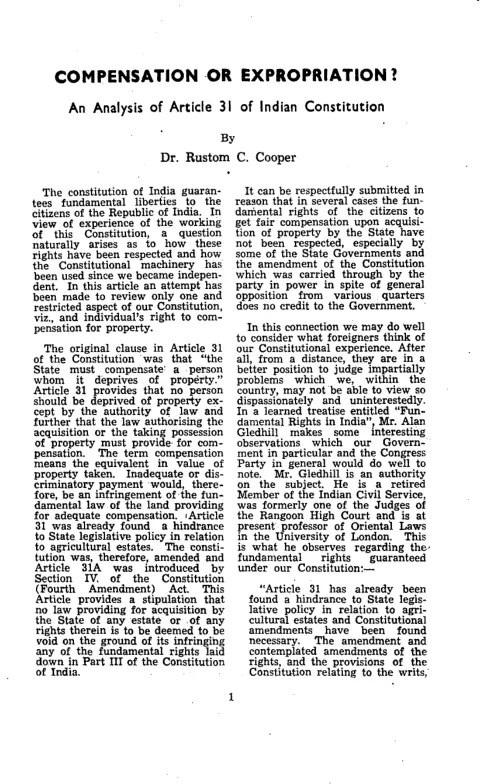
This Forum of Free Enterprise pamphlet by Dr. Rustom C. Cooper offers a legal-constitutional critique of Article 31 of the Indian Constitution and the Fourth Constitutional Amendment that introduced Article 31A. Cooper argues that the original Article 31 — which obliged the State to compensate citizens whose property it acquired — was steadily eroded by a series of state acquisition statutes and by parliamentary amendments designed to insulate compensation amounts from judicial review. The pamphlet reads the constitutional history as a record of how ‘doctrinaire thinking’ progressively stripped property of its standing as a fundamental right.
The argument moves through three registers. First, Cooper rehearses the textual change: Article 31’s original language required compensation ‘equivalent in value’ to property taken, but Article 31A was inserted by Section 17 of the Fourth Amendment Act to immunise State legislation on agricultural estates from being struck down as a breach of fundamental rights. Second, he reads Prime Minister Jawaharlal Nehru’s 10 September 1949 Constituent Assembly speech against later practice — Nehru himself, Cooper notes, accepted that ‘full compensation should be paid to small owners’ while saying the legislature would not tolerate being ‘interfered with by courts of law’. Third, Cooper supplies a worked case study: the Port Canning and Land Improvement Company Ltd., whose Rs. 60,00,000 capital invested over 85 years yielded an annual dividend of about 2.8 per cent and which, under the West Bengal Estates Acquisition Act 1953, would receive non-negotiable bonds at 3% interest worth roughly one-tenth of its original investment.
Cooper closes by quoting an unnamed ‘leading thinker’ to the effect that freedom of speech, press, religion and assembly historically collapse wherever the right to own and manage property is denied. The pamphlet’s polemical centre is that, by removing the judicial test of compensation, India has placed citizens — including widows, office clerks, retired persons and ‘lower middle class people’ holding small shareholdings in acquired companies — ‘helpless before the Leviathan of the State’. He also cites Alan Gledhill’s treatise Fundamental Rights in India for the proposition that Article 31’s drift makes parliamentary majorities, not the constitutional text, the practical guarantor of property rights.
Key points
-
Reads Article 31 of the Indian Constitution as a once-robust guarantee of compensation that has been progressively weakened by State legislation and the Fourth Constitutional Amendment (Article 31A).
-
Cites Nehru’s 10 September 1949 Constituent Assembly speech to show that the original constitutional intent included ‘just and equitable compensation’ even for large properties, especially limited liability companies with many small shareholders.
-
Quotes Alan Gledhill (in Fundamental Rights in India) to argue that Article 31 now functions less as a justiciable right than as a ‘temporary majority’ subject to parliamentary will.
-
Anchors the abstract argument in the Port Canning and Land Improvement Company Ltd. case under the West Bengal Estates Acquisition Act 1953 — Rs. 60,00,000 paid-up capital, Rs. 32,00,000 spent on development, average annual dividend of 2.8% over 83 years, compensation roughly Rs. 6,00,000.
-
Notes that compensation is paid in non-negotiable bonds at 3% interest payable over 20 years, with the shareholder receiving roughly one-tenth of the original investment in real terms.
-
Identifies who actually bears the loss: widows, office clerks, retired persons and lower-middle-class shareholders, not the ‘rich men’ the legislation purports to reach.
-
Cites Supreme Court of Bihar vs Kameshwar, A.I.R. (1952) S.C. 252, on the principle that legislation effectively depriving citizens of property without colourable compensation must be void.
-
Closes with an unattributed quotation tying private-property rights to free speech, free press, freedom of religion and freedom of assembly — the pamphlet’s framing of property as a precondition for the other liberties.
Metadata and summary are AI-extracted from the source PDF and reviewed for editorial accuracy. The original work is available via the Read PDF tab above (where present); paragraph-level citation inside the PDF is deferred to a future engagement.