speech
Property Rights under the Constitution
Published by M. R. Pai for the Forum of Free Enterprise, 235, Dr. Dadabhai Naoroji Road, Bombay-1, and Printed by Michael Andrades at the Bombay Chronicle Press, Horniman Circle, Bombay-1. · Bombay · 1968
17 pages
Part of A. D. Shroff Memorial Lecture
Property Rights under the Constitution
By K. Subba Rao
Summary
K. Subba Rao, retired Chief Justice of the Supreme Court of India, uses the Third A. D. Shroff Memorial Lecture (delivered 28 October 1968) to trace how the constitutional right to property has been progressively hollowed out by eighteen years of legislative amendment and judicial accommodation. He opens by clarifying the misconception that property exists only at the pleasure of the legislature: the Constitution, he argues, took the substantive law of property as it found it and guaranteed it subject only to reasonable, public-interest restrictions, so that Parliament cannot redefine property out of existence without infringing the fundamental right itself.
Rao walks through the major constitutional amendments — the First, Fourth, Seventeenth and successive insertions of Articles 31A, 31B and the Ninth Schedule — showing how each step shifted compensation, agrarian acquisition and the very category of “estate” outside judicial scrutiny. Through close readings of Kochuni, Seethabhathi Devi, Vajravelu, Ranjit, Karimbil Kunhikoman, Chemudu and Vijayanagaram, he argues that the Supreme Court drew a workable line — substantive reasonableness, non-illusory compensation, public purpose tested in court — until political amendments removed those tests, replacing the rule of law with what he calls a “totalitarian slant” on State power.
The second half generalises the argument from property to business, corporations and the freedom of trade under Articles 19(1)(g) and 301–307. Rao warns that nationalisation, corporate management takeovers and the open-ended Ninth Schedule together convert constitutional democracy into something closer to centralised planning. He insists planning is compatible with democracy only when subjected to the rule of law; haphazard, ideology-driven planning, he says, will end either in failure or in the death of democracy.
Rao closes with a constitutional and philosophical creed: democratic socialism, lucidly explained by A. B. Shah, can be reconciled with individual right; what cannot be reconciled is the unrestrained constituent power exercised by transitory parliamentary majorities. The Supreme Court has saved the other fundamental rights — speech, religion, equality, personal liberty — but its salvage of property has been incomplete. The lecture ends with a plea for “a just society where a right balance will be maintained between the right to property and social justice,” and a warning that India’s tragedy is “the uninformed repetition of foreign slogans.”
Key points
-
Frames A. D. Shroff as neither doctrinaire Marxist nor nineteenth-century capitalist but a believer in a Welfare State whose economic philosophy synchronised with the Constitution’s.
-
Rejects the textbook doctrine that property exists only because law recognises it: the Constitution, Rao argues, accepted property as it stood under statute, custom and common law and only then subjected it to reasonable restrictions.
-
Reads the right to property as three rights — to acquire, to possess and enjoy, and to dispose — each subject to taxation, police power, eminent domain and public-interest restriction, but not to extinction by redefinition.
-
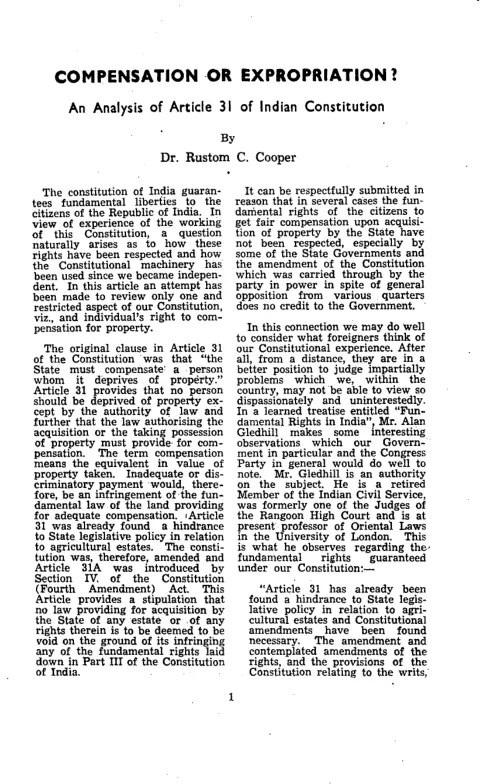
Traces the erosion through the First (Article 31A and 31B), Fourth (compensation made non-justiciable) and Seventeenth (expansion of ‘estate’ to forest, waste and slum lands) Amendments, plus the open-ended Ninth Schedule.
-
Builds a doctrinal arc through Kochuni, Seethabhathi Devi, Vajravelu, Karimbil Kunhikoman, Ranjit, Chemudu, Vijayanagaram and the Bank Nationalisation-adjacent corporate-personality cases to show how courts policed reasonableness until amendments removed the tests.
-
Extends the property argument to corporate personhood and freedom of trade, warning that nationalisation, state takeovers of management, and forced amalgamations under amended Article 31A convert the Constitution’s safeguards into mere slogans.
-
Distinguishes democratic from totalitarian planning: democratic planning works within the rule of law and operates as a tool of free, complex human personality; totalitarian planning, however efficient, kills democracy.
-
Concludes that the Supreme Court protected most fundamental rights but only partially saved property, and pleads for constitutional pragmatism rather than ideological imitation of foreign models.
Generated by the v1.5 extraction pipeline. Awaiting editorial review.
Metadata and summary are AI-extracted from the source PDF and reviewed for editorial accuracy. The original work is available via the Read PDF tab above (where present); paragraph-level citation inside the PDF is deferred to a future engagement.