essay
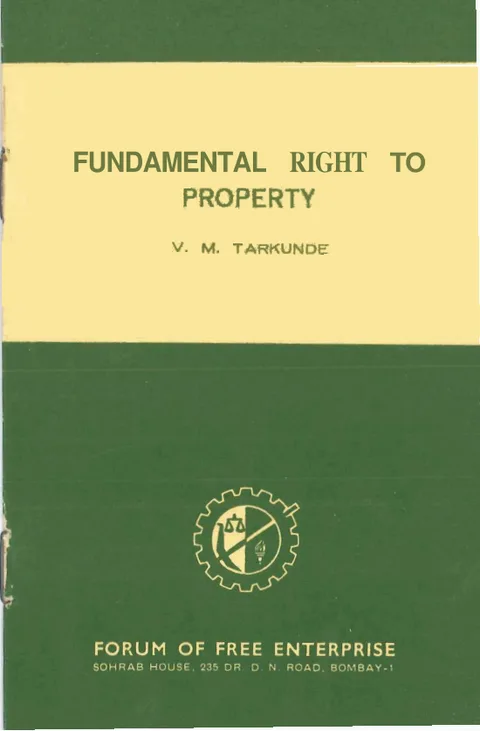
Fundamental Right to Property
FORUM OF FREE ENTERPRISE, SOHRAB HOUSE, 235 DR. D. N. ROAD, BOMBAY-1. Published by M. R. PAI for the Forum of Free Enterprise, "Sohrab House", 235 Dr. Dadabhai Naoroji Road, Bombay-1, and printed by H. NARAYAN RAO at H. R. MOHAN & CO. (PRESS), 9-B, Cawasjee Patel Street, Bombay-1. · Bombay · 1971
9 pages
Summary
V. M. Tarkunde, a former judge of the Bombay High Court, argues that the right to property was rightly placed among the fundamental rights by the Constitution-makers, even though successive amendments have made it the weakest of those rights. Reprinted from the March 1971 issue of The Radical Humanist as a Forum of Free Enterprise booklet, the editorial pushes back on Justice Hidayatullah’s view in the Golaknath case that including property among fundamental rights was an ‘error’. Tarkunde reasons that the enjoyment of every other fundamental right — food, shelter, freedom of movement, the freedom to practise a profession — presupposes a minimum of private property, so property must be regarded as a necessary complement of rights that are ‘unquestionably fundamental’.
The bulk of the essay is a close survey of the constitutional erosion of property rights: the original guarantees in Articles 19(1)(f) and 31(2); the limits introduced by the First Amendment in Article 19(5) and 19(6); the Fourth Amendment’s reach over compensation and over trade or business; and Articles 31A and 31B with the Ninth Schedule, which now shields a large body of acts and regulations — particularly on agricultural and forest lands and on industrial takeovers — from review on fundamental-rights grounds. Tarkunde concedes that the state may legitimately regulate property, fix prices, manage rents and modify shareholder rights, and even acquire urban properties and inefficiently run undertakings. But he draws a hard line against confiscation: lawfully acquired property and efficiently run concerns cannot, in his view, be taken over without fair compensation if the private sector is to function in a mixed economy.
To the social-justice case for further dilution, he answers that confiscation is the wrong instrument for reducing economic disparities. Once inflation and import licensing are addressed, residual inequality is better attacked through estate duty, wealth tax, excise on luxury, progressive income tax — and above all through a policy of full employment, citing a comparison in which the wage ratio between unskilled and managerial labour is about 1 to 2.5 in the United States but about 1 to 11 in Bombay. Tarkunde closes by reaffirming the journal’s standing position that no further abridgement of any fundamental right should be attempted unless a concrete case shows that the right obstructs socially beneficial legislation, since fundamental rights are ‘the main guarantee for the preservation of freedom and democracy’ in India. The booklet is rounded out with framing quotations from Eugene Black, F. A. Hayek’s The Road to Serfdom, Max Eastman on Marx, and A. D. Shroff.
Key points
-
Disputes Justice Hidayatullah’s Golaknath dictum that placing the right of property among fundamental rights was a Constitution-making ‘error’, while accepting his observation that property is the weakest of those rights.
-
Defends property as a fundamental right on the ground that enjoyment of other admittedly fundamental rights — food, clothing, shelter, freedom of movement, freedom to practise a profession — presupposes some private property.
-
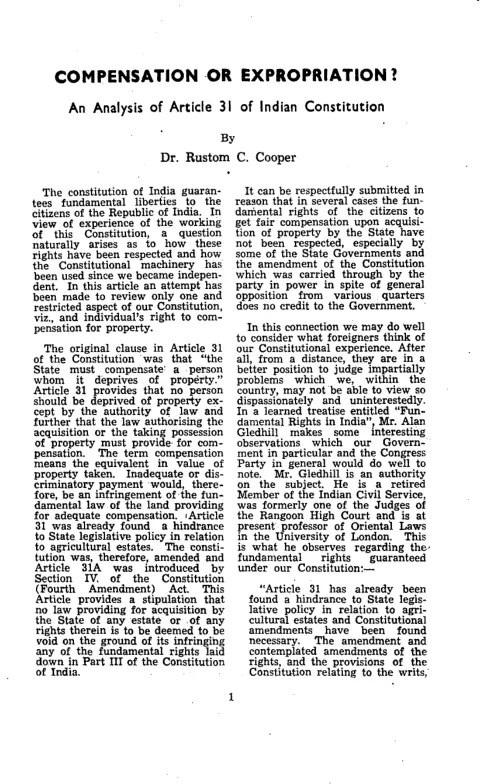
Traces the constitutional erosion of property rights through Articles 19(1)(f) and 31(2), the First Amendment’s ‘reasonable restrictions’ clauses, the Fourth Amendment, and Articles 31A, 31B and the Ninth Schedule.
-
Distinguishes legitimate state action (regulation, rent control, price control, taxation, acquisition with compensation of urban property and of inefficiently run concerns) from confiscation of lawfully acquired or efficiently run property, which he opposes.
-
Argues that further constitutional amendments waiving fair compensation are neither necessary for social justice nor effective in reducing economic disparities.
-
Proposes redistribution through estate duty, wealth tax, excise on luxury goods and progressive income tax, with full employment as the most effective remedy, citing a US/Bombay wage-ratio comparison of roughly 1:2.5 against 1:11.
-
Notes that the second Bank Nationalisation Act was not even challenged in court, and argues the rulers’ privy-purse rights should have been abolished by negotiation rather than executive fiat.
-
Concludes that fundamental rights are the main guarantee of freedom and democracy and should not be tinkered with absent a compelling, concrete necessity.
Metadata and summary are AI-extracted from the source PDF and reviewed for editorial accuracy. The original work is available via the Read PDF tab above (where present); paragraph-level citation inside the PDF is deferred to a future engagement.