edited volume · anthology
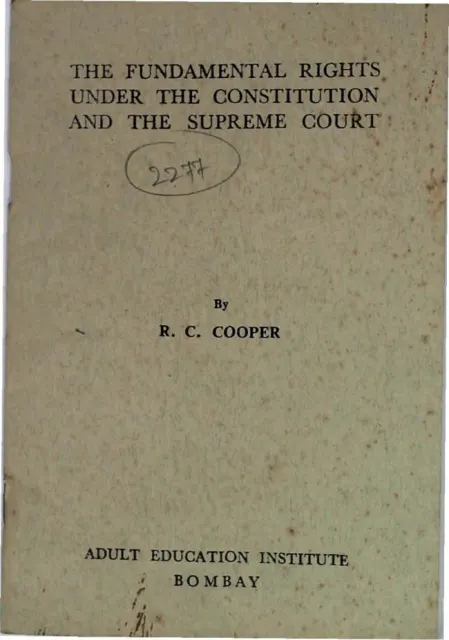
Fundamental Rights in India
By B. Shiva Rao
Published by M. R. Pai for the Forum of Free Enterprise, 235, Dr. Dadabhai Naoroji Road, Bombay 1, and Printed by S. J. Patel, at Onlooker Press, (Prop. Hind Kitabs Ltd.), Sassoon Dock, Coiaba, Bombay-5. · Bombay · 1969
15 pages
Summary
Published by the Forum of Free Enterprise in Bombay and drawing on two articles — B. Shiva Rao’s historical survey reproduced from the Times of India of 17 December 1968, and Dr. M. V. Pylee’s constitutional analysis reproduced from Quest (July–September 1969) — this pamphlet intervenes in the controversy surrounding Nath Pai’s private member’s Bill, which sought to restore Parliament’s power to amend the Fundamental Rights chapter of the Constitution following the Supreme Court’s landmark ruling in Golak Nath v. State of Punjab (February 1967).
Shiva Rao’s contribution traces the Indian demand for constitutionally guaranteed rights from the Swaraj Bill of 1895 (inspired by Tilak) through Mrs. Besant’s Commonwealth of India Bill, the Nehru Committee Report of 1928, the Round Table Conferences, Sir Tej Bahadur Sapru’s Non-Party Committee of 1944–45, and the Cabinet Mission Plan of 1946. He shows that the demand was unanimous across Congress, the Liberals, religious minorities and constitutional lawyers — rejected only by the British-imposed Government of India Act, 1935. The Constituent Assembly, chaired by Sardar Patel for the rights sub-committee and with Dr. Ambedkar heading the Drafting Committee, embedded not just rights but remedies (Article 32), with Ambedkar calling Article 32 ‘the very heart’ of the Constitution.
Dr. Pylee’s essay explains the Golak Nath decision (six judges against five, presided over by Chief Justice Subba Rao) and dissects Nath Pai’s Bill. The Bill purported to re-establish parliamentary supremacy, but Pylee argues this conflates popular sovereignty with parliamentary sovereignty — a category error drawn from British constitutional history inapplicable to India’s written, federal, judicially reviewable constitution. He warns that if Parliament could amend Article 368 by simple majority to remove the two-thirds threshold, the Constitution would be at the mercy of ephemeral majorities. The pamphlet concludes that Fundamental Rights and Directive Principles of State Policy (Parts III and IV) form an integrated, elastic scheme sufficient to accommodate social reform without dismantling individual and minority protections.
Key points
-
The demand for constitutionally entrenched fundamental rights in India dates to the Swaraj Bill of 1895 and runs through the Nehru Committee (1928), the Round Table Conferences, and the Cabinet Mission Plan (1946), rejected at every stage by the British Government.
-
The Golak Nath case (1967) was decided six to five by all eleven Supreme Court judges sitting as a Constitution Bench; the majority held that Fundamental Rights in Part III are outside the amending power of Parliament under Article 368.
-
Dr. Ambedkar identified Article 32 — the right to approach the Supreme Court directly for enforcement of Fundamental Rights — as ‘the very heart’ of the Constitution, and argued that rights without remedies are meaningless.
-
Nath Pai’s Bill sought to restore Parliament’s power to amend Fundamental Rights and require ratification by more than half the states; its proponents framed it as asserting popular sovereignty against judicial overreach.
-
Pylee distinguishes popular sovereignty from parliamentary sovereignty: India’s written, federal constitution constrains Parliament’s legislative field, and the Supreme Court’s power to invalidate Parliament’s laws is incompatible with any doctrine of parliamentary supremacy.
-
The exclusion of ‘due process of law’ (borrowed from the US) in favour of ‘procedure established by law’ — on Justice Frankfurter’s advice — was itself contested; Muslim members feared it would strip courts of the power to review the merits of legislation.
-
Fundamental Rights in the Constitution are not absolute; each carries enumerated limitations allowing the state to impose reasonable restrictions in the public interest, making radical social legislation compatible with rights protection.
-
Chief Justice Subba Rao warned that an all-comprehensive amending power cannot prevent revolution, but a restrictive amending power gives stability and guards against totalitarian or dictatorial capture of the constitutional order.
Metadata and summary are AI-extracted from the source PDF and reviewed for editorial accuracy. The original work is available via the Read PDF tab above (where present); paragraph-level citation inside the PDF is deferred to a future engagement.