speech
STATE TAKEOVER OF FOODGRAINS TRADE
Published by M. R. PAI for the Forum of Free Enterprise, 3rd Floor, 235, Dr. D. N. Road, Bombay-400001, and printed by H. NARAYAN RAO at H. R. MOHAN & CO., (Press), 9-B, Cowasji Patel Street, Bombay-400001. · Bombay · 1973
11 pages
STATE TAKEOVER OF FOODGRAINS TRADE
By DR. A. C. CHHATRAPATI
Summary
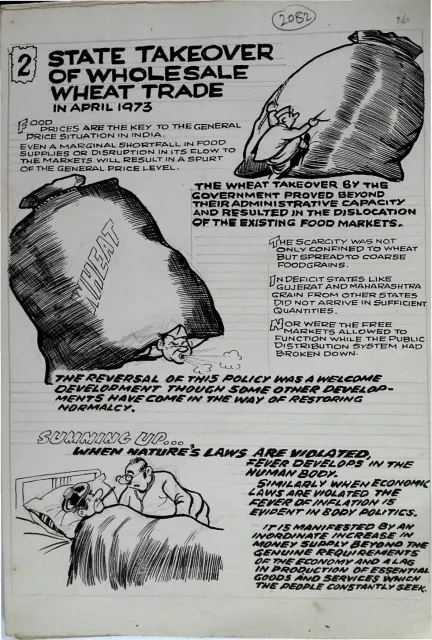
Dr. A. C. Chhatrapati’s pamphlet argues that the Government of India’s 1973 decision to take over the wholesale trade in wheat and rice is an unwise and unworkable expansion of state economic power, taken without serious public debate. Drawing on his expertise in agricultural economics, he walks the reader through the role of the private wholesaler — financing producers, grading produce, storing surpluses, smoothing price movements between primary and consuming markets — and contends that no democratic country has abandoned free markets in foodgrains; only Communist regimes have done so, and they are now retreating from the experiment. He warns that the stated objectives of the takeover (eliminating speculation, ensuring remunerative prices to farmers, reasonable prices to consumers, and elimination of intermediaries) cannot be reconciled with the operational reality that the Food Corporation of India (FCI) is already procuring wheat at Rs. 76 per quintal but selling at Rs. 78, and would have to absorb Rs. 18.45 per quintal of subsidy on wheat and Rs. 16.50 on rice in 1973-74.
Chhatrapati develops a sustained critique of administered prices and bureaucratic management: handling costs in FCI will rise as organised public-sector labour demands higher wages, a single nationwide monopoly creates strike vulnerability that can hold the country to ransom, and political rather than economic considerations will dominate procurement and issue prices. He cites the Maharashtra Government’s recent failure to attract cotton acreage despite attractive prices as evidence that administrative price-setting harasses rather than helps the cultivator. Pointing to the Soviet Union’s own admission of the “baneful effects of production of goods which they can sell and minimise costs” and its turn toward enterprise autonomy, he asks why India is moving in the opposite direction. He also worries that once wholesale trade in essential commodities is in state hands, the space for active dissent and a healthy democracy will shrink, since industries dependent on government allotments of raw materials are already reluctant to criticise.
The booklet is rounded out by four appendices. Appendix I reproduces excerpts from a 1922 paper by Mary G. Lacy on “Food Control During Forty-Six Centuries”, cataloguing failed price-fixing attempts from Egypt, China, Athens, Rome, Great Britain, Antwerp, Revolutionary France, the Colonial United States and India itself, to argue that price fixing in times of scarcity has always removed the most powerful check on consumption — namely high prices. Appendix II reprints Jayaprakash Narayan’s press statement calling the takeover “an unwise adventure” and “a case of the remedy being worse than the disease”. Appendices III and IV present FCI’s cost structure for 1973-74 and the cumulative losses of Rs. 330.23 crore that the State trading scheme in foodgrains had already accumulated by 1967-68.
Key points
-
Frames the wholesale takeover of wheat and rice as a fait accompli rushed through without adequate debate in legislatures, party forums or mass media.
-
Defends the private wholesaler’s economic functions — financing producers, grading, storage, smoothing seasonal and inter-regional price differentials — against the charge of being a monopolist.
-
Argues that no democratic country has abolished free markets in foodgrains and that the only relevant comparators are Communist economies which themselves are now liberalising.
-
Quantifies the cost gap that subsidies must absorb: FCI procurement at Rs. 76 per quintal of wheat plus incidentals reaches Rs. 96.45, against an issue price of Rs. 78, implying Rs. 18.45 per quintal of subsidy on wheat and Rs. 16.50 on rice for 1973-74.
-
Warns that a single State trading corporation creates a strike vulnerability that can hold the entire country to ransom, citing November cannibalisation strikes in STC and MMTC.
-
Uses the Maharashtra cotton case (orders for seed for only 125 hectares against 4,000 hectares targeted) to show that administered procurement schemes harass cultivators and discourage acreage.
-
Reads the Soviet turn toward enterprise autonomy and individual rule-following as confirmation that administered prices and bureaucratic distribution failed even under stricter discipline than India can muster.
-
Links the political economy of state monopoly trading to the erosion of democratic dissent, since industries dependent on government allotments avoid public criticism.
-
Appendices marshal a long historical record (Mary G. Lacy’s 1922 paper) and a contemporary endorsement (Jayaprakash Narayan’s press statement) to reinforce the case that price fixing and state trading in foodgrains is a recurrent and recurrently failed policy.
Generated by the v1.5 extraction pipeline. Awaiting editorial review.
Metadata and summary are AI-extracted from the source PDF and reviewed for editorial accuracy. The original work is available via the Read PDF tab above (where present); paragraph-level citation inside the PDF is deferred to a future engagement.