speech · memorial lecture
Role of Intellectuals in Public Life
Published by M. R. PAI for the Forum of Free Enterprise, "Piramal Mansion", 235 Dr. Dadabhai Naoroji Road, Bombay-1. and printed by B. D. Nadirshaw at Bombay Chronicle Press, Sayed Abdulla Brelvi Road, Fort, Bombay-1. · Bombay · 1980
16 pages
No. 14 in A. D. Shroff Memorial Lecture
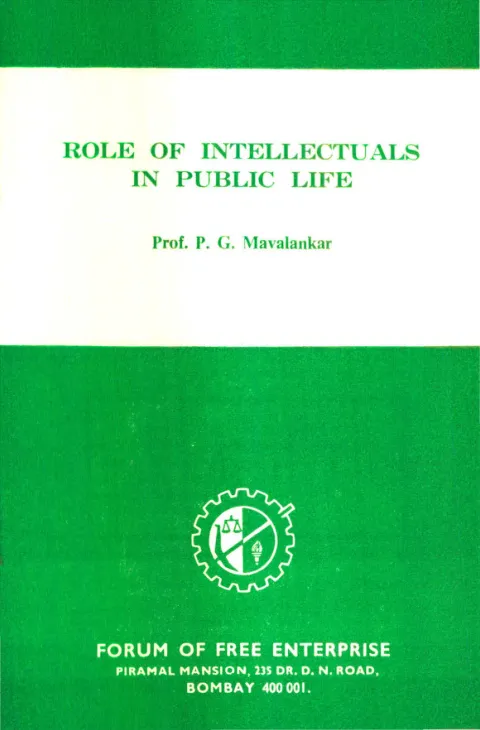
Role of Intellectuals in Public Life
By Prof. P. G. Mavalankar
Summary
This booklet reproduces the 14th A. D. Shroff Memorial Lecture, delivered by Prof. P. G. Mavalankar under the auspices of the Forum of Free Enterprise in Bombay on 30th October 1979. Opening with a tribute to A. D. Shroff as a rare individual whose clarity of thought, hard work and vision made him an effective crusader on the National Planning Committee and the Bombay Plan, Mavalankar argues that the real Shroff legacy is the discipline of expressing one’s views firmly, without waiting for authority’s permission. He insists, against the prevailing Indian habit, that public life is far vaster than political life — and that India’s tragedy is the conflation of the two, which has polluted public life with the venalities of party politics.
Mavalankar then anatomises the intellectual. Drawing on Pericles, Lincoln, Mao Tse-Tung, J. S. Mill, Adlai Stevenson, Tagore, Einstein and Gandhi, he sketches the intellectual as a rare commodity who thrives only in a climate of liberty: intelligent but not clever, sane but not sullen, idealist but not romanticist; possessed of imagination, integrity, independence and incorruptibility; vigilant, single-minded, a championing ‘live-wire’ even for lost causes. He distinguishes intellectuals from the wider intelligentsia, warns against ‘pseudo-intellectuals’ and ‘fake intellectuals’, and dwells at length on the duty to ‘go alone’ on grounds of conscience, citing Gandhi’s reply to Julian Huxley that the inseparability of rights and duties is best taught by an illiterate mother.
The second half traces the concept of public life from the ganatantras of pre-Buddhist India and the street-corner Socratic assembly of Athens through Lord Bryce’s ‘Ideal Democracy’ to Gopal Krishna Gokhale’s 1910 dictum that ‘our public life is weak, because our public spirit is weak’. Against this backdrop Mavalankar indicts the thirty-two years since Independence as a slow erosion in which educated classes have drifted into ‘Yesmanship’ and a cosy proximity to the Establishment — a weakness most cruelly exposed during the Emergency of 1975-77, when intellectuals failed to show the courage of their convictions. His prescription is unambiguous: intellectuals must serve as catalyst for change and as non-conformist critic, ready to stand for elective office, willing to live dangerously, and committed to freedom of thought and expression as the means of toning up public life. He closes by holding up Jayaprakash Narayan’s life of dynamism, daring and dedication as the model Indian intellectuals must follow if they are not to fail the country or their own conscience.
Key points
-
Frames the lecture as a memorial tribute to A. D. Shroff (1899-1965), founder of the Forum of Free Enterprise, and to his insistence on expressing views frankly regardless of authority.
-
Argues a sharp distinction between ‘public life’ (broader, ideal-bearing) and ‘political life’ (party-bound) and warns that India is dangerously conflating the two.
-
Defines the intellectual through a series of paradoxical pairings (intelligent but not clever, sane but not sullen, idealist but not romanticist) and four essential qualities: imagination, integrity, independence and incorruptibility.
-
Distinguishes true intellectuals (rare, principled, willing to ‘go alone’) from a wider intelligentsia and from ‘pseudo-’ or ‘fake’ intellectuals.
-
Traces the concept of public life through ancient Greece (Socratic assembly), pre-Buddhist Indian ganatantras, Lord Bryce’s Ideal Democracy, and Gokhale’s 1910 lecture on public spirit.
-
Reads the Emergency of 1975-77 as evidence that the educated classes lack the courage of their convictions and have drifted into ‘Yesmanship’ alongside the Establishment.
-
Prescribes a dual role for intellectuals — catalyst for change and non-conformist critic — including willingness to stand for elective office and to ‘live dangerously’.
-
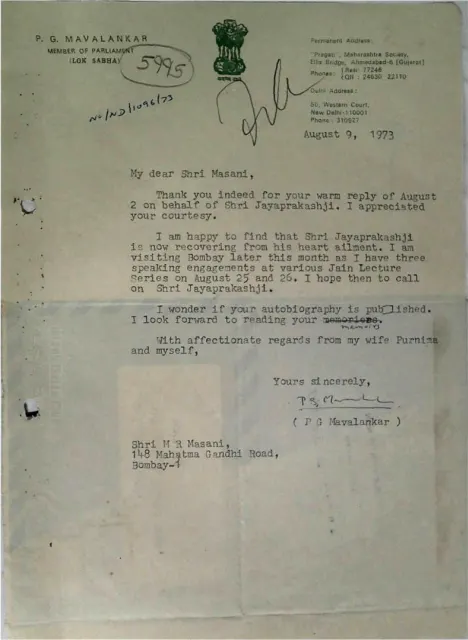
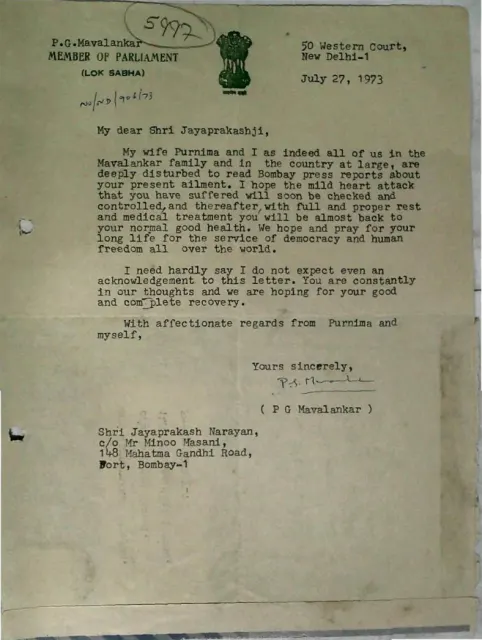
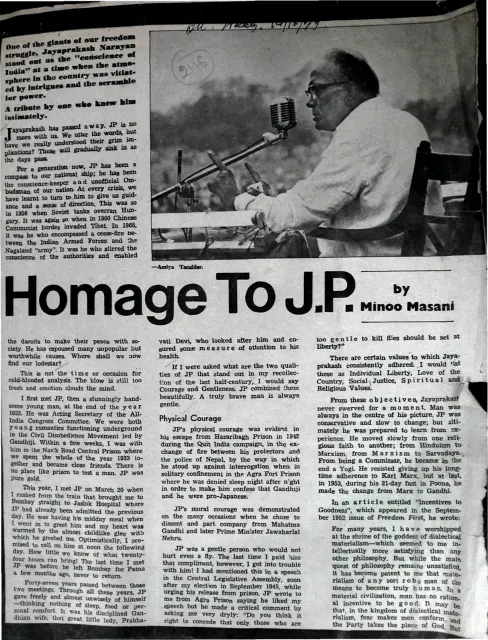
Holds up Jayaprakash Narayan as the inspiring contemporary model of dynamism, daring and dedication that Indian intellectuals must emulate.
Generated by the v1.5 extraction pipeline. Awaiting editorial review.
Metadata and summary are AI-extracted from the source PDF and reviewed for editorial accuracy. The original work is available via the Read PDF tab above (where present); paragraph-level citation inside the PDF is deferred to a future engagement.