periodical issue
Liberal Times
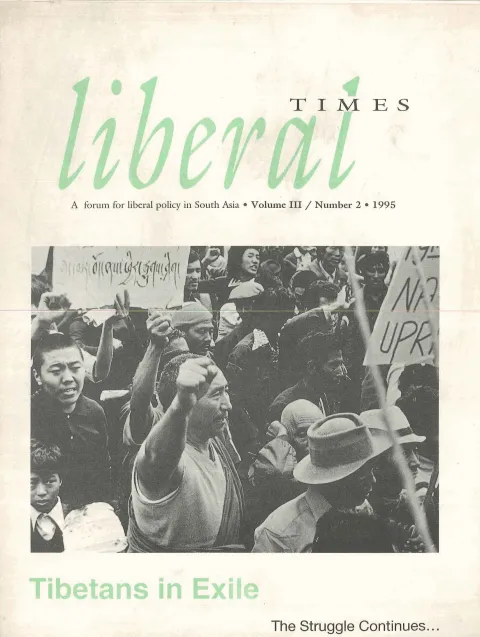
Tibetans in Exile — The Struggle Continues…
By Ajit Bhattacharjea, Samdhong Rinpoche, Erhard Haubold
Published by the Friedrich-Naumann-Stiftung, Regional Office South Asia. · New Delhi · 1995
40 pages
Summary
This issue of Liberal Times (Volume III / Number 2, 1995), published by the Friedrich-Naumann-Stiftung Regional Office South Asia, is devoted to the Tibetan exile experience under the thematic banner ‘Tibetans in Exile — The Struggle Continues…’. In the rendered pages, the issue assembles voices from Tibetan activists, Indian commentators, and a US Congressional document to examine three interlocking problems: China’s ongoing cultural, demographic and ecological destruction of Tibet; the democratic institutions built by the exile community under the Dalai Lama; and the strategies — non-violent resistance, international lobbying, youth mobilisation, and women’s political organising — that define the contemporary freedom movement. The editorial perspective is broadly liberal-internationalist, emphasising self-determination, human rights, rule of law, and non-violent civil disobedience as the legitimate basis for Tibet’s claim to independence.
Key points
-
Pema Thinley’s cover essay “Tibet: The Tragedy and the Hope” describes Chinese policy as subtle genocide through population transfer and documents the destruction of 6,254 monasteries alongside coercive birth control and environmental devastation.
-
Ajit Bhattacharjea’s “The Exile Identity and Democratic Vision” traces thirty-five years of democratic development among Tibetan exiles, culminating in the 1991 Charter that turned the Assembly of Tibetan People’s Deputies into a fully parliamentary legislature.
-
Prof. Samdhong Rinpoche, chairman of the Assembly of Tibetan People’s Deputies, grounds the freedom movement in Buddhist inter-dependence and proposes escalating to a Satyagraha of civil disobedience decided by referendum.
-
Yangchen Dolkar’s essay on Tibetan youth presents the 12,000-member Tibetan Youth Congress as a loyal opposition that also serves as a conduit to Chinese dissidents and the peoples of East Turkistan and Inner Mongolia.
-
Nawang Lhamo surveys women’s political activism from the 30,000-strong 1959 Lhasa march to the Tibetan Women’s Association’s lobbying at the 1995 Beijing Fourth World Conference on Women.
-
Karma Wangdui contributes further first-person testimony from the exile community, while Erhard Haubold of the Frankfurter Allgemeine Zeitung supplies an outside dispatch on Tibet’s international politics.
-
Fazal-ur-Rahman situates the Tibet question within wider South Asian regional and strategic concerns, reflecting the issue’s broadly liberal-internationalist emphasis on self-determination and human rights.
-
The issue reprints a United States Congress resolution from the Foreign Relations Authorization Act of 1992-93 declaring Tibet occupied and recognising the Dalai Lama’s government-in-exile as its true representative.
Essays
Tibet: The Tragedy and the Hope
By Pema Thinley
Pema Thinley’s cover essay frames Tibet’s situation as ‘subtle Chinese genocide’: a systematic replacement of Tibetan people, culture, language and enterprise by Chinese substitutes, with economic liberalisation serving as the policy fillip for population transfer. In the rendered pages, Thinley traces the People’s Republic’s 1949 founding, the coerced Seventeen Point Agreement of 1951, the 1959 uprising and the Dalai Lama’s flight into exile with 80,000 followers, and the subsequent destruction of 6,254 monasteries. He then surveys the exile community’s institutional responses — the Central Tibetan Schools Administration, cultural preservation bodies (Library of Tibetan Works and Archives, Norbu Lingkha Institute, Tibetan Medical Institute), and the seasonal sweater trade that sustains Tibetan livelihoods in India. The essay closes by cataloguing China’s coercive birth-control policy in Tibet, its environmental devastation, and the exile community’s aspiration to return to a free, demilitarised, ecologically protected homeland.
- China’s population-transfer policy, accelerated by economic liberalisation, is making Tibetans a marginalised minority in their own land.
- The 1951 Seventeen Point Agreement was signed under duress and lacked legitimacy; Tibet’s political tragedy is rooted in international inaction during the 1950s.
- Between 1980 and September 1994, several thousand Tibetans escaped to India and Nepal annually; the refugee flow is rising.
- The exile administration, established under Indian government assistance (Central Tibetan Schools Administration), functions as a parallel state preserving language, religion, medicine and handicrafts.
- China enforces a coercive birth-control policy in Tibet, requiring permission to marry and have children, with penalties including demotion and salary cuts.
- Tibet’s role as Asia’s water tower and its nuclear-waste dumping make environmental protection a global concern, not merely a Tibetan one.
The Exile Identity and Democratic Vision
By Ajit Bhattacharjea
Ajit Bhattacharjea traces the thirty-five-year democratic evolution of the Tibetan exile community, centred on the Assembly of Tibetan People’s Deputies (parliament-in-exile). He notes that as early as January 1960, the Dalai Lama — barely a year after reaching India — began designing democratic self-rule without abandoning Tibetan tradition. The article documents successive stages: the first elected body (September 1960), the Dalai Lama’s voluntary relinquishment of traditional powers, the dissolution of the old assembly in May 1990, and the inauguration of the 11th Assembly in 1991, which made the body a fully parliamentary legislature. Bhattacharjea argues that the exile community’s transformation from ‘virtual destitutes’ to a self-confident, institutionally mature polity is unique in the history of refugee politics, and that the proposed multiparty constitution with separation of powers will serve as the nucleus of a free Tibet’s future government.
- The Dalai Lama outlined democratic self-rule in January 1960 at Bodh Gaya, barely a year after exile began.
- The Assembly of Tibetan People’s Deputies took office on September 2, 1960 — observed as Democracy Day — with representatives from all three provincial regions and four religious sects.
- In May 1991, the 11th Assembly adopted the Charter for Tibetans-in-Exile, making the government-in-exile a fully parliamentary system with effective powers over the executive.
- The Dalai Lama has categorically declared he will play no role in any future government of Tibet, reducing dependency on his personal authority.
- A proposed future constitution envisions Tibet as a demilitarised, nuclear-free, environmentally protected state governed by Buddhist economic principles with full separation of powers.
Political Struggle of the Tibetans
By Prof. Samdhong Rinpoche
Prof. Samdhong Rinpoche, Chairman of the Assembly of Tibetan People’s Deputies, sets out the philosophical and strategic foundations of the Tibetan freedom movement. In the rendered pages, he argues that Tibet’s cause is neither an ideological nor an ethnic conflict but a universal human responsibility rooted in the Buddhist concept of inter-dependence: because the people of Tibet’s spiritual land bear a duty to all sentient beings, liberation is a moral imperative. He traces the movement’s three core principles — Truth, Non-violence, and Democracy — and its ‘gradual development’ from the armed resistance of the 1950s–60s to the fully non-violent civil resistance formalised in the 1991 Charter. Rinpoche recounts failed negotiations with China (Deng Xiaoping’s 1979 dialogue, the Five Point Peace Programme of 1987, the Strasbourg Proposal of 1988, and the 1991 offer to visit Tibet), and concludes that China was never sincere; the movement must now consider a Satyagraha (‘Insistence on Truth’) strategy including civil disobedience and passive resistance, to be decided by referendum among Tibetans in exile and inside Tibet.
- Tibet’s freedom struggle is grounded in three principles: Truth, Non-violence, and Democracy, with compassion as the motivating force.
- The struggle is not against the Chinese people but against the Chinese state’s occupation; Tibet’s liberation is framed as a universal human responsibility.
- The 1991 Charter of Tibetans-in-exile formally renounces all forms of warfare and enshrines non-violence as national policy.
- All Chinese negotiating overtures since 1979 are assessed as stalling tactics; the movement must now consider escalating to Satyagraha with civil disobedience.
- A proposed ‘Tibbat Mukti Sadhana’ (spiritual practice for liberation) will be put to referendum among Tibetans in exile and inside Tibet.
- Tibet’s unique geographical position as a buffer state between India and China, and as source of Asia’s major rivers, makes its freedom a matter of regional and global interest.
United States Congress Resolution on Tibet
A reprint of the United States Congress resolution (Foreign Relations Authorization Act, Fiscal Years 1992 and 1993, signed by President Bush on October 28, 1991) declaring Tibet an occupied country whose true representatives are the Dalai Lama and the Tibetan Government in exile. In the rendered pages, the resolution recites a series of ‘Whereas’ clauses citing UN General Assembly resolutions condemning China’s human rights abuses in Tibet (1959, 1961, 1965), the US State Department’s 1991 Country Reports on Human Rights Practices, and the February 1992 ‘Situation in Tibet’ resolution submitted to the UN Human Rights Commission. It resolves that the US Government should support the European Community-led resolution on Tibet, vigorously condemn Beijing’s human rights abuses in occupied Tibet in international forums, and raise Tibet human rights issues with senior PRC officials.
- The US Congress formally declared Tibet an occupied country in October 1991 and identified the Dalai Lama and the government-in-exile as Tibet’s true representatives.
- The resolution cites three UN General Assembly resolutions (1959, 1961, 1965) condemning China’s human rights abuses in Tibet.
- The US State Department’s 1991 report cited persistent, credible reports of torture, harsh sentences for political activities, and religious and cultural persecution of six million Tibetans.
- Twenty-two countries led by the European Community submitted a ‘Situation in Tibet’ resolution to the UN Human Rights Commission’s annual meeting in Geneva, February–March 1992.
- The Senate resolved that the US should vigorously condemn Beijing’s abuses in all international forums and raise Tibet issues directly with PRC senior officials.
The Role of Youth in the Struggle for Tibetan Independence
By Yangchen Dolkar
Yangchen Dolkar, Information Secretary of the Tibetan Youth Congress, argues that the TYC — founded in October 1970 and now the largest Tibetan non-governmental organisation with 59 regional chapters and 12,000 members across 7 countries — has become an indispensable political force in the exile community. In the rendered pages, she traces the TYC’s evolution from a leadership training ground to a vocal opposition body that critically examines the performance of the government-in-exile. She notes that TYC activism has had a direct echo inside Tibet, where the majority of those arrested by Chinese authorities for political activities are young people trained or influenced by TYC ideology. The essay urges Tibetans, particularly youth, to strengthen communication across the Tibet–exile divide, build solidarity with Chinese dissidents and peoples of East Turkistan and Inner Mongolia, and mobilise mass support to ‘SAVE TIBET’ before the Tibetan civilisation is wiped from the map of history.
- The Tibetan Youth Congress, founded 1970, is the largest Tibetan non-governmental organisation globally, with 59 regional chapters and 12,000 members in 7 countries.
- More than half of Tibetan prisoners of conscience detained by Chinese authorities are young people, predominantly aged 25–30 years.
- TYC serves as a loyal opposition to the government-in-exile, publicly examining its performance and offering suggestions.
- Youth strategy must include outreach to Chinese dissidents and occupied peoples of East Turkistan and Inner Mongolia.
- China’s internal instability — inflation, unemployment, weakening central control, the Deng Xiaoping succession — creates an opening for Tibetan activists to press their case.
Tibetan Women: Nose-dive into Politics with Devotion
By Nawang Lhamo
Nawang Lhamo surveys the history of Tibetan women’s political activism from the 1959 uprising to the mid-1990s. In the rendered pages, she notes that 30,000 women marched in Lhasa against Chinese occupation on March 12, 1959, and that women inside Tibet in the 1980s concentrated their protests on non-violent principles following the 14th Dalai Lama’s Buddhist teachings — with Buddhist nuns leading the first major demonstration in December 1987. The essay then turns to the Tibetan Women’s Association (TWA), re-established in 1981, whose international strategy has focused on the 1995 Fourth World Conference on Women in Beijing: TWA lobbied extensively at preparatory conferences in Manila, New York, Helsinki, Vienna, and Copenhagen, fearing that Chinese-controlled delegations would misrepresent Tibetan women’s issues. The article was cut off at printed page 20.
- 30,000 women demonstrated in Lhasa on March 12, 1959, marking the beginning of organised Tibetan women’s political activism.
- Buddhist nuns led the first non-violent demonstration inside Tibet in December 1987, setting a precedent for women-led resistance.
- Total number of Tibetan political prisoners in 1995 exceeds 450, with women routinely arrested, tortured and imprisoned without trial.
- The Tibetan Women’s Association (TWA, re-established 1981) has built a global advocacy network focused on the Beijing 1995 women’s conference.
- TWA fears that China will use the All China Women’s Federation to present state-controlled Tibetan women as ‘true representatives’, suppressing independent Tibetan voices at Beijing 1995.
Metadata and summary are AI-extracted from the source PDF and reviewed for editorial accuracy. The original work is available via the Read PDF tab above (where present); paragraph-level citation inside the PDF is deferred to a future engagement.