
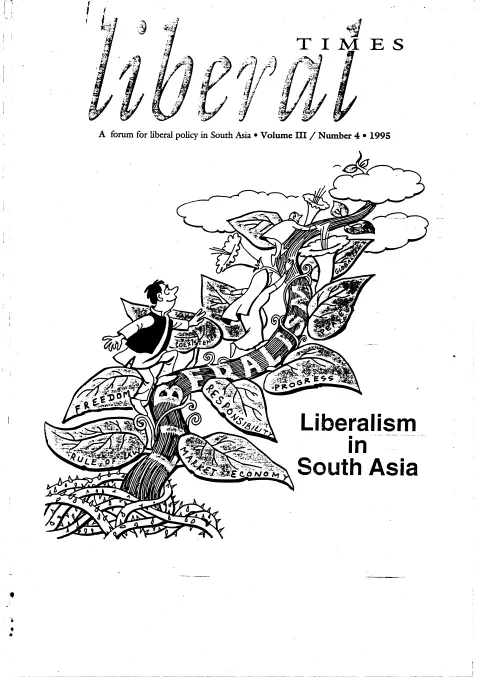
periodical issue
Liberalism in South Asia
By Sharad Joshi, Ashok Desai, Chanaka Amaratunga, Kusum Shrestha, Detmar Doering, S. V. Raju
Published by the Friedrich-Naumann-Stiftung, Regional Office South Asia. · New Delhi · 1995
36 pages
Summary
This issue of Liberal Times (Volume III / Number 4, 1995), published by the Friedrich-Naumann-Stiftung Regional Office South Asia, takes ‘Liberalism in South Asia’ as its unifying theme. In the rendered pages, six contributors — from India, Sri Lanka, Nepal, and Germany — survey the state of liberal thought and practice across the region. The issue opens with Sharad Joshi’s sweeping historical essay on why liberalism never took firm root in India despite a hospitable philosophical environment, arguing that the dominant intellectual traditions — from Gandhian quasi-anarchism to Congress socialism — crowded out a genuine liberal politics. Ashok V. Desai’s tightly argued piece follows with an analysis of how the post-independence ‘control regime’ was inherited from wartime British economic management and how the economic liberalisation of the 1990s, while substantively significant, proceeds without any ideological acknowledgment of liberty as a political value. Chanaka Amaratunga surveys the surprisingly resilient liberal tradition in Sri Lanka, centred on the Liberal Party and its programme of federalism, proportional representation, and ethnic reconciliation. Kusum Shrestha examines Nepal’s 1990 Constitution as an expression of liberal constitutionalism — sovereignty in the people, supremacy of the Constitution, an independent judiciary, and a formal bill of fundamental rights — while noting the dualistic gap between aspirational ‘Directive Principles’ and judicially enforceable rights. Detmar Doering opens a brief intellectual history of liberalism, tracing its lineage from Locke through 19th-century liberals and the post-war social-liberal divergence; only the first page of that essay falls within this chunk.
Key points
-
Sharad Joshi opens the issue with a historical essay arguing that Gandhian quasi-anarchism and Congress socialism crowded out a genuine liberal politics in India, producing a ‘Nehruvian socialist brand of statism’.
-
Ashok V. Desai traces India’s post-independence control regime to wartime British economic management and argues the 1990s liberalisation proceeds without any ideological acknowledgment of liberty as a political value.
-
Chanaka Amaratunga surveys Sri Lanka’s resilient liberal tradition, centred on the Liberal Party’s programme of federalism, proportional representation, and ethnic reconciliation.
-
Kusum Shrestha reads Nepal’s 1990 Constitution as liberal constitutionalism grounded in popular sovereignty and an independent judiciary, while flagging the gap between justiciable rights and aspirational Directive Principles.
-
Detmar Doering’s brief intellectual history of liberalism traces its lineage from classical antiquity through Locke’s Two Treatises of 1689, though only the essay’s first page falls within the rendered chunk.
-
S. V. Raju, the Freedom First editor and Indian Liberal Group figure, is listed as a contributor whose piece lies in the unrendered pages beyond page twenty.
-
The issue is edited by Jurgen Axer for the Friedrich-Naumann-Stiftung’s Regional Office South Asia and unites six contributors from India, Sri Lanka, Nepal, and Germany under the theme of liberalism in South Asia.
Essays
Any Hope for Indian Liberals?
By Sharad Joshi
Sharad Joshi’s cover essay asks whether Indian liberalism has any political future, and answers with a long historical argument for why it has so far failed. In the rendered pages he surveys the philosophical compatibility of ‘Vedanta’ individualism with liberalism, the ways in which British colonial rule introduced rule of law while also seeding a ‘plethora of statists’, and the three streams that dominated nationalist politics — socio-religious reformism, Hindu revivalism, and the Gandhian platform — none of which produced a durable liberal politics. Joshi argues that Gandhi’s quasi-anarchist village-economy vision, though spiritually sincere, produced a programme antithetical to liberal modernity, while the Congress socialist tradition actively modelled itself on the USSR. He diagnoses the resulting post-independence state as a ‘Nehruvian socialist brand of statism’ that proved hospitable to bureaucratic rent-seeking and hostile to individual economic freedom. The closing pages — visible through printed page 8 — turn to the prospects: with socialist credibility exhausted after the Bangladesh debacle and the left’s failure on economic management, Joshi argues the window for a genuine liberal party may be opening, though the Hindu nationalist parties are capitalising on the same vacuum.
- Ancient Vedanta philosophy is philosophically congruent with liberalism — it stresses individuality, rejects absolutism, and distrusts intermediary institutions like Planning Commissions.
- British colonial rule introduced rule of law but limited itself to administration and exploitation after 1857, producing a ‘plethora of statists’ rather than liberal democrats.
- The three dominant nationalist streams — socio-religious reform movements, Hindu revivalism, and Gandhism — all failed to generate a liberal political economy.
- Gandhi’s village-economy programme combined genuine ecumenism with an economic vision that was static, anti-growth, and antithetical to liberal modernity.
- The post-independence ‘Nehruvian socialist’ state, modelled on the USSR, gave power to a bureaucratic class that used regulation and licensing to entrench itself.
- By 1995 the socialist brand of statism holds little promise, creating an opening for liberals, though Hindu nationalist parties are filling the same political vacuum.
- Joshi calls for a new liberal party — tentatively referenced as ‘Swatantra Bharat’ — built on Maharashtrian farmers and urban self-employed workers rather than the old elite.
Liberalisation and Liberalism in India
By Dr. Ashok V. Desai
Ashok V. Desai’s essay traces the origins of India’s post-independence ‘control regime’ to the wartime British economic machine that India inherited in 1947, and then explains why the economic liberalisation of the 1990s has proceeded without any accompanying liberal ideology. Desai catalogues the major instruments — industrial licensing, capital-flow controls, import controls, agricultural procurement and distribution controls, and discriminatory taxation — as mechanisms that were originally wartime expedients but became entrenched because powerful interests grew up around them. He distinguishes sharply between ‘liberalisation’ (the pragmatic relaxation of controls to reduce inefficiency) and ‘liberal philosophy’, arguing that India belongs to the post-war social-liberal tradition in which liberty is not accepted as the ultimate goal of political systems. The essay closes by observing that the foreign enterprise is perceived as a structural threat to domestic actors at every level of the economy, which explains the paradox of strong growth coexisting with pervasive shame and no public celebration of reform.
- India’s comprehensive control regime was not an ideological choice at independence — it was directly inherited from the Allied wartime economic machine.
- The five major control instruments (industrial licensing, capital flow, import controls, agricultural procurement, discriminatory taxation) reinforced each other and bred vested interests that perpetuated them.
- India belongs to the post-war social-liberal tradition: liberty is not accepted as the ultimate goal, hence the paranoia about foreign investment.
- Economic liberalisation since 1991 has been ‘on the defensive’ — starting from a crisis, proceeding without ideological confidence, and producing growth that no one openly celebrates.
- The essay distinguishes clearly between liberalisation (a set of policy changes) and liberalism (a philosophy of individual freedom).
Liberalism in Sri Lanka
By Dr. Chanaka Amaratunga
Chanaka Amaratunga’s essay surveys the surprisingly resilient prospects for liberalism in Sri Lanka. He opens with a long history of Sri Lanka’s constitutional evolution — two constitutions (1972 and 1978), each drafted in a spirit of majoritarianism — and documents how political authoritarianism, ethnic conflict, and the civil war involving the LTTE have dominated the post-independence decades. Against this, he identifies several structural advantages: Sri Lanka’s unbroken tradition of elected government since 1833, its adoption of proportional representation in 1989, and the active role of the Council for Liberal Democracy (CLD) and the Liberal Party (a full member of the Liberal International since 1987). The essay then outlines the Liberal Party’s five-area reform programme: constitutional reform, resolution of ethnic conflict, economic reform, media freedom, and social freedom and criminal-law reform. Amaratunga argues that the party’s sustained advocacy for federalism and maximum devolution of power to the provinces as the route to ethnic reconciliation distinguishes Sri Lankan liberalism in the region. He concludes that despite many illiberal features, Sri Lanka’s history of constitutional government and small but committed liberal constituency make its prospects ‘brighter than elsewhere in the South Asian region’.
- Sri Lanka has had unbroken constitutional democratic government since 1833 — longer than any other South Asian nation — and has never had a military government.
- The Liberal Party has existed since 1981 and is a full member of both the Liberal International and the Council of Asian Liberals and Democrats (CALD).
- The party’s top reform priority is constitutional change: abolishing the executive presidency, creating a bicameral parliament with proportional representation, and devolving maximum power to provinces.
- The Liberal Party has been one of the strongest advocates of federalism and devolution as the path to resolving the ethnic conflict between Sinhalese and Tamil communities.
- Economic reform advocacy focuses on privatisation, deregulation, welfare measures for the poor, and inclusion of private property rights in the Constitution.
- Liberals in Sri Lanka strongly oppose the death penalty, corporal punishment, censorship, and criminalisation of consensual adult acts.
Liberal Aspects of Nepal’s Constitution
By Kusum Shrestha
Kusum Shrestha’s essay reads Nepal’s 1990 Constitution as an expression of liberal constitutionalism, arising out of the democratic movement that forced King Birendra to abandon the panchayat system. The essay catalogues the liberal structural features of the new constitution: sovereignty in the people, supremacy of the Constitution over any act of state, an independent judiciary, checks and balances between the King, the Parliament, and the executive, and an explicit bill of twelve fundamental rights — including rights to equality, personal liberty, freedom from preventive detention, press and publication rights, right to information, cultural and educational rights, right to religion, right to privacy, right to freedom from exile, and right to constitutional remedies. Shrestha identifies a ‘dualistic approach’ as the constitution’s main limitation: civil and political rights are guaranteed and justiciable, but social, economic, and cultural rights are placed in ‘Directive Principles and Policies of the State’, which are aspirational and non-justiciable. She concludes that the challenge is to translate the liberal and democratic values embodied in the constitution into living reality, so that democratic and progressive aspirations of the people can be addressed.
- Nepal’s 1990 Constitution arose from the democratic movement that overthrew the panchayat system, converting a dynastic state into a constitutional monarchy with sovereignty in the people.
- The Constitution is made supreme — all laws inconsistent with it are void, and its basic structures (Article 116) cannot be destroyed even by constitutional amendment.
- Twelve fundamental rights are guaranteed and justiciable; courts can declare any inconsistent law void.
- A ‘dualistic approach’ limits the constitution: social, economic and cultural rights are relegated to non-justiciable Directive Principles.
- The essay cites Nepal’s ratification of several UN human rights conventions (Convention on the Right of the Child, ICCPR, ICESCR, ICCPR, Convention against Torture) as positive developments.
- The essay ends with a call to translate constitutional liberal values into democratic reality to meet the aspirations of the people.
Liberalism: The Eternal Quest for Freedom
By Dr. Detmar Doering
Only the first page of Detmar Doering’s essay falls within this chunk (printed page 20). In the rendered page, Doering opens with an intellectual-history argument: the idea that power must be limited is as old as mankind, traceable through classical authors (Cicero, Tacitus), medieval thinkers (Thomas Aquinas), and the Reformation. He credits John Locke’s Two Treatises of Government (1689) as the first systematic rational theory of inalienable rights — life, liberty, and property. He then notes that Adam Smith’s Physiocrats and the Scottish philosophical tradition developed a new approach to economics — the market economy — and that Montesquieu contributed the concept of division of power. The essay breaks off on page 20 with a reference to 19th-century liberal theorists including John Stuart Mill, Alexis de Tocqueville, Frédéric Bastiat, and Herbert Spencer.
- Doering traces the genealogy of liberal ideas from classical antiquity through medieval natural-law theory to the Enlightenment.
- Locke’s Two Treatises of Government (1689) is identified as the first universal, rational theory of inalienable rights encompassing life, liberty, and property.
- Adam Smith and the Physiocrats developed the ‘market economy’ concept as a practical application of liberal principles.
- Montesquieu’s concept of division of power is presented as a foundational contribution to liberal constitutional design.
Metadata and summary are AI-extracted from the source PDF and reviewed for editorial accuracy. The original work is available via the Read PDF tab above (where present); paragraph-level citation inside the PDF is deferred to a future engagement.
People in this work
Related across the archive
 ThePrintFrom Vedanta, India turned to Nehruvian socialism and buried its liberal roots: Sharad Joshi
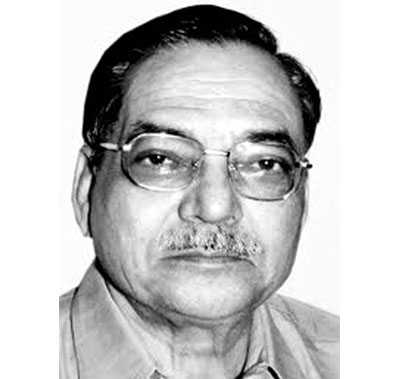 ExcerptSharad Joshi on Liberalism in India
 ThePrintA shame-faced modesty pervades 1991 reforms. This is strange and inappropriate: Ashok Desai
 ExcerptManifesto for Indian Liberals
 Primary workFreedom First