edited volume · anthology
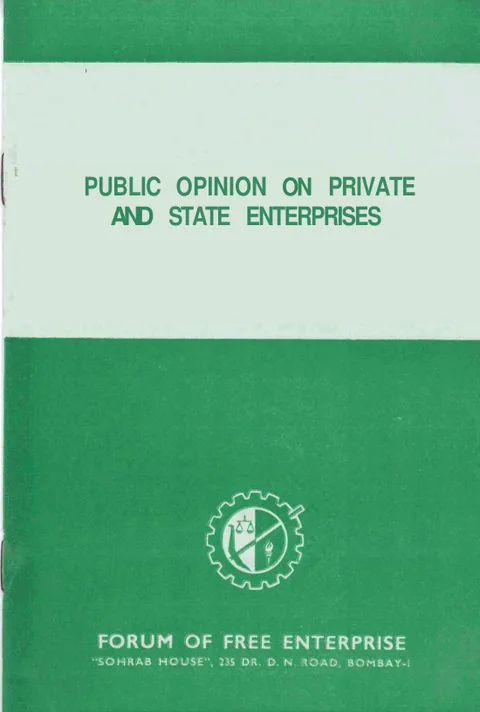
Public Opinion on Private and State Enterprises
By a-sen-gupta, c-k-g, d-srinivasaiah, g-rangarajan, field-officer, subimal-sen, kalidas-bose, tapesh-ch-goswami, n-k-chaudhuri, madhukar-n-gogate, a-consumer, nihal-chand-jain, m-n-prasad, t-n-kalidoss-aiyar, y-z
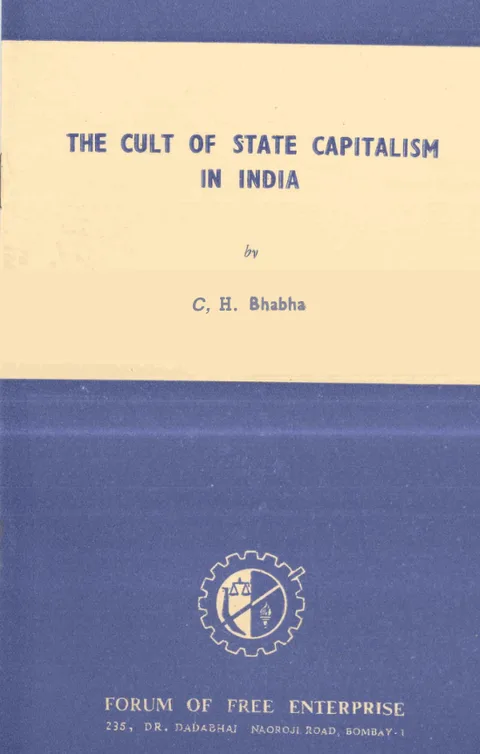
Published by M. R. Pai, for Forum of Free Enterprise, "Sohrab House", 235, Dr. Dadabhai Naoroji Road, Bombay 1, and printed by S. J. Patel at Hind Kitabs Ltd., Printing Division, Sassoon Docks Colaba, Bombay-5. · Bombay · 1962
9 pages
Public Opinion on Private and State Enterprises
Summary
This Forum of Free Enterprise booklet, dated 9 December 1962, compiles selected letters to the editor that had appeared in major Indian newspapers — the Statesman of Calcutta, the Indian Express of Bombay, the Hindu of Madras, the Times of India and Navabharath of Mangalore — protesting the inefficiency of nationalised state enterprises. The Forum’s brief introduction frames the exercise: freedom, like oxygen, is taken for granted until its supply is threatened, and the nationalisation slogans of the day have obscured the value of private enterprise. By printing letters that contrast the service once rendered by private firms with the bureaucratic torpor that succeeded them, the booklet aims to surface dangers of state monopolies that, in the editor’s words, can and often do exploit the ordinary consumer.
The letters cover a representative spread of state-run undertakings. Subscribers and policy-holders of the Life Insurance Corporation describe lapsed premiums, missing receipts and stonewalling officials; a field officer of the LIC writes from the inside to attack the “Policy-holder” reply offered by Mr. P. R. Gupta and argue that the Corporation’s administrative machinery cannot keep pace with its growing volume. Other correspondents complain of postal money-order instalments rejected on technicalities, of registered parcels lost without recourse, of State Transport buses now used as mailbags, of BEST electricity billing chaos in Bombay, and of the decline of the Kolar Goldfields after nationalisation drove out experienced engineers.
A further cluster of letters turns to the Ministry of Information and Broadcasting and its arms — All India Radio, the Films Division and the Central Film Censors Board — describing them as instruments of official propaganda, vested patronage and stifled private cultural enterprise; T. N. Kalidoss Aiyar protests the way nationalised railways have raised fares and freight while running at fifty per cent efficiency; and “Y. Z.” reports from an educational tour of Hindustan Shipyard, Chittaranjan Locomotive Works, Nangal Fertilisers and the Heavy Water Plant whose upkeep, he says, compares unfavourably with TELCO, Ashok Leyland and TISCO. Closing pages carry signed slogans by Eugene Black of the World Bank and A. D. Shroff, and a recruitment notice inviting readers to join the Forum.
Key points
-
Publication is a 1962 Forum of Free Enterprise booklet that anthologises letters to the editor from leading Indian newspapers (Statesman, Indian Express, Hindu, Times of India, Navabharath) attacking the performance of nationalised undertakings.
-
The introduction articulates the Forum’s framing thesis: nationalisation slogans have obscured the value of private enterprise, and contrast with state monopolies is now revealing what was lost.
-
Multiple letters target the Life Insurance Corporation — bureaucratic non-receipt of premia, lapsed policies, unanswered correspondence — including a letter from a serving LIC field officer arguing that the Corporation’s administrative machinery has become obsolete.
-
Other complaints itemise failures at the postal department, State Transport buses doubling as postal carriers, the Bombay Electric Supply and Transport Undertaking (B.E.S.T.) and its billing irregularities.
-
Several letters tie the decline of the Kolar Goldfields to the post-nationalisation exodus of experienced Indian mining engineers under Mysore Government recruitment rules.
-
A bloc of letters indicts the Ministry of Information and Broadcasting and its arms — All India Radio, the Films Division, the Central Film Censors Board — as propaganda monopolies that have stifled the private documentary sector.
-
T. N. Kalidoss Aiyar contests nationalised Indian Railways’ fare and freight hikes, citing that the project ran at only fifty per cent efficiency in spite of huge expenditure on the 70-percent rule.
-
The closing letter (“Y. Z.”) reports a study tour finding the Hindustan Shipyard, Chittaranjan Locomotive Works, Nangal Fertilisers and the Heavy Water Plant in technically informal and poorly maintained condition compared to private firms like TELCO, Ashok Leyland and TISCO.
Generated by the v1.5 extraction pipeline. Awaiting editorial review.
Metadata and summary are AI-extracted from the source PDF and reviewed for editorial accuracy. The original work is available via the Read PDF tab above (where present); paragraph-level citation inside the PDF is deferred to a future engagement.