Musing · excerpt
Censorship and the Law of Inexorability
29 October 2021
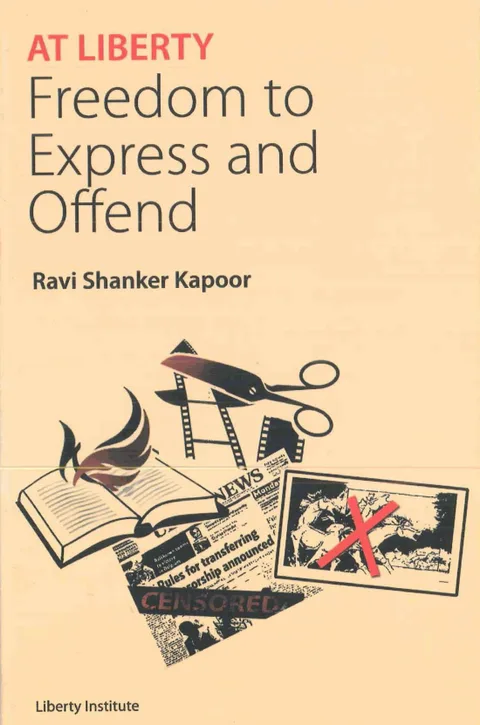
_The following essay is part of a 2012 booklet published by The Liberty Institute, New Delhi, in partnership with the Friedrich Naumann Foundation for Freedom. The booklet was title At Liberty: Freedom to Express and Offend. Authored by Ravi Shanker Kapoor, the essay examines ban on cinema and attacks on artistic freedom by the government, political organisations and pressure groups, despite the existence of the Central Board of Film Certification, a statutory body._In India, no other form of human expression has faced more restrictions than cinema. Unfortunately, it is not only the Central Board of Film Certification (CBFC) which does the job of censorship but, as we shall see, a variety of forces tend to curtail the filmmakers’ creative freedom.
The CBFC, a statutory body under the Ministry of Information & Broadcasting, is mandated to regulate the public exhibition of films under the provisions of the Cinematograph Act, 1952. Films can be publicly exhibited in India only after they have been certified by the CBFC or the censor board in common parlance.
The Board, headquartered in Mumbai, comprises a chairperson and non-official members, all of whom are appointed by the Central government. It has nine regional offices, one each in Mumbai, Kolkata, Chennai, Bangalore, Thiruvananthapuram, Hyderabad, New Delhi, Cuttack, and Guwahati.
Films are certified under four categories: ‘U’ certificate or Unrestricted Public Exhibition; ‘UA’ certificate or Unrestricted Public Exhibition, but with a word of caution that parental discretion required for children below 12 years; ‘A’ certificate or restricted to adults; and ‘S’ certificate or restricted to any special class of persons. The vision behind the setting up of the CBFC was “to ensure good and healthy entertainment” in accordance with the established provisions.
**Supreme Court’s Justification **
Why should cinema be subjected to censorship when other forms of expression like the press, novels, and short stories are not? The Supreme Court of India justified film censorship, arguing:
_Film censorship becomes necessary because a film motivates thought and action and assume a high degree of attention and mention as compared to the printed word. The combination of act and speech, sight and sound in semi-darkness of the theatre with elimination of all distracting ideas will have a strong impact on the minds of the viewers and can affect emotions. Therefore, it has as much potential for evil as it has for good and has an equal pound to instill or cultivate violent or good behavior. It cannot be equated with other modes of communication. Censorship by prior restraint is, therefore, not only desirable but also necessary. _
Our argument is that even if the apparently harmless vision of the CBFC (good and healthy entertainment) and the apex court’s justification (potential for evil) are accepted on their face value, it is not possible to resolve the issue. For there have been instances where films have been banned despite clearance from the censor board. While categorizing films as per various certificates is essential, the very idea of CBFC acting as a censor board is not good. What makes the matters worse is that the CBFC’s certification is not considered final either by the political class or society.
Mrinal Sen-directed Neel Akasher Neechey (1959) was banned for two years, apparently by the government and not the censor board. That it was banned by the government run by Jawaharlal Nehru, the quintessential liberal, makes the assault on creative freedom even more deplorable. His government also went on to proscribe the 1962 film_ Nine __Hours to _Rama, which showed Nathuram Godse’s political and psychological motivation for killing Gandhi. The movie was based on a book by celebrated historian Stanley Wolpert; incidentally, he also wrote an authoritative biography of Nehru.
If gold rusts, what will happen to iron? With men of high ideals with touching faith in liberalism falling prey to political expedience, the lesser and later politicians showed much less tolerance to the subjects and viewpoints that they found unpalatable. Directed by Gulzar, _Aandhi _(1975) was said to be based on triangle of Indira Gandhi-Nehru-Feroze Gandhi relationships. Its release faced problems, even though it showed Indira Gandhi in a favorable light. Then there was Amrit Nahata-directed _Kissa Kursi __Ka _(1977). Though not depicting any prominent leader in particular, it showed a corrupt and vile politician wooing personified public, played by Shabana Azmi. The movie was banned by the government.
**Nationalistic peevishness **
Nationalistic peevishness is another factor. In 1984, _Indiana Jones __and __the Temple __of Doom was proscribed for “racist portrayal of Indians and overt imperialistic tendencies.” The West Bengal government banned City _of Joy in 1992 for the alleged denigration of Calcutta.
Prudery has also been the bane of hackers. Kama _Sutra: A __Tale of Love __Banned _(1996) faced trouble with the censors; a truncated version was later released. The same year, Fire faced the air of Hindu groups who objected to lesbianism and the names of protagonists, Sita and Radha. Using these names for lesbians was mischievous, the activists said. This was a slur on Hinduism. Religious sensibilities are easily offended in India. Politicians in some states with a substantial Christian population banned The Da Vinci Code, even though the Christian West did not do that.
Sometimes it is publicity hunger that propels people to attack films. The 2009 _Billu Barber _met with fierce resistance from salon and beauty parlor associations; they said that the word ‘Barber’ was derogatory. The head of the production company, Shahrukh Khan, was forced to rename the title as Billu. He also found it politic to invite members of the Hairdressers’ Association of Mumbai members to the premier of the movie.
Politics has always played a big role in attracting proscription. In 1971, Satyajit Ray-directed Sikkim faced a ban, which lasted till September 2010. In 2006, the film Fanaa was banned in Gujarat for a strange reason-that the lead star, Aamir Khan, was against the Sardar Sarovar Dam over the river Narmada and had demanded adequate rehabilitation for the ousted villagers! Shatrughan Sinha, popular film star and member of the Bharatiya Janata Party (which ruled in the state), even hinted his party would launch violent protests if the Khan did not retract his support to the anti-dam activists.
Then there was the curious case of Jo Bole So Nihal. In May 2005, the Shiromani Akali Dal (SAD) sought ban on film in which the hero, Sunny Deol, played the role of Sikh cop. “The producer of the film has misused the holy Sikh community slogan (Bole So Nihal),” SAD chief Parkash Singh Badal told a press conference. “It is pertinent to mention here that a sub-committee of the Akal Takht had given ‘clean chit’ to the Hindi film starring Sunny Deol,” said a PTI report on May 18.
The ruckus was the product of intra-Alzali bickering; some factions used the movie as a pretext to score brownie points. The most recent controversy, regarding the ban on Prakash Jha’s_ Aarakshan_, is a typical case of political correctness not just going berserk but also it mingling with the shenanigans of politicians.
National Commission for scheduled Castes & Scheduled Tribes chairman P.L. Punia objected to some dialogues in the film, calling them anti-Dalit. This was despite the fact that the film was cleared by a panel comprising nine people, including a Dalit activist and a former high court judge. Usually, such panels include four or five people. The result of Punia’s petulance was that the movie was banned in Uttar Pradesh, Andhra Pradesh, and Punjab.
Politics, pure and simple
It was politics, pure and simple. Punia, a Congress leader who was earlier a confidante of Uttar Pradesh chief minister Mayawati, wanted to present himself as a ‘true’ leader of the Dalits. The Congress and Mayawati’s Bahujan Samaj Party, seen as the big rivals in the country’s largest state, were both vying for the bigger chunk of Dalit vote. It was Jha’s misfortune that he was caught in the crossfire.
More dangerous than the machinations of politicians is the tacit and often explicit support they get from intellectuals in the assaults on freedom of expression. For instance, Dalit scholar Kancha Ilaiah and prominent editor Ajay Bose practically supported ban on Aarakshan. Bose saw nothing wrong in Mayawati’s ban on Aarakshan on the grounds that she was entitled to take whatever action she deemed fit for her political survival. The ideals and rights enshrined in the Constitution mattered little to him.
It is this intellectual milieu that emboldens the political class to trample over the fundamental rights of citizens. Eminent academics, media Brahmins, and other opinion makers-most of them steeped in dirigiste mindset-have convinced themselves that meaningful change in human existence can be brought only by the state. A natural corollary is that any political cunning is justified. Hence the easy condoning of the actions of Punia and Mayawati by intellectuals.
In short, the so-called reasonable restrictions on the freedom of expression may have occasioned the censor board to regulate cinema but the matter did not end there. As any other government regulation, it has also acquired a life of its own, often making the existence of the CBFC redundant. Any political party, social outfit, cultural group, or publicity seeker can don the mantle of a censor and torment a filmmaker. Punia cited reasonable restrictions justify his attack on Aarakshan; it is another matter that the restrictions he wanted to impose were unreasonable. The concept from which the censor board derives its legitimacy is also the one from which super-censors do.
Creative freedom will remain constrained and restrained till the individual is deprived of the right to express himself without restrictions, reasonable or otherwise. Until that is done, grumpy politicians, tetchy outfits, blackmailers, mischief mongers, and trouble makers will inexorably continue to thrive at the expense of freedom of expression.Last week’s musing: ART VERSUS LAW AND ORDER