letter
An Open Letter to L.I.C.
By Peregrine
Published by M. R. Pai for Forum of Free Enterprise, "Sohrab House", 235, Dr. Dadabhai Naoroji Road, Bombay 1, and printed by B. G. Dhawale at Karnatak Printing Press, Chira Bazar, Bombay 2 · Bombay · 1962
4 pages
Summary
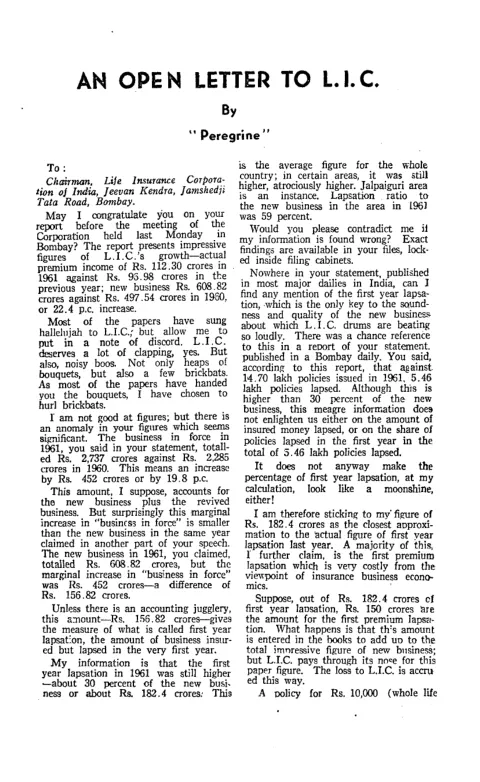
An Open Letter to L.I.C., signed by the pseudonymous “Peregrine” and reproduced from the Amrit Bazar Patrika of September 1, 1962, is a sceptical reading of the Life Insurance Corporation’s first major progress report by a writer who is also a policy-holder. While most papers, the letter notes, have “sung hallelujah” to the LIC’s claimed jump in new business from Rs. 497.54 crores in 1960 to Rs. 608.82 crores in 1961, Peregrine argues that the corresponding rise in “business in force” — Rs. 452 crores, or 19.8 per cent — is too small to be consistent with that growth once first-year lapsation is honestly counted. The gap of Rs. 156.82 crores, he writes, either reflects accounting jugglery or simply measures policies that lapsed within the first year; his own estimate of true first-year lapsation is about Rs. 182.4 crores, or roughly 30 per cent of new business nationally and as high as 59 per cent in pockets such as Jalpaiguri.
The second half of the letter shifts from arithmetic to incentives. Peregrine traces the LIC’s promotional culture back to Morarji Desai’s 1959 Lok Sabha exhortation to reach Rs. 1,000 crores of new business as soon as possible, and argues that the resulting target-chasing has hardened into a system where field workers are rated chiefly on “gross completed business” — with the predictable result that officials are promoted for booking volumes of “unsound or simply fictitious” policies. He recounts a Calcutta Division episode in which Rs. 20 crores of new business was reportedly booked in a single day to save end-of-year quotas, and cites the Lok Sabha Estimates Committee’s April 1962 report — which scolded the Corporation for emphasising expansion over servicing — to show that even Parliament has noticed the pattern. The pamphlet closes by demanding that the LIC make its admitted “adverse trend” public and asserts a citizen-and-policy-holder right to know the actual condition of the national insurance monopoly. The Forum of Free Enterprise reissued the letter in December 1962 with its standard disclaimer that the views expressed are not necessarily those of the Forum.
Key points
-
Frames itself as the dissenting “brickbat” against a press chorus celebrating the LIC’s 1961 results.
-
Argues that the Rs. 156.82 crore gap between claimed new business (Rs. 608.82 cr) and the marginal increase in “business in force” (Rs. 452 cr) measures first-year lapsation hidden by the Corporation’s framing.
-
Estimates true first-year lapsation in 1961 at about Rs. 182.4 crores (~30 per cent of new business), citing Jalpaiguri’s 59 per cent ratio as an example of regional concentration.
-
Cites the LIC’s own admission that 5.46 lakh of 14.70 lakh policies issued in 1961 lapsed, and works out a unit economics example showing each lapsed policy costs the Corporation a net Rs. 13.
-
Traces the incentive distortion to Morarji Desai’s 1959 Lok Sabha target of Rs. 1,000 crores and to internal appraisal formulae that weight “gross completed business” above servicing and retention.
-
Recounts a Calcutta Division episode where Rs. 20 crores of new business was reportedly booked on the last day of the year to save divisional prestige.
-
Invokes the Lok Sabha Estimates Committee’s April 1962 report, which faulted the LIC for prioritising expansion over servicing, as Parliamentary corroboration.
-
Closes by asserting a citizen-and-policy-holder right to know, demanding the Corporation publish the “adverse trend” it has admitted only internally.
Metadata and summary are AI-extracted from the source PDF and reviewed for editorial accuracy. The original work is available via the Read PDF tab above (where present); paragraph-level citation inside the PDF is deferred to a future engagement.