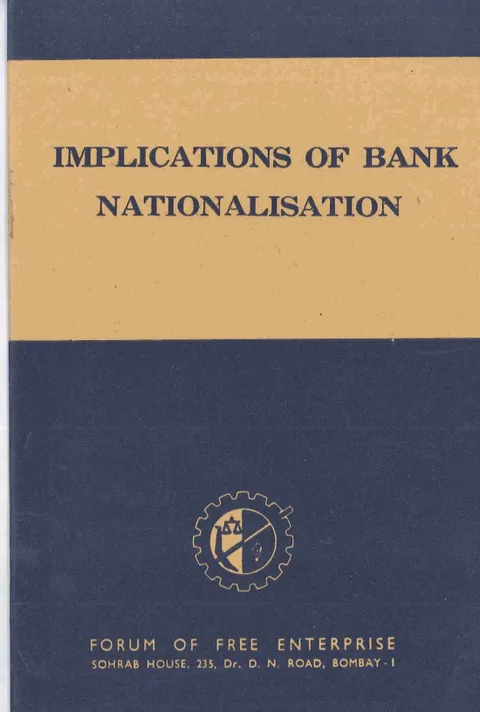
pamphlet
"Social Control" Over Commercial Banks
There Is No Economic Case For Bank Nationalisation
Published by M. R. PAI for the Forum of Free Enterprise, "Sohrab House", 235, Dr. Dadabhai Naoroji Road, Bombay-1, and printed by H. NARAYAN RAO at H. R. MOHAN & CO. (PRESS), 9-B, Cawasjee Patel Street, Bombay-1. · Bombay · 1966
20 pages
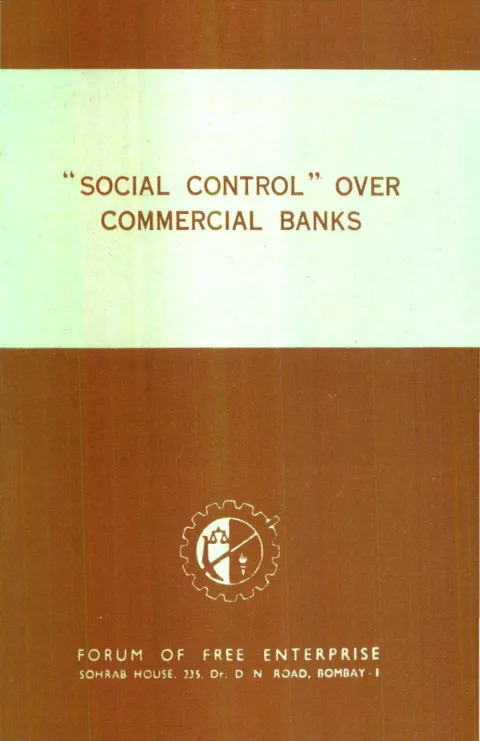
“Social Control” Over Commercial Banks
By CANDIDUS
Summary
Published by the Forum of Free Enterprise in late 1966, this 16-page booklet is a compact polemic against the Indian National Congress’s then-mooted ‘social control’ over commercial banks, which the Forum reads as a euphemism for staged nationalisation. The pamphlet is assembled rather than authored: it opens with a syndicated article by the pseudonymous ‘Candidus’ reproduced from the Amrit Bazar Patrika of 15 September 1966, followed by a Times of India piece (7 October 1966) by A. S. Bhaskar, Financial Editor of that paper, and a resolution adopted by the Reserve Bank of India Employees’ Association in Bombay in July 1964 opposing nationalisation. The remainder collects letters to the editor — from S. N. Iyer in Madras, S. G. Subramanian in Tirunelveli, N. Goyal in Ganganagar, and Taradas Dutt in Calcutta — alongside excerpted statements from Burma’s Premier U Nu, the Soviet economist V. Tyagunenko, and the 1965 Kenyan government paper African Socialism and its Application to Planning in Kenya. The booklet is bookended by epigraphs from Eugene Black and A. D. Shroff.
The core economic argument runs as follows: nationalisation does not create new resources; it merely transfers existing ones, and in doing so substitutes the bureaucratic rigidities of state ownership for the discipline of private finance. Candidus marshals figures from 1964-65 — total deposits of Rs. 2,610.22 crores, of which Rs. 727.60 crores were already invested in government securities, and a Rs. 260-crore contraction in bank credit in 1965-66 — to show that the public sector is in fact already a heavy claimant on bank resources, and that further claims would ‘starve’ the productive sector. Bhaskar argues that the Congress phrase ‘social control’ is dangerously elastic, ranging from tighter supervision to outright nationalisation, and that such uncertainty itself is corrosive to a banking system that ‘cannot function best in a climate of uncertainty’.
The reader letters form a second register: anecdotal indictments of the Life Insurance Corporation, the State Trading Corporation, and state electricity boards, framing public-sector enterprise as synonymous with red tape, indifference, and (in N. Goyal’s words) ‘incompetent and corrupt hands that are eating into the national economy like the termites’. The booklet’s closing international section borrows authority from unlikely quarters — a socialist Burmese premier confessing ‘blunders’, a Soviet economist counselling case-by-case caution, and a Kenyan ruling-party document warning that nationalisation ‘would discourage additional private investment’. The compendium’s argumentative spine is that ‘social control’ is bad economics dressed as good politics, and that the proper alternative is a comprehensive inquiry of the kind urged by T. A. Pai, then chairman of the Food Corporation.
Key points
-
Forum of Free Enterprise pamphlet (Bombay, 1966) responding to Congress proposals for ‘social control’ over banks and renewed Lok Sabha talk of nationalisation.
-
Lead article by ‘Candidus’ (Amrit Bazar Patrika, 15 Sept 1966) argues that nationalisation creates no new resources, citing 1964-65 deposit and credit-contraction figures to show banks already heavily fund the public sector.
-
A. S. Bhaskar (Times of India, 7 Oct 1966) attacks the vagueness of ‘social control’, noting that no Congress spokesman at the AICC’s Ernakulam session had defined the phrase, and that uncertainty itself damages banking.
-
Reproduces the Reserve Bank of India Employees’ Association Bombay resolution of 3 July 1964 dissociating itself from the campaign for nationalisation.
-
Compiles reader letters from S. N. Iyer, S. G. Subramanian, N. Goyal and Taradas Dutt indicting LIC, state electricity boards and the State Trading Corporation as evidence that public-sector expansion breeds inefficiency.
-
International section quotes Burma’s Premier U Nu admitting to nationalisation ‘blunders’, Soviet economist V. Tyagunenko counselling caution, and the 1965 Kenyan paper African Socialism warning that nationalisation reduces growth.
-
Endorses T. A. Pai’s proposal for a broad-based New Delhi committee to undertake a comprehensive review of rural, commercial and industrial credit before any structural change.
-
Closes with A. D. Shroff’s aphorism — ‘Free Enterprise was born with man and shall survive as long as man survives’ — restating the Forum’s founding creed.
Generated by the v1.5 extraction pipeline. Awaiting editorial review.
Metadata and summary are AI-extracted from the source PDF and reviewed for editorial accuracy. The original work is available via the Read PDF tab above (where present); paragraph-level citation inside the PDF is deferred to a future engagement.