
edited volume · anthology
Implications of Bank Nationalisation
By observer, uday, uday
Published by M. R. Pai for the Forum of Free Enterprise, 235, Dr. Dadabhai Naoroji Road, Bombay 1, and Printed by Michael Andrades at the Bombay Chronicle Press, Horniman Circle, Bombay-1. · Bombay · 1964
19 pages
Summary
Issued by the Bombay-based Forum of Free Enterprise in March 1964, this 28-page booklet bundles three Economic Times articles, two appendices of cautionary quotations and reader letters, and a short editorial introduction to argue against the then-current demand for nationalisation of India’s commercial banks. The introduction frames the booklet as an antidote to slogan-driven thinking, insisting that radical changes in the banking economy would ‘hurt the much-desired economic growth’ and push the country ‘towards totalitarianism’ unless the public studies the question ‘in a rational manner’. The main essay, signed ‘Observer’, surveys the three standard cases for nationalisation — service-over-profit, mobilisation of deposits for planning, and breaking the monopolistic concentration of credit — and rebuts each in turn, leaning heavily on the underwhelming record of the State Bank of India and the Life Insurance Corporation after their nationalisation in 1955 and 1956. A second pair of pieces, signed ‘Uday’, dismantles the Company Law administration’s interlocking-directorships study and the Reserve Bank’s bank-shareholding survey, treating both as statistically thin pretexts for a political decision the Finance Minister has already ‘vehemently denied’ is on the cards.
The argumentative centre is that the commercial banking system is already ‘extensively regulated’ by the Reserve Bank and the Banking Companies Act, that the State Bank has not outperformed the private banks even with privileged access to PL-480 and Reserve Bank balances, and that ‘the heavier concentration of economic power’ under state ownership ‘could only lead to greater delay, intense irritation, official interference and lost opportunities, if not to increased corruption and unhealthy practices’. The Observer article distinguishes carefully between money and wealth — ‘Banks can and certainly do create money but they cannot create wealth’ — to puncture what it sees as the soft socialist notion that a transfer of ownership is itself an act of creation. Appendix A reproduces second-thoughts on nationalisation from prominent British Labour figures (Gaitskell, Bevan, Attlee, Douglas Jay, Crossman, Norman Dodds, Roy Jenkins, Balogh) and the Webbs, plus Burma’s U Nu, presented as a chorus of socialists ‘disillusioned with nationalisation’. Appendix B prints two reader letters from Roorkee and Gauhati recounting frustrating encounters with the nationalised State Bank and LIC, offered as anecdotal evidence that public-sector banking would extend, not solve, the consumer’s grievance. The booklet closes with the colophonic A. D. Shroff line that ‘Free Enterprise was born with man and shall survive as long as man survives.‘
Key points
-
Forum of Free Enterprise pamphlet (Bombay, 9 March 1964) compiling three Economic Times articles plus two appendices, published five years before bank nationalisation actually occurred in 1969.
-
Editorial framing positions the booklet as a ‘rational’ rebuttal to slogan-mongering, warning that nationalisation of banks, foodgrains trade and rice mills would push India ‘towards totalitarianism’.
-
The lead essay by ‘Observer’ identifies three schools demanding nationalisation — service-over-profit, planning needs, and breaking monopolistic credit concentration — and rebuts each by appealing to the disappointing record of the State Bank of India (nationalised 1955) and the LIC (1956).
-
Repeated use of distinction between money and wealth: ‘Banks can and certainly do create money but they cannot create wealth’ is the analytical hinge of the anti-nationalisation case.
-
Two follow-up pieces by ‘Uday’ attack the Company Law Administration’s interlocking-directorships study (Raj K. Nigam) and the Reserve Bank’s call for shareholding data, treating both as inadequately supported political pretexts.
-
Appendix A assembles cautionary quotations from British Labour figures and the Webbs, plus Burmese socialist Premier U Nu, as evidence that socialists abroad have themselves ‘turned away’ from nationalisation as a route to socialism.
-
Appendix B reprints two reader letters about the State Bank of India (Roorkee) and LIC (New Delhi) as consumer-side evidence that public-sector financial services degrade service quality.
-
The booklet argues that the commercial banks are already ‘extensively regulated’ by the Reserve Bank and the Banking Companies Act, so further regulatory aims can be achieved without ownership change.
Metadata and summary are AI-extracted from the source PDF and reviewed for editorial accuracy. The original work is available via the Read PDF tab above (where present); paragraph-level citation inside the PDF is deferred to a future engagement.
People in this work
Related across the archive
 Primary work\"Social Control\" Over Commercial Banks
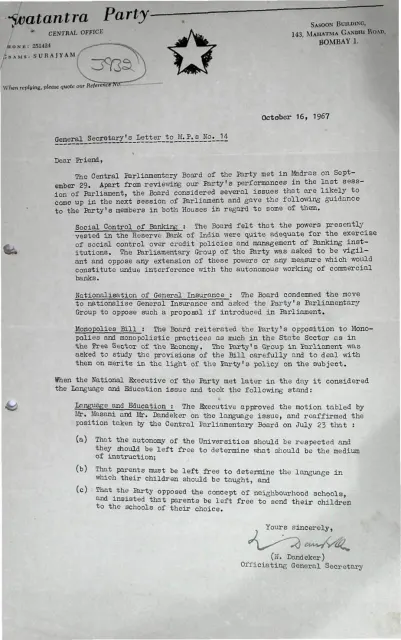 Primary workGeneral Secretary's Letter to M.P.s No. 14
 Primary workA Survey of State Enterprises in India
 ExcerptN. A. Palkhivala's Views on Socialism
 ThePrintBank nationalisation will be a blow to India’s mixed economy, lead to totalitarianism: Phiroze Shroff