pamphlet
SOCIALISM—HAS IT BECOME A DOCTRINE OF THE PAST?
By A. D. Shroff
Published by M. R. Pai for Forum of Free Enterprise, "Sohrab House", 235 Dr. Dadabhai Naoroji Road, Bombay 1, and printed by P. A. Raman at Inland Printers, 55 Gamdevi Road, Bombay 7. · Bombay
4 pages
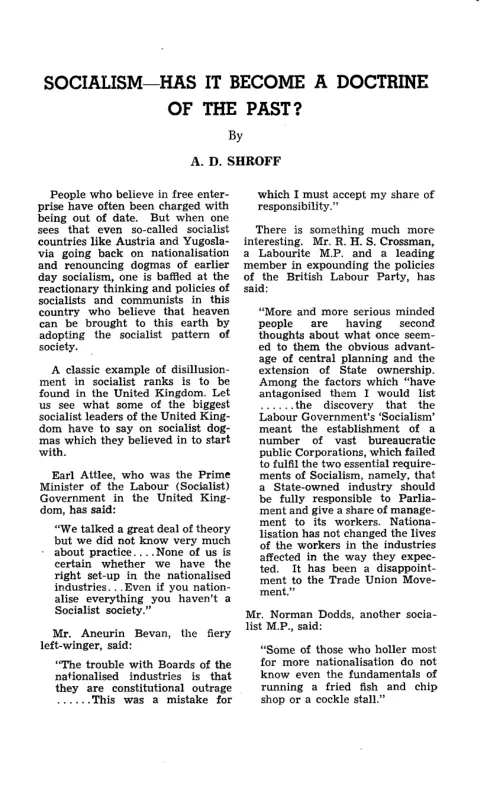
SOCIALISM—HAS IT BECOME A DOCTRINE OF THE PAST?
By A. D. Shroff
Summary
A. D. Shroff’s pamphlet, issued by the Forum of Free Enterprise, mounts a brisk polemic against the Indian socialist consensus of the late 1950s. Shroff opens by inverting the familiar charge that free-enterprise advocates are ‘out of date’: in his telling, it is the Indian socialists and communists who cling to dogmas that even Austria, Yugoslavia and the United Kingdom’s own Labour Party have begun to discard. To make that case he marshals a string of testimonies from senior British Labour figures — Clement Attlee, Aneurin Bevan, R. H. S. Crossman, Norman Dodds, Francis Noel-Baker, and the economist Thomas Balogh — each conceding that nationalisation had failed to deliver on its theoretical promises and had often left workers and consumers worse off than under private industry.
Shroff then turns the lens onto India. He argues that the country’s public-sector enterprises, far from being more humane or efficient than private firms, have generated a bureaucratic class he calls ‘Chota Hitlers’ — officials so convinced of their own indispensability that they cannot conceive of the private sector outperforming them. He cites the gulf between scheme estimates and outcomes at the Bhilai and Rourkela steel plants, the army of foreign technicians employed there, and the cost overruns of public projects as evidence that the dirigiste model is delivering ‘typical bureaucratic phenomena’ rather than rapid development. He contrasts this with the Tatas’ expansion, which made do with a far smaller cadre of American technicians.
The pamphlet closes on a note of cautious optimism: Shroff sees a growing constituency in India that is alive to the threat socialism poses to individual freedom and the democratic way of life, and he urges his readers to keep voicing dissent ‘without fear or favour’ until ‘the day of deliverance from the horrors of a socialist society’ arrives. Page 4 is a Forum of Free Enterprise membership pitch and imprint, naming M. R. Pai as the publisher.
Key points
-
Shroff frames Indian socialists as the ones ‘out of date,’ citing Austria, Yugoslavia and Britain’s own retreat from nationalisation dogma.
-
He stacks his case with quotations from British Labour figures (Attlee, Bevan, Crossman, Dodds, Noel-Baker) and the socialist economist Balogh, all conceding that nationalisation had not lived up to its theory.
-
Balogh is quoted reversing the familiar moral indictment of private industry: nationalised industry’s treatment of its own workers is ‘if anything, worse.’
-
Shroff coins the phrase ‘Chota Hitlers’ to describe Indian bureaucrats whose arrogance, in his view, blocks the private sector from doing the developmental work it is capable of.
-
He uses Bhilai (700 Russian technicians) and Rourkela (800 German technicians) as comparators against the Tatas’ expansion, which employed 115 American technicians from Kaisers — public-sector projects, he claims, exceed estimates ‘beyond reasonable measure.’
-
He reports that the Prime Minister himself acknowledged the private sector’s competence, citing Tatas’ 50 years of experience, before later defending the public sector against journalists’ criticism.
-
Shroff sees a rising Indian constituency dissatisfied with the dirigiste consensus and urges them to dissent openly until ‘the day of deliverance from the horrors of a socialist society’ arrives.
Generated by the v1.5 extraction pipeline. Awaiting editorial review.
Metadata and summary are AI-extracted from the source PDF and reviewed for editorial accuracy. The original work is available via the Read PDF tab above (where present); paragraph-level citation inside the PDF is deferred to a future engagement.