
pamphlet
L.I.C. — Discounting the Assured
FORUM OF FREE ENTERPRISE PIRAMAL MANSION, 235 DR. D. N. ROAD, BOMBAY 400 001. · Bombay · 1979
23 pages
Summary
Shailaja Bapat’s 1979 booklet, reproduced by the Forum of Free Enterprise from the June 1979 issue of Imprint, is a sustained policy critique of the Life Insurance Corporation of India twenty-two years after its formation. Her opening premise is structural rather than personal: the failures of LIC are not the fault of the people who run it but of the monopoly form itself, and ‘State monopolies’ are ‘no different from privately owned ones’. Against the promises C. D. Deshmukh made on the eve of nationalisation in 1956 — cheaper insurance, better service, higher efficiency, growth-oriented investment and employment — Bapat assembles an evidentiary indictment drawn from LIC’s own valuation reports, the Estimates Committee of the Lok Sabha, and the Administrative Reforms Commission.
On premium rates, she shows that LIC continues to use the Modified Oriental (1925-35) Ultimate Mortality Table even though successive in-house surveys (1953-54, 1962, the tenth valuation for 1973-75) confirm that actual deaths are between 43 and 45 per cent of those projected; the postal life insurance scheme, working in the same Indian conditions, charges premiums 18-20 per cent lower. On bonuses, she calculates that if the LIC had assumed realistic interest income and expense provisions, its distributable surplus for the 1973-75 biennium would have been Rs. 152.79 crores higher, enabling bonuses of Rs. 32 and Rs. 40 against the Rs. 17.60 and Rs. 22 actually declared. On expenses, she documents a renewal expense ratio (20.79 per cent) far above the UK (12.23 per cent) and the USA (16.9 per cent), inflated peon wages, and a Class I officer head-count that grew 467 per cent between 1957 and 1978 while the supervisory load per officer fell from 30 to 13 subordinates.
The second half of the booklet broadens into a service and governance audit: rising complaints, three-month policy transfers, delayed claim settlements (outstanding claims up 350 per cent in two decades), lapse ratios above 30 per cent, near-total neglect of the rural market (3.5 per cent of new business in 1977-78), and an investment policy that holds 75.6 per cent of funds in low-yielding government securities even though the statutory minimum is only 50 per cent, costing policyholders an estimated Rs. 41 crores in 1978 alone. Bapat’s prescriptions are explicit: decentralise the central office, break LIC into four or five competing units as the ARC recommended in 1969, give policyholders representation on the actuarial and audit boards, and abolish the monopoly so ‘healthy competition’ can supply the ‘norms for judging the efficiency of life insurance business’. The argument is offered as a cautionary case study at a moment of ‘ideological demands for nationalisation of more sectors of the economy’.
Key points
-
Frames LIC’s failures as a structural problem of state monopoly rather than the fault of its managers, and treats the case as a warning against further nationalisation.
-
Argues LIC’s premium rates are anchored to the Modified Oriental (1925-35) mortality table even though actual deaths are 43-45 per cent of projected, and the postal life insurance scheme charges 18-20 per cent less for similar plans.
-
Calculates that realistic interest and expense assumptions would have raised distributable surplus by Rs. 152.79 crores for 1973-75 and allowed bonuses of Rs. 32 and Rs. 40 per thousand against the Rs. 17.60 and Rs. 22 actually declared.
-
Documents a renewal expense ratio of 20.79 per cent in India versus 12.23 per cent in the UK and 16.9 per cent in the USA, and a 467 per cent rise in Class I officers between 1957 and 1978 while supervisory load per officer fell from 30 to 13 subordinates.
-
Catalogues service deterioration: 7,818 complaints to the central office in 1977-78, a 350 per cent rise in outstanding claims over two decades, three-month policy transfers, and lapse ratios above 30 per cent.
-
Shows LIC investing 75.6 per cent of its funds in government securities yielding only 5 per cent, against a statutory minimum of 50 per cent, and estimates the foregone return at about Rs. 41 crores in 1978 alone.
-
Notes that only 3.5 per cent of new business in 1977-78 came from rural areas, against the Union Finance Minister’s 1956 promise that LIC would carry insurance ‘to the doors of the people’.
-
Endorses the Administrative Reforms Commission’s 1969 proposal to break LIC into four or five competing units, demands policyholder representation on its actuarial and audit boards, and calls for the abolition of the monopoly.
Metadata and summary are AI-extracted from the source PDF and reviewed for editorial accuracy. The original work is available via the Read PDF tab above (where present); paragraph-level citation inside the PDF is deferred to a future engagement.
People in this work
Related across the archive
 Primary workCONSUMERS OF A STATE MONOPOLY: LIC POLICYHOLDERS
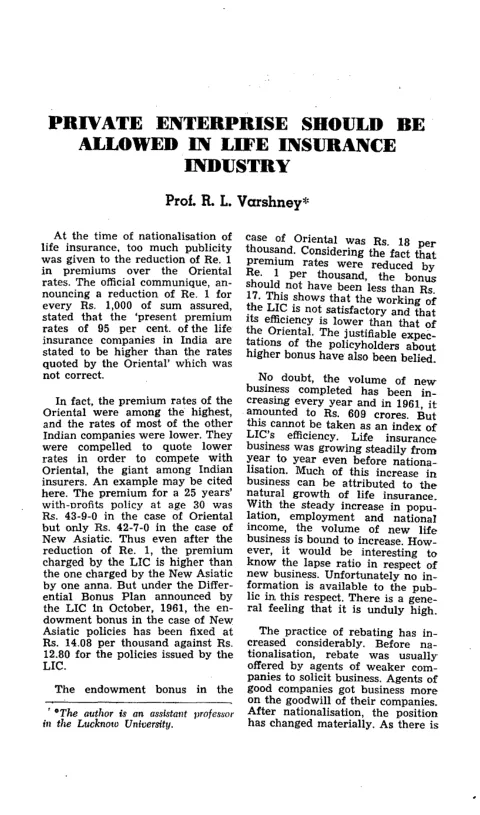 Primary workPRIVATE ENTERPRISE SHOULD BE ALLOWED IN LIFE INSURANCE INDUSTRY
 Primary workRole of Life Insurance in National Economy
 ExcerptSTATE MONOPOLIES AND THE CITIZEN IN A DEMOCRACY
 ThePrintBank nationalisation will be a blow to India’s mixed economy, lead to totalitarianism: Phiroze Shroff