
pamphlet
CONSUMERS OF A STATE MONOPOLY: LIC POLICYHOLDERS
FORUM OF FREE ENTERPRISE, SOHRAB HOUSE, 235 DR. D. N. ROAD, BOMBAY-1 · Bombay · 1975
20 pages
Summary
Prof. L. G. Bapat’s 1975 Forum of Free Enterprise booklet audits the Life Insurance Corporation of India eighteen years after nationalisation, asking whether LIC delivered on the better deal promised to policyholders when the Draft Bill was introduced in 1956. Bapat evaluates the corporation under four heads — premium rates, share in LIC’s prosperity (bonus), service while the policy is in force, and settlement of claims on maturity — and finds the state monopoly wanting on every count.
On premium rates, Bapat shows that LIC continues to base its tariffs on the obsolete Oriental (1925-35) Ultimate Mortality Table even though the death rate has fallen from 36.3 per 1,000 in the 1920s to 12 per 1,000, and even though the corporation’s own valuations and an Administrative Reforms Commission recommendation called for an immediate 25 per cent cut. He argues that by simultaneously assuming a much lower rate of interest than it actually earns and a much higher renewal expense ratio than it actually incurs, LIC artificially shrinks the surplus available for bonus, so the bonus declared on endowment and whole-life policies is consistently lower than what private companies (Western India, United India, Oriental) paid before nationalisation.
On service, Bapat catalogues a steady rise in complaints (17,304 in 1972-73 at the central office alone), policy transfers that take three months or more, surrender values that are punitive compared to British insurers like Prudential and Eagle Star, an investment policy that locks 74.7 per cent of total investment in low-yielding government securities, and a rural-area neglect such that thirty districts still had no LIC branch in 1969. He also tracks how subordinate-employee headcount and per-capita salaries have ballooned — wages obtained complete neutralisation of inflation while policyholders were squeezed — and how only 3 per cent of death claims are settled within one month, with the balance taking 199-343 days.
The conclusion is unambiguous: as long as LIC remains a monopoly it cannot honour the hopes of its creators. Bapat endorses Parliament’s 1966 Public Undertaking Committee recommendation that LIC be broken into five or more autonomous units, and former LIC chairman T. A. Pai’s call for splitting it into five corporations — and adds that the Government should either implement that recommendation or open the field to private competition immediately, in the interest of all concerned including LIC itself.
Key points
-
Frames the booklet as a stocktaking of LIC against the 1956 ministerial promise of a ‘better deal’ for policyholders, eighteen years on.
-
Documents that LIC still prices premiums off the 1925-35 Oriental mortality table even though the death rate has fallen from 36.3 to 12 per 1,000 and an Administrative Reforms Commission recommended an immediate 25 per cent cut.
-
Demonstrates that LIC depresses declared bonus by assuming a 2-7/8% to 3-3/8% rate of interest while actually earning up to 5.97%, and by assuming 17-23.25% renewal expense ratios while actual ratios sit near 13-14%.
-
Shows the share of LIC’s total income passed to policyholders has slid from 32.1% in 1956 to 23.4% in 1972-73, while subordinate-employee per-capita salaries rose 259% over the same span.
-
Cites comparative data — Indian surrender values at 56% of premiums paid where Prudential pays 95% and Eagle Star 77%; 49.7% of insurer assets locked in government securities against 2% in Canada and 4.8% in the USA.
-
Catalogues service failures: 17,304 complaints in 1972-73 at the central office, transfers taking 3+ months, only 3% of death claims settled within one month, urban concentration despite a stated rural mandate.
-
Argues that none of these distortions would survive in a competitive market — LIC behaves this way because it faces no threat of losing business.
-
Endorses the 1966 Public Undertaking Committee recommendation to break LIC into five or more autonomous units, or in the alternative to admit private competition at once.
Metadata and summary are AI-extracted from the source PDF and reviewed for editorial accuracy. The original work is available via the Read PDF tab above (where present); paragraph-level citation inside the PDF is deferred to a future engagement.
People in this work
Related across the archive
 Primary workL.I.C. — Discounting the Assured
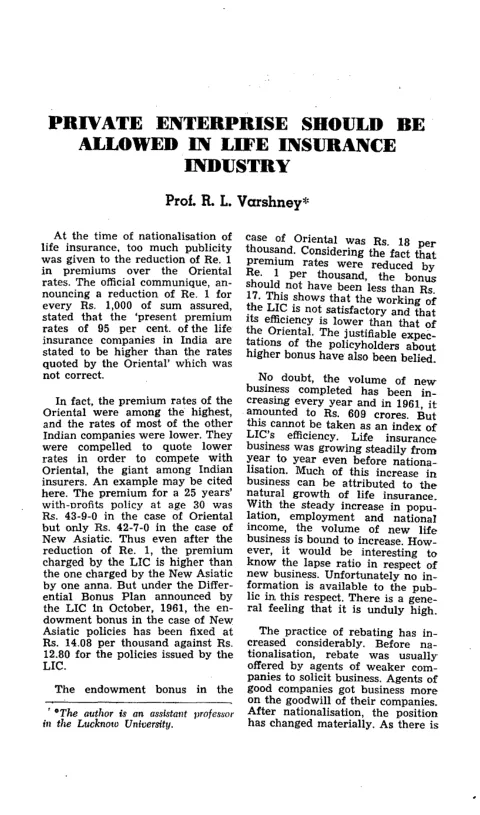 Primary workPRIVATE ENTERPRISE SHOULD BE ALLOWED IN LIFE INSURANCE INDUSTRY
 Primary workThe Role of General Insurance After Nationalisation
 ExcerptEconomic Reforms In India: Where Are We And Where Do We Go?
 ThePrintBank nationalisation will be a blow to India’s mixed economy, lead to totalitarianism: Phiroze Shroff