essay
PRIVATE ENTERPRISE SHOULD BE ALLOWED IN LIFE INSURANCE INDUSTRY
Published by M. R. Pai, for Forum of Free Enterprise, "Sohrab House", 235 Dr. Dadabhai Naoroji Road, Bombay 1, and Printed by P. A. Raman at Inland Printers, Victoria Mills Building, 55, Gamdevi Road, Bombay 7. · Bombay · 1962
4 pages
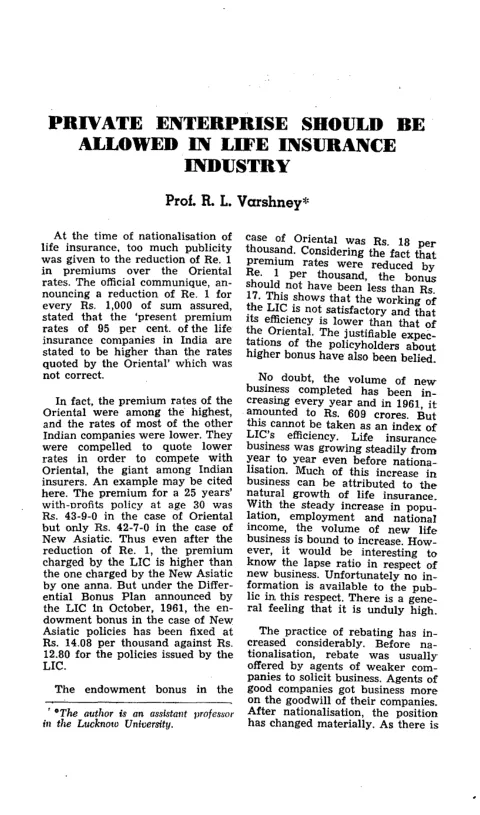
PRIVATE ENTERPRISE SHOULD BE ALLOWED IN LIFE INSURANCE INDUSTRY
By Prof. R. L. Varshney
Summary
Prof. R. L. Varshney, an assistant professor at Lucknow University, mounts a sustained critique of the Life Insurance Corporation of India (LIC) six years after the 1956 nationalisation of life insurance, arguing that on every important index — premium rates, bonuses, agent quality, claims handling, expense ratios, and product range — the state monopoly has under-performed the private insurers it displaced. He marshals concrete comparisons: at the time of nationalisation an official communique promised a Re. 1 reduction in premiums per Rs. 1,000 of sum assured, yet in fact pre-nationalisation premium rates of leading Indian companies such as the Oriental and the New Asiatic were already lower than what the LIC now charges, and the bonuses paid out have fallen short of pre-takeover expectations. The growth in new business — Rs. 609 crores in 1961 — cannot, he insists, be read as evidence of efficiency, since rising population, employment and national income would have produced the same expansion under any regime.
The essay then catalogues operational failures that policyholders feel directly: an unchecked practice of premium rebating that nationalisation was meant to abolish; poorly trained agents who push standardised endowment plans regardless of a client’s marriage, education or retirement needs; unreasonable delays in answering letters, inquiries and claims, with a deductible-from-interest penalty proposed for officers responsible; the withdrawal of joint-life policies without justification; and the abandonment of attractive products like the Retirement Benefit Plan and Endowment Benefit Plan offered by the pre-nationalisation United India.
Varshney’s constructive proposals run in two directions. First, restore competition by allowing sound state-owned general insurers — he names the Oriental and the New India — to re-enter life business, a move he attributes to a committee appointed by the Congress Parliamentary Party; competition, he argues, will lift talent into senior positions and force the LIC to develop its own character. Second, even short of competition, reform corporate governance: abolish without-profit issues of with-profit policies (which subsidise the LIC’s costs at policyholders’ expense), and give policyholders a statutory right to elect at least a third of LIC’s directors and members of its Investment Committee, restoring a representational right they enjoyed before nationalisation. The piece was first published in the Economic Times of 2 April 1962 and reissued as a Forum of Free Enterprise leaflet dated 8 May 1962.
Key points
-
Six years after nationalisation, premium rates of the LIC remain higher than those previously charged by leading private Indian insurers such as the Oriental and the New Asiatic, and bonuses have fallen below expectations.
-
The Rs. 609 crore volume of new business in 1961 is not a valid index of LIC efficiency, because population growth, rising employment and rising national income would produce comparable expansion under any organisational form.
-
The practice of rebating premiums — explicitly cited as a reason for nationalisation — has actually increased under the LIC, with agents and dummy agencies openly inducing business through rebates.
-
LIC agents are insufficiently trained to recommend differentiated products (marriage, education, retirement plans) and default to a multi-purpose endowment policy that does not fit varied policyholder circumstances.
-
Service has deteriorated: unreasonable delays in answering letters, inquiries and settling claims have prompted Varshney to propose deducting one per cent interest per month from the salary of officers responsible.
-
The LIC has withdrawn attractive pre-nationalisation products without justification, including joint-life policies and the Retirement Benefit Plan of the former United India, which offered notably lower premiums.
-
Without-profit issues of with-profit policies should be abolished because they cross-subsidise LIC expenses, lack any compensating return to policyholders, and contradict the purpose of insurance — risk coverage at lowest premium.
-
The cleanest remedy is to allow sound general insurers like Oriental and New India to re-enter life business — a step recommended by a committee of the Congress Parliamentary Party — so that competition restores efficiency and develops the LIC’s own character.
-
Policyholders should regain the right they had before nationalisation to elect directors: those holding with-profit policies of not less than Rs. 3,000 for three years should elect at least one-third of LIC’s board and have representation on the Investment Committee.
Generated by the v1.5 extraction pipeline. Awaiting editorial review.
Metadata and summary are AI-extracted from the source PDF and reviewed for editorial accuracy. The original work is available via the Read PDF tab above (where present); paragraph-level citation inside the PDF is deferred to a future engagement.