edited volume · anthology
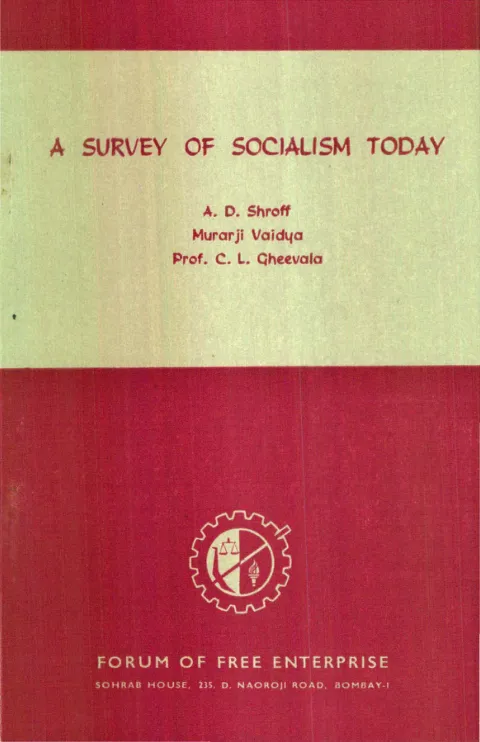
A Survey of Socialism Today
By A. D. Shroff, Murarji Vaidya
Forum of Free Enterprise, 235 Dr. Dadabhai Naoroji Road, Bombay 1 · Bombay · 1961
60 pages
Summary
A short pamphlet issued by the Forum of Free Enterprise (Bombay, 1961) collecting three contributions on the meaning and consequences of pursuing a ‘socialist pattern of society’ in India. The unsigned introduction frames the booklet’s central premise — that ‘a democratic society and a socialist society cannot be the same; in fact, they are mutually contradictory concepts’ — and previews three essays: A. D. Shroff contrasts socialist comprehensive planning with planning for free enterprise, Murarji J. Vaidya reviews state enterprises in Indian democracy, and Prof. C. L. Gheevala subjects the concept of socialism to a searching analysis with comparative reference to socialist experience elsewhere. Two appendices — selected quotations on socialism and a reading list — close the volume.
The rendered pages cover the cover, an epigraph from Eugene Black of the World Bank, the title page, the two-page introduction, Shroff’s essay in full, and the opening seven printed pages of Vaidya’s essay. Gheevala’s essay and the appendices are not in this chunk. The booklet reads as an argumentative intervention: it accepts the case for planning in an underdeveloped economy but insists planning need not be monolithic, totalitarian, or hostile to private enterprise; instead the State should act as a ‘catalyst’ that builds infrastructure, fosters competition, and respects private property, while State Undertakings should be justified case by case on grounds of efficiency, accountability and consumer welfare rather than ideological compulsion.
Key points
-
A. D. Shroff argues that private enterprise is not opposed to planning, noting the 1944 Bombay Plan was drafted by industrialists and that under the First Five-Year Plan the private sector over-fulfilled its investment targets while the public sector fell about forty percent short.
-
Shroff contends the Second Five-Year Plan imported Soviet-style totalitarian planning techniques, including all-comprehensive central direction and a heavy-industry bias that starved agriculture, structurally incompatible with a pluralistic Indian democracy.
-
The essay’s proposed alternative, “planning for free enterprise,” calls on the State to build infrastructure, foster competition rather than monopoly, and act as a catalyst instead of a substitute for private and joint-stock enterprise.
-
Murarji J. Vaidya argues that India’s “public sector” is not genuinely public, surveying eight varieties of State Undertaking catalogued by a Congress Parliamentary Party sub-committee, from statutory corporations to port trusts.
-
He points to the diversion of ordnance factories into truck production, despite idle private automobile capacity, as a cause of arms shortages just as Chinese “Communist imperialism” threatens India’s frontier.
-
Six criteria, in Vaidya’s account, must justify any State Undertaking: that it be productive rather than ideological, free of monopoly power over consumers, and run efficiently and economically.
-
Prof. C. L. Gheevala’s contribution subjects the concept of socialism to a searching analysis with comparative reference to socialist experience elsewhere.
-
The unsigned introduction frames the booklet’s central premise that a democratic society and a socialist society are mutually contradictory concepts, previewing all three essays in turn.
Essays
Socialist Planning vs. Planning for Free Enterprise & Prosperity
By A. D. Shroff
Shroff opens by puncturing what he calls the cultivated myth that private enterprise in India is opposed to planning, reminding readers that the Bombay Plan of 1944 — the first major attempt to mobilise Indian opinion around planning to raise mass living standards — was authored by industrialists, himself among them. The real argument, he says, is not whether to plan but how: the First Five-Year Plan worked as a loose conglomeration of projects under which the ‘much maligned private sector’ over-fulfilled its investment targets while the public sector fell roughly 40% short; the Second Plan, by contrast, imported totalitarian techniques from the Soviet Union — all-comprehensive central direction, physical targets searched for resources after the fact, a heavy-industry bias that starves agriculture and consumer goods, and a monolithic administrative apparatus backed (in its parent form) by secret police. None of these conditions, Shroff argues, can be reproduced inside a democratic, pluralistic India without dismantling democratic values themselves.
The essay’s positive programme outlines ‘planning for free enterprise’: start from human nature as it is, not as it ought to be; firmly establish private property; recognise the pluralism of Indian society and the limits of any central authority’s knowledge; let the State set reasonable targets, build infrastructure (roads, railways, ports, schools, telecoms, an apolitical administration), foster competition rather than monopoly, and refrain from nationalising existing industries or starting insulated state monopolies. Where the State must enter industry, it should compete on fair terms with the private sector. The goal — production of adequate consumer goods, rising incomes, all-round prosperity — depends on millions of individual decisions rather than ‘godlike book-keeping of human destiny’ by a few planners.
- Private enterprise is not anti-planning; the Bombay Plan (1944) was conceived by industrialists, and the First Five-Year Plan saw the private sector over-fulfil its investment targets while the public sector fell ~40% short.
- The Second Five-Year Plan imported Soviet-style totalitarian planning techniques (all-comprehensive scope, physical targets without resources, heavy-industry bias, monolithic administration) which are structurally incompatible with Indian democracy and pluralism.
- Comprehensive central planning fails in India for two further reasons: inadequate statistical data magnifies any error nationally, and a pluralistic society cannot be subjected to monolithic solutions.
- Realistic planning must begin from human nature ‘as it is and not as it ought to be,’ firmly establish the right to private property, and treat the State as a catalyst rather than a substitute for individual and joint-stock enterprise.
- The State’s positive role is to build infrastructure, ensure an apolitical administrative machinery, foster competition, and avoid creating insulated monopolies — production of consumer goods, not ideology, gives meaning to ‘standard of living.‘
State Enterprises in a Democracy
By Murarji J. Vaidya
Vaidya opens with a semantic complaint: ‘people’s democracies’ are not democracies and the Indian ‘public sector’ is not public — its undertakings are merely owned in theory by the people, the way a reflection in a river is part of the river. He surveys the eight varieties of State Undertaking catalogued by a Congress Parliamentary Party sub-committee (State Banks, statutory corporations, departmental undertakings, commodity and control boards, commissions, port trusts and local authorities, limited companies) and notes that state ownership of mints, postal services and mines is ancient, not a socialist invention — what is new in India is the ideological compulsion behind the expansion of the politico-bureaucratic sector. As an illustration, the diversion of ordnance factories to truck production while private automobile capacity sits idle has produced an arms shortage at the very moment Chinese ‘Communist imperialism’ threatens the frontier.
From this Vaidya derives six criteria by which any State Undertaking must be justified: that the move is productive rather than ideological; that it is not a monopoly holding the consumer hostage; that it is run efficiently and economically; that workers are fairly treated without imposing disproportionate burdens on the community; that it can be freed of political interference and patronage; and that it remains controllable by Parliament and ultimately the people. Applied honestly, he argues, the criteria mostly disqualify the existing expansion. The rendered pages reach the third criterion — efficiency — where Vaidya cites the Congress sub-committee’s own admission that Hindustan Aircraft Ltd. and Bharat Electronics Ltd. cannot even be compared with private firms because they operate under defence secrecy, and a 1959 CPSU decree confessing consumer-goods shortages in the Soviet Union, before the chunk ends mid-argument on political freedom for state employees.
- ‘Public sector’ is a misleading label: State Undertakings are public only in the notional sense that their ownership theoretically vests in the people.
- State ownership of certain functions (mints, postal services, mines) is ancient and uncontroversial; what is novel is the ideological compulsion driving the present expansion in India.
- The diversion of ordnance factories to truck production while idle private capacity exists has caused an arms shortage at a moment of Chinese threat — an illustration of ideological allocation harming national interest.
- Vaidya proposes six tests for justifying any State Undertaking: productive (not ideological) motive, absence of monopoly power, efficient operation, fair treatment of workers without burdening the community, freedom from political patronage, and accountability to Parliament.
- Even much-praised state undertakings like Hindustan Machine Tools show the gap between professed worker-ownership and actual labour-management schism; the Pay Commission has endorsed denying state employees the political freedoms guaranteed to other citizens.
Metadata and summary are AI-extracted from the source PDF and reviewed for editorial accuracy. The original work is available via the Read PDF tab above (where present); paragraph-level citation inside the PDF is deferred to a future engagement.