edited volume · anthology
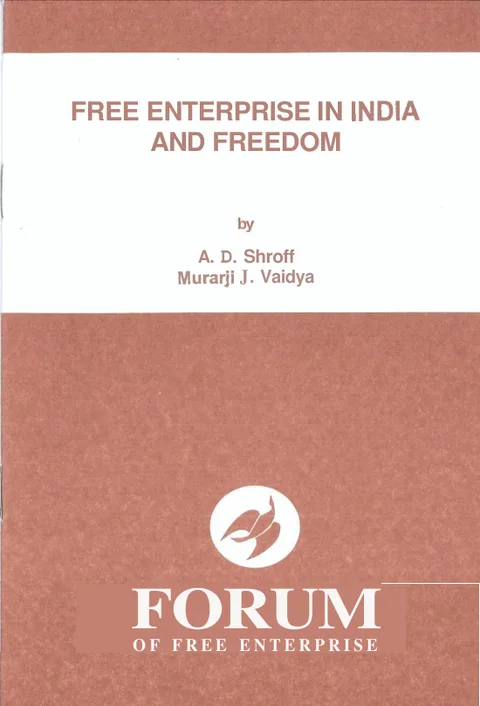
Free Enterprise in India and Freedom
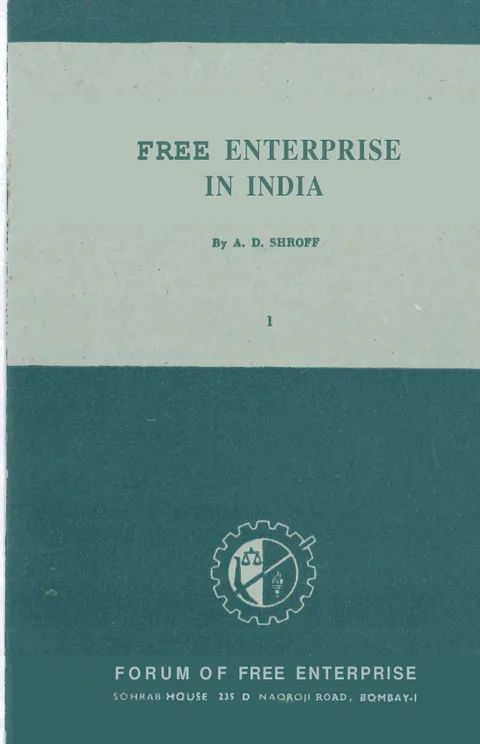
By A. D. Shroff
Published by S. S. Bhandare for the Forum of Free Enterprise, Peninsula House, 2nd Floor, 235, Dr. D. N. Road, Mumbai 400001, and Printed by S. V. Limaye at India Printing Works, India Printing House, 42 G. D. Ambekar Marg, Wadala, Mumbai 400 031 · Mumbai · 2011
16 pages
Summary
This 2011 Forum of Free Enterprise pamphlet reproduces two companion articles originally published in The Times of India on 30 March 1956 — A. D. Shroff’s “Free Enterprise in India” and Murarji J. Vaidya’s “Free Enterprise and Freedom” — bracketed by a fresh introduction from then-president Minoo R. Shroff that frames the reissue as a tribute to the late Farrok Mulla, a long-serving Forum office-bearer whose family sponsored the booklet. The two essays were prompted by the Government of India’s adoption of a “socialistic pattern of society” as the credo of the Second Five-Year Plan, and together they argue that assigning the commanding heights of the economy to the public sector will both stifle the private sector that sustained pre-Independence growth and, more dangerously, concentrate economic power in the hands of politicians and bureaucrats in ways that will erode democracy and individual liberty.
Shroff’s piece concentrates on the practical and morale-based case for the private sector — describing the despondency among small businesspeople under Section 23-A of the Income-tax Act, the misrepresentation of “the Private Sector” as a handful of large industrialists, and the indispensable role of agriculture, trade and small enterprise — and calls for an organised, country-wide educative campaign by the Forum and like-minded bodies. Vaidya’s essay treats the same Second Plan documents as a political-philosophical problem: drawing on the experience of Eastern European countries that slid from socialism into communism, he warns that simultaneous pursuit of socialism and democracy in an under-developed economy risks sacrificing the latter, and that institutional changes envisaged by the Planners are dictated by the Avadi resolution rather than by any economic necessity. The introduction concludes that Forum’s 1950s campaign has “in some way led to the liberalisation of the economy and the assignment of a larger role to the private sector after 1991”.
Key points
-
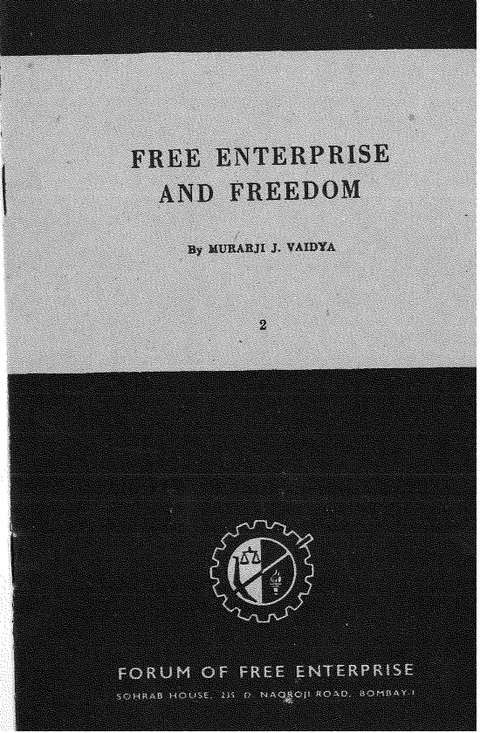
The pamphlet reprints two companion articles from The Times of India of 30 March 1956, A. D. Shroff’s Free Enterprise in India and Murarji J. Vaidya’s Free Enterprise and Freedom, reissued in 2011 as a tribute to the late Farrok Mulla.
-
Minoo R. Shroff’s introduction frames both essays as responses to the government’s adoption of a socialistic pattern of society as the credo of the Second Five-Year Plan.
-
A. D. Shroff argues that Section 23-A of the Income-tax Act and related fiscal measures were breeding a defeatist mentality among small businesspeople, amounting to a suicide of the Private Sector.
-
Shroff cites National Income Committee figures showing Small Enterprises produced Rs. 910 crores of net output in 1950-51 against Rs. 550 crores from Factory Establishments, employing 11.5 million workers against 3 million.
-
He calls for an organised, country-wide educative campaign by chambers of commerce and trade associations to counter the caricature of the private sector as a handful of large industrialists.
-
Shroff singles out press vilification of private life-insurance management ahead of nationalisation as a template for how the state justifies expanding public ownership of the economy.
-
Murarji J. Vaidya reads the Second Plan’s draft outline as a near-final commitment to the Avadi resolution’s Socialistic Pattern of Society, hardened into plain socialism by subsequent Congress speeches.
-
Vaidya warns that Eastern European countries which pursued socialism and democracy simultaneously slid into communism, losing both, and cautions India against the same trajectory.
-
The introduction credits the Forum’s 1950s campaign with having in some way led to the liberalisation of the economy and the private sector’s larger role after 1991.
Essays
Free Enterprise in India
By A. D. Shroff
Shroff assesses the role of private enterprise in the context of the Government’s decision to establish a Socialist State, identifying two consequences: the State will progressively assume ownership of the means of production, and resources will be steadily diverted from the Private Sector to the Public Sector. He argues that while the unthinking majority may accept the official claim that this will raise mass living standards, many thinking citizens believe the policy will neither accelerate development nor serve the country’s long-term interest, and that the cumulative effect of fiscal measures — notably Section 23-A of the Income-tax Act — is already breeding a defeatist mentality among small entrepreneurs that could amount to the “suicide of the Private Sector”.
The essay then turns from diagnosis to remedy. Shroff calls for an organised, country-wide educative campaign to dispel the caricature of the private sector as a few “tall poppies”, reminding readers that it encompasses all of agriculture, the bulk of trade, and the great majority of industrial employment. He outlines a programme of cooperation with Government on national objectives, criticises the press for amplifying the ruling party while neglecting counter-arguments — singling out the campaign of vilification against private life insurance management ahead of nationalisation — and ends with a warning that India’s thin borderline between democracy and totalitarianism can be crossed unless public opinion becomes vigilant enough to defend the freedom to think and to criticise.
- Frames the Second Five-Year Plan’s socialist credo as a binary choice that will shift ownership of production to the State and starve the Private Sector of resources.
- Identifies Section 23-A of the Income-tax Act and broader fiscal measures as already producing a defeatist mood among small businesspeople who began with modest capital.
- Insists the Private Sector is not a clique of large industrialists but encompasses agriculture, small and cottage industries, and the whole of internal and external trade.
- Cites National Income Committee figures: nett output of “Small Enterprises” in 1950-51 was Rs 910 crores versus Rs 550 crores for “Factory Establishments”, with 11.5 million workers in the former against 3 million in the latter.
- Argues for an organised, country-wide educative campaign by Chambers of Commerce, trade associations and the Forum to counter Government propaganda, while still respecting laws and tax obligations.
- Reads the vilification campaign against private life insurance management as a template for how the State justifies further nationalisation, and warns against tacit public acquiescence.
- Closes with a civil-liberty warning that under one dominant party and no effective opposition, the line between democracy and totalitarianism in the economic field can soon be crossed.
Free Enterprise and Freedom
By Murarji J. Vaidya
Vaidya reads the first chapter of the Second Five-Year Plan’s draft outline as a near-final commitment to the “Socialistic Pattern of Society” adopted at the Avadi session of Congress, hardened in subsequent speeches by the Prime Minister and other Congress leaders into plain “Socialism”. He notes that the Planning Commission justifies expanding the public sector chiefly on the ground of reducing inequalities of income, wealth and economic power, and that the Commission itself insists private profit can no longer be the criterion for major investment decisions, which must instead be made by “agencies informed by social purpose”.
Vaidya’s central objection is not that these objectives are themselves illegitimate, but that simultaneous pursuit of socialism and democracy in an under-developed economy carries grave risks — risks already realised, he argues, by the Eastern European countries that slid from socialism into communism and lost both democracy and individual liberty. He warns that an expanding public sector will simply transfer concentrated economic power from “so-called capitalists” to politicians and bureaucrats whose integrity and patriotism cannot be assumed to exceed the average, and that the institutional changes envisaged are dictated by the Avadi resolution rather than by any demonstrated economic necessity, especially given the Private Sector’s adequate performance in the First Plan outside of steel. He concludes by arguing that the new economic order should advance through the “surer and historically proven processes of comparatively slow moving democracy” rather than through totalitarian methods.
- Treats the draft Second Plan as the operational expression of the Avadi resolution, with “Socialism” now formally replacing “Socialistic Pattern of Society”.
- Highlights the Commission’s claim that private profit cannot be the basic criterion for major decisions, which must be made by “agencies informed by social purpose”.
- Draws an explicit parallel with Eastern European countries (including Russia) that began with socialism and ended with communism — “the death-knell of democracy and of individual liberty”.
- Argues that nationalisation merely relocates concentrated economic power from capitalists to politicians and bureaucrats, with no guarantee that the latter will be more virtuous.
- Questions whether the rate of industrial-sector development envisaged justifies the institutional overhaul, given the Private Sector’s record in the First Plan outside of the Steel Plants.
- Frames the choice as one between achieving rapid socialism at the expense of democracy or achieving democracy at the expense of speed, and prefers the slower democratic path.
Notable passages
"Shroff calls for an organised, country-wide educative campaign to dispel the caricature of the private sector as a few "tall poppies""
"a warning that India's thin borderline between democracy and totalitarianism can be crossed unless public opinion becomes vigilant enough to defend the freedom to think and to criticise"
Metadata and summary are AI-extracted from the source PDF and reviewed for editorial accuracy. The original work is available via the Read PDF tab above (where present); paragraph-level citation inside the PDF is deferred to a future engagement.