pamphlet
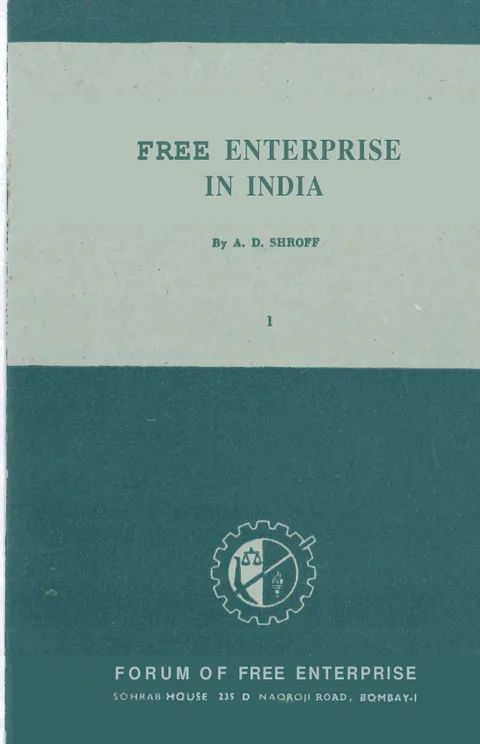
FREE ENTERPRISE IN INDIA
By A. D. Shroff
FORUM OF FREE ENTERPRISE, SOHRAB HOUSE 235 D NAOROJI ROAD, BOMBAY-1 · Bombay
8 pages
Summary
Free Enterprise in India is a short Forum of Free Enterprise pamphlet reproducing a 30 March 1956 Times of India article by A. D. Shroff. Writing in the immediate aftermath of the government’s declared intention to establish a ‘Socialist State’ — the political setting of the Second Five Year Plan and the Industrial Policy Resolution of 1956 — Shroff argues that the future role of the private sector can be assessed only in that context. He reads two corollaries into the declaration: the state will assume increasing control of the means of production, and resources available to the private sector will be gradually diverted to the public sector.
The argumentative core is an urgent call for the private sector to mount a countrywide educative campaign. Shroff contends that ‘thousands of thinking people’ have been demoralised by the policy and by harsh fiscal measures such as Section 23-A of the Indian Income-tax Act, with some businessmen seriously considering emigration. He insists that the ‘private sector’ is widely misrepresented: not a clutch of ‘tall poppies’ running large factories, but the totality of agriculture, small and cottage industries, and the whole range of wholesale and retail trade. He cites National Income Committee figures — small enterprises in 1950–51 producing roughly 1,910 crores of nett output against factory establishments’ 550 crores, employing 11.5 million workers against three million — to make the scale concrete.
The pamphlet then sketches a positive programme on the basis of a mixed economy. The state, Shroff argues, should confine itself for the next fifteen to twenty years to genuine prerequisites of orderly progress: a quick spread of education, essential health services, clearance of slums, roads, rail and river transport, postal and telegraph services, irrigation, modern agricultural methods, and credit and marketing facilities for the seventy per cent of Indians dependent on agriculture. He documents petty state failures — a Bombay General Post Office that will not accept more than 500 registered letters a day from one party, third-class railway passengers ‘packed like sardines’, the Calcutta air-office running short of luggage tickets, a Bihar telegraph office out of forms — as evidence that the state cannot meet its existing obligations, let alone subsume large-scale industry. He calls for a concrete development plan with clear demarcation between public and private spheres, urges the private sector to observe high standards of integrity and pay its taxes promptly, and asks government to give ‘concrete proofs’ of its preparedness to let the private sector serve the country.
The piece closes with a constitutional warning that has given it lasting force: in a country with one dominant political party and no effective organised opposition, the thin borderline between democracy and totalitarianism can soon be crossed, and unless public opinion becomes more vigilant Indians risk losing their most cherished possessions — the freedom to think and the freedom to criticise.
Key points
-
Frames the future of private enterprise entirely in terms of the government’s declared intention to establish a Socialist State, with consequent state control of production and a diversion of resources from private to public sector.
-
Identifies the most urgent need as organising a countrywide educative campaign to dispel mistaken public impressions of the private sector and its role.
-
Argues that Section 23-A of the Indian Income-tax Act has been cruelly applied, demoralising businessmen to the point where some seriously contemplate emigration before ‘the worse coming in future’ materialises.
-
Insists the private sector is not a few ‘tall poppies’ running large factories but encompasses all agriculture, large, small-scale and cottage industries, and the whole range of trade including import, export, wholesale and retail.
-
Cites National Income Committee figures: 1950–51 nett output of ‘Small Enterprises’ around 1,910 crores against 550 crores for ‘Factory Establishments’, employing 11.5 million workers against three million.
-
Reads the campaign of vilification around the nationalisation of life insurance as a deliberate sweeping condemnation of all private management, requiring counter-propaganda from organised business.
-
Sets out a mixed-economy programme in which the state confines itself for fifteen to twenty years to prerequisites of orderly progress — education, health, slum clearance, roads, rail and river transport, posts, telegraphs, irrigation, agricultural credit and marketing — rather than expanding into industry.
-
Documents state failures in elementary services (Bombay GPO refusing more than 500 registered letters per party per day; third-class rail passengers packed like sardines; Calcutta air-office short of luggage tickets; Bihar telegraph office short of forms) as evidence the state is not meeting its existing obligations.
-
Closes with a constitutional warning that one-party dominance with no effective opposition risks crossing the line from democracy into totalitarianism and erasing the freedom to think and to criticise.
Notable passages
"the private sector to mount a countrywide educative campaign"
"in a country with one dominant political party and no effective organised opposition, the thin borderline between democracy and totalitarianism can soon be crossed"
Metadata and summary are AI-extracted from the source PDF and reviewed for editorial accuracy. The original work is available via the Read PDF tab above (where present); paragraph-level citation inside the PDF is deferred to a future engagement.