essay
Free Enterprise and Freedom
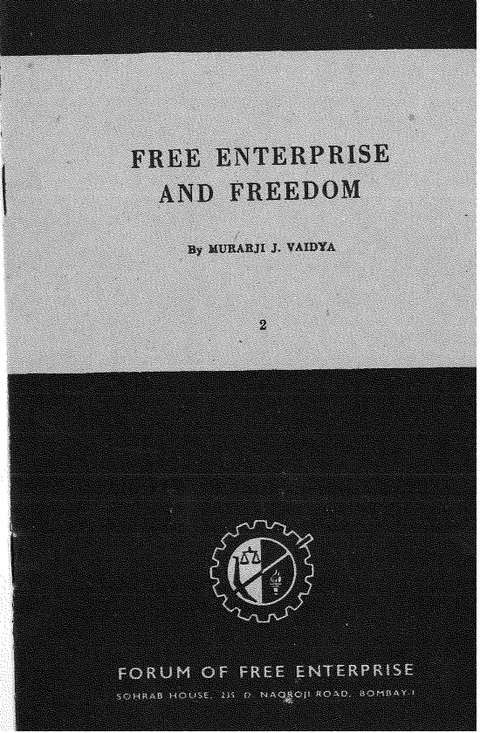
FORUM OF FREE ENTERPRISE, SOHRAB HOUSE, 235 D. NAOROJI ROAD, BOMBAY-1 · Bombay · 1956
6 pages
Summary
Free Enterprise and Freedom is a short polemical pamphlet (No. 2 in the Forum of Free Enterprise series) reproducing an article by Murarji J. Vaidya from The Times of India of 30 March 1956. Its subject is the draft outline of the Second Five-Year Plan and, more pointedly, the Planning Commission’s commitment to the “Socialist Pattern of Society” adopted at the Avadi session of the Congress. Vaidya quotes the Commission’s own framing at length to show how programmatically the planners have absorbed the Avadi resolution into the basic criterion for what counts as economically advanced.
The argumentative core is that simultaneously evolving democracy and a socialist pattern in an “underdeveloped economy working under an infant democracy” is historically unproven and dangerous. Vaidya invokes Eastern Europe, Russia and China to argue that socialism has elsewhere “sounded the death-knell of democracy and of individual liberty,” and turns the planners’ own anti-concentration logic against them: if human nature, integrity and selflessness are at a uniformly low level across businessmen, industrialists, politicians and civil servants, there is no reason to believe that concentrating economic power in the hands of a few politicians and bureaucrats will yield better results than the supposed concentration already deplored in a few capitalists.
From this, Vaidya draws a constitutional-liberal conclusion: a country that took decades to win political freedom should rank democracy, freedom and individual liberty above the pace of economic growth, and should prefer “the surer and historical proven processes of comparatively slow moving democracy” over the rapid methods witnessed in totalitarian countries. He further argues, on the planners’ own numbers, that the Second Plan’s industrial-sector targets are not of such higher magnitude than the First Plan as to require the institutional shift toward public ownership the draft proposes; the expansion of the public sector is, he says, “entirely dictated by the ideological determination based upon the Avadi resolution and not on considerations of the need for rapid rate of development.” The pamphlet closes with an OUTLAY table comparing First and Second Plan allocations across seven major heads totalling Rs. 4,800 crores; the table runs to the last rendered page and appears truncated mid-list.
Key points
-
Reproduction of a Times of India article (30 March 1956) by Murarji J. Vaidya, issued as Forum of Free Enterprise pamphlet No. 2; the topic is the draft outline of the Second Five-Year Plan and the place of the private sector within it.
-
Vaidya argues the Plan is conditioned by the Avadi-session “Socialist Pattern of Society” and that the Prime Minister and Congress leaders have already moved rhetorically from “Socialist Pattern” to plain “Socialist.”
-
He challenges the feasibility of pursuing democracy and a socialist pattern simultaneously in an “underdeveloped economy working under an infant democracy,” citing Eastern Europe, Russia (socialism abolishing democracy) and the still-unfolding Chinese experiment.
-
Central rhetorical move: if standards of integrity and selflessness are uniformly low across businessmen, industrialists, politicians and civil servants, replacing one concentration of economic power with another offers no guarantee of better outcomes.
-
Normative claim: a country that took decades to win political freedom should weigh democracy, freedom and individual liberty above the pace of economic development, preferring “comparatively slow moving democracy” to the rapid methods of totalitarian states.
-
Quantitative case: the Second Plan’s industrial-sector targets (apart from already-decided steel plants) are not of such magnitude beyond First Plan capacity as to require an institutional shift to public ownership; the shift is ideological, not developmental.
-
Pamphlet ends with an OUTLAY table comparing First Plan and Second Plan provisions across seven heads — agriculture, irrigation, power, industries, transport, social services and miscellaneous — on a total developmental outlay of Rs. 4,800 crores.
Notable passages
"simultaneously evolving democracy and a socialist pattern in an "underdeveloped economy working under an infant democracy" is historically unproven and dangerous"
"there is no reason to believe that concentrating economic power in the hands of a few politicians and bureaucrats will yield better results than the supposed concentration already deplored in a few capitalists"
Metadata and summary are AI-extracted from the source PDF and reviewed for editorial accuracy. The original work is available via the Read PDF tab above (where present); paragraph-level citation inside the PDF is deferred to a future engagement.