speech · memorial lecture
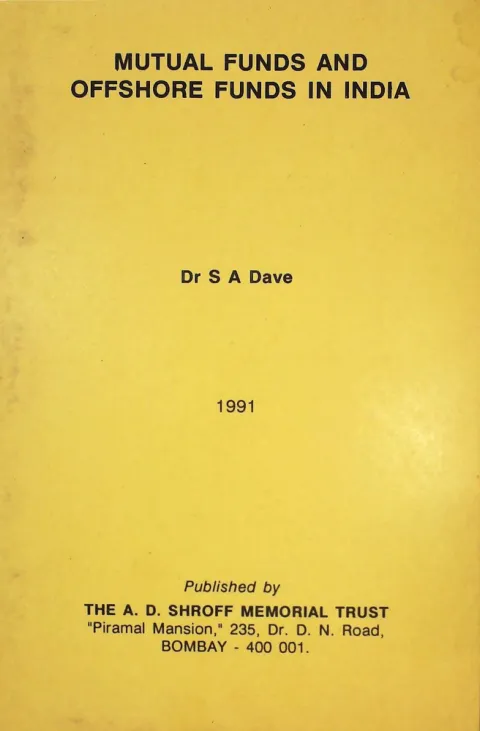
MUTUAL FUNDS AND OFFSHORE FUNDS IN INDIA
By Dr S A Dave
Published by THE A. D. SHROFF MEMORIAL TRUST, "Piramal Mansion," 235, Dr. D. N. Road, BOMBAY - 400 001. Published by M. R. Pai on behalf of The A. D. Shroff Memorial Trust, 235, Dr. Dadabhai Naoroji Road, Bombay 400 001, and Printed by S. V. Limaye at the India Printing Works, 42, G.D. Ambekar Road, Wadala, Bombay 400 031. · Bombay · 1991
33 pages
Summary
S. A. Dave’s 1991 A. D. Shroff Memorial Lecture opens with an unusually candid intellectual autobiography. As a student of economics in the 1950s, Dave was raised on Marx, Soviet planning and the Mahalanobis model, and saw free enterprise as the cause of India’s problems rather than the cure; only over time, watching the planning era fail to deliver, did he come to appreciate the courage it took A. D. Shroff to found the Forum of Free Enterprise in 1956. The lecture is framed as homage to Shroff and to the Unit Trust of India, whose ninety lakh unitholders Dave sees as the living test of an institution built entirely on individual trust.
The first half develops a theory of household saving — safety, liquidity and yield — and explains why mutual funds matter for the small saver who lacks the capital to buy a single growth-share trading lot of Rs. 25,000. Dave defends, as a peculiarly Indian innovation, the practice of declaring assured moderate returns at the launching of a scheme, arguing that this ‘unconventional practice’ is what drew household savings into the equity cult and that no Indian fund has yet failed its assurances. He traces UTI from Shri T. T. Krishnamachari’s 1963 pitch to Pandit Jawaharlal Nehru through the explosive growth of the eighties — annual sales from Rs. 19 crores in 1964-65 to Rs. 5,569 crores by 1989-90, investible funds crossing Rs. 17,650 crores — and recounts the high-growth experiment that drew over a million US-64 unitholders in a single year.
The second half turns to offshore funds, with UTI’s India Fund (London, 1986) and India Growth Fund (NYSE, 1988) as the country’s first portals to foreign portfolio capital. Dave pays tribute to international fund managers as ‘modern day Columbuses’ who discovered and ‘hardsold’ emerging markets to domestic professionals in the developed world who had never before parted with money across borders. He links the rise of country funds to the LDC debt crisis of 1982, the drying up of soft commercial loans, financial globalisation and an Asian growth wave running two to four times the world average; total capitalisation of emerging markets, he notes, grew from USD 81 billion in 1983 to USD 611 billion in 1990. The rendered pages close mid-argument on the ‘Prospects and Scope for Newer Funds’ — Dave’s prediction that Indian mutual funds will continue to grow through the nineties, particularly as nationalised banks, squeezed for deposits, move decisively into the mutual fund business.
Key points
-
Dave frames the lecture as an autobiographical conversion narrative: an economics student raised on Marx, Soviet planning and the Mahalanobis model who came, over time, to see free enterprise as the remedy rather than the cause of India’s problems.
-
He positions A. D. Shroff’s 1956 founding of the Forum of Free Enterprise as an act of unusual intellectual courage at the high tide of planning orthodoxy.
-
Mutual funds are defended as the only practical channel for small savers to enter the equity market when a single growth-share trading lot costs more than Rs. 25,000.
-
He acknowledges that Indian funds’ practice of declaring assured moderate returns at launch is unconventional and would be frowned on by regulators abroad, but credits it with mobilising household savings.
-
UTI’s lineage is traced from T. T. Krishnamachari’s letter to Nehru to Krishnamachari’s later piloting of the UTI Bill, with growth figures (Rs. 19 cr to Rs. 5,569 cr in annual sales; 1.3 lakh to 87 lakh unitholders) presented as vindication.
-
UTI’s US-64 high-growth experiment drew over one million unitholders and Rs. 190 crores in a single year — the largest single-year subscription to any Indian scheme — with strong uptake from economically backward states.
-
Offshore funds are framed through UTI’s India Fund (London 1986) and India Growth Fund (NYSE 1988); international fund managers are valorised as ‘modern day Columbuses’ of emerging markets.
-
Dave links the rise of country funds to the 1982 LDC debt crisis, the exhaustion of soft loans, financial globalisation, and the Asian growth wave that lifted emerging-market capitalisation from USD 81 bn (1983) to USD 611 bn (1990).
Metadata and summary are AI-extracted from the source PDF and reviewed for editorial accuracy. The original work is available via the Read PDF tab above (where present); paragraph-level citation inside the PDF is deferred to a future engagement.