speech · memorial lecture
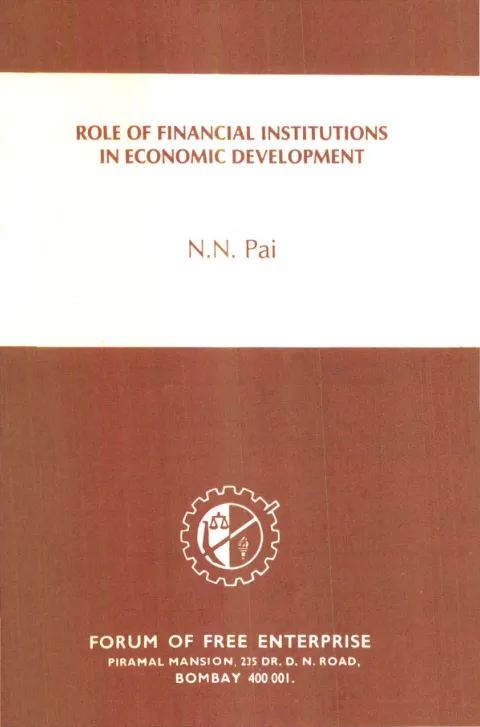
ROLE OF FINANCIAL INSTITUTIONS IN ECONOMIC DEVELOPMENT
By N. N. Pai
FORUM OF FREE ENTERPRISE, PIRAMAL MANSION, 235 DR. D. N. ROAD, BOMBAY 400 001. · Bombay · 1983
22 pages
ROLE OF FINANCIAL INSTITUTIONS IN ECONOMIC DEVELOPMENT
By N.N. Pai
Summary
N. N. Pai, then Chairman of the Industrial Development Bank of India, uses this Murarji J. Vaidya Memorial Lecture (delivered 18 January 1983, published as a Forum of Free Enterprise booklet) to survey India’s network of term-lending financial institutions and argue for the next stage of their evolution. He traces the institutional architecture that grew up alongside the Five Year Plans — the Industrial Finance Corporation of India (IFCI), the State Financial Corporations (SFCs), the Industrial Credit and Investment Corporation (ICICI), IDBI as the apex coordinating body, the Unit Trust of India (UTI), the State Industrial Development Corporations (SIDCs) and the Industrial Reconstruction Corporation (IRCI) — and credits this multiplicity with quickening industrial growth in regions and sectors that earlier capital markets had failed to reach.
The lecture’s quantitative backbone reports that aggregate term-finance sanctions rose from Rs. 254 crores in 1970-71 to Rs. 3,130 crores in 1981-82, with cumulative sanctions of Rs. 14,916.5 crores catalysing some Rs. 25,500 crores of investment and around 32 lakh new jobs. Against this performance Pai sets the Sixth Plan’s funding gap: he estimates that the private corporate sector will need to mobilise Rs. 7,000–8,000 crores from external sources, and that conventional government and bond-market support is constrained by budgetary pressures and a stretched Statutory Liquidity Ratio.
His prescriptions push the financial institutions toward a more market-oriented role: tap concessional foreign borrowings while debt-service ratios remain favourable, deepen the secondary market for non-convertible debentures through the LIC-UTI-GIC repurchase scheme, and use convertibility and pricing reforms to revive the primary equity market — without resorting to what entrepreneurs feared as ‘back-door nationalisation’. Roughly 41 per cent of cumulative assistance, he reports, has been routed to backward areas, and IDBI is now coordinating Technical Consultancy Organisations to seed industry in the 87 ‘No Industry Districts’. The lecture closes with a sober note on industrial sickness — an RBI study finding 52 per cent of sick units suffered from management, not financial, deficiencies — and warns against treating institutional finance as a panacea for badly run firms.
Key points
-
Frames financial institutions as ‘a fulcrum on which the process of economic growth rests heavily’, built up alongside the Five Year Plans as a deliberate break with the pre-Plan stagnation.
-
Maps the institutional ecosystem — IFCI, SFCs, ICICI, IDBI (apex, since 1964), UTI, SIDCs, IRCI — and credits multiplicity with reaching small/medium units and backward regions that earlier markets missed.
-
Reports aggregate term-finance sanctions rising from Rs. 254 crores (1970-71) to Rs. 3,130 crores (1981-82); cumulative sanctions of Rs. 14,916.5 crores have catalysed an estimated Rs. 25,500 crores of investment and around 32 lakh jobs.
-
Describes consortium-financing reforms — common appraisal, lead-institution model, single-disbursement window, participation certificates — that have largely eliminated entrepreneurs’ fears of dealing with multiple lenders.
-
Argues that with budget and SLR ceilings constraining domestic public funds, the institutions must lean more on foreign commercial borrowings (debt-service ratio is around 10 per cent) and on a deeper capital market for non-convertible debentures and equity.
-
Defends the 1980 convertibility guidelines (cap at 40 per cent of share capital, no convertibility under Rs. 1 crore) and explicitly denies that conversion is a ‘back-door nationalisation’ device — institutions will assume control only in mismanaged or defaulting units.
-
About 41 per cent (Rs. 5,553 crores) of cumulative assistance has gone to backward-area units; IDBI is using Technical Consultancy Organisations to identify viable projects in the 87 ‘No Industry Districts’.
-
Treats industrial sickness as principally a management problem — citing an RBI finding that 52 per cent of sick units fail on management — and resists the idea that finance alone can rescue badly run enterprises.
Generated by the v1.5 extraction pipeline. Awaiting editorial review.
Metadata and summary are AI-extracted from the source PDF and reviewed for editorial accuracy. The original work is available via the Read PDF tab above (where present); paragraph-level citation inside the PDF is deferred to a future engagement.