speech · memorial lecture
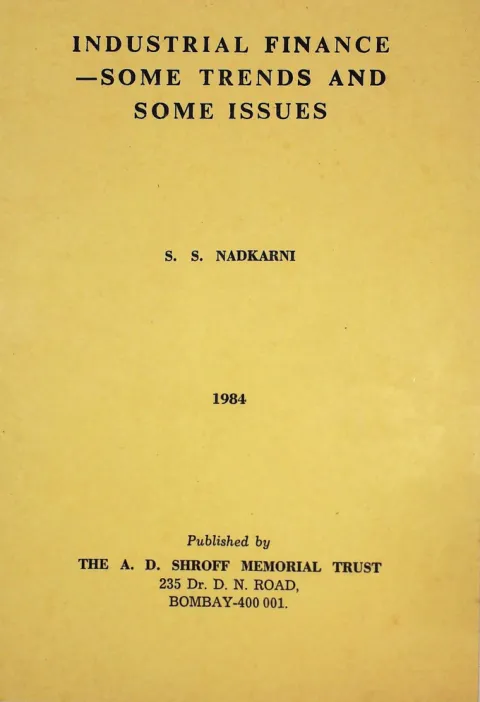
INDUSTRIAL FINANCE—SOME TRENDS AND SOME ISSUES
Published by THE A. D. SHROFF MEMORIAL TRUST, 235 Dr. D. N. Road, BOMBAY-400 001. Published by M. R. Pai on behalf of The A. D. Shroff Memorial Trust. 235, Dr. Dadabhai Naoroji Road, Bombay 400 001, and Printed by S. V. Limaye at the India Printing Works, 9, Nagindas Master Road, Fort, Bombay 400 023. · Bombay · 1984
29 pages
Part of A. D. Shroff Memorial Lecture
Summary
Delivered as the 1984 A. D. Shroff Memorial Trust public lecture by S. S. Nadkarni, then Chairman and Managing Director of ICICI, this address surveys the structure and direction of Indian industrial finance three and a half decades after independence. Nadkarni opens by setting aside transient controversies in order to identify abiding trends — quantitative and structural growth of the manufacturing sector, the expansion of the entrepreneurial base, dispersal into backward regions, and a Sixth Plan rebalancing in which public and private sector outlays in mining and manufacturing are projected at roughly equal levels. He stresses that the private sector remains the dominant source of value added (81% of factory output) and that the government has begun signalling room for private investment in fertilizers, communications and modernisation.
The core of the lecture analyses the financial system itself — financial institutions, the capital market, and commercial banks — under the long shadow of nationalisation (LIC 1956, banks 1969, general insurance 1973, IDBI Act 1975). Nadkarni concedes that pervasive government ownership is not about to recede, and shifts the question from ownership pattern to operating efficiency. He quotes Dr. I. G. Patel on the discipline that credit is not a gift or subsidy, and lays out a managerial agenda for the financial system: merit-based selection of top management, continuity in tenure, day-to-day operational freedom, commitment to operational surpluses, and reward structures tied to results.
On term finance, he describes the bewildering but defensible architecture of IDBI, ICICI, IFCI, LIC, GIC, UTI, State Financial and Development Corporations, IRCI and the new Export-Import Bank; sanctions rose from Rs. 343 crores in 1971–72 to Rs. 3,278 crores in 1982–83. He defends institutional shareholding (Rs. 627 crores face value at end-1982) against the popular misperception that it has been built through the convertibility clause — less than 10% has — and treats the 1971 convertibility regime as one whose recent liberalisation industry has failed to recognise. He flags worsening debt-equity and current-ratio trends in Indian corporates and argues that institutions must insist on healthier capital structures, even at the cost of underwriting equity that earns nothing in early years. He calls for taxation incentives to enliven the primary equity market, for venture-capital organisations with tax-free dividend and capital-gains status, and for coordination between banks (working capital) and institutions (fixed capital), an absence felt most acutely in sick-unit rehabilitation. The chunk ends inside the Capital Market section, noting that India’s roughly 2.75 million shareholders are fewer than those of a single U.S. company like AT&T.
Key points
-
Manufacturing sector invested capital roughly tripled from Rs. 10,000 crores (1970-71) to Rs. 30,000 crores (1979-80); non-traditional engineering and chemical industries grew at 8-14% annually against 1.2% for textiles (1951-1982).
-
Despite nationalisations and public-sector growth, the private sector owned 56% of factory capital and accounted for 81% of value of output and value added in 1978-79; the Sixth Plan projects roughly equal public-private outlays in mining and manufacturing.
-
Nadkarni accepts that pervasive government influence over banks, LIC, GIC, IDBI etc. is here to stay, and reframes the question from ownership to operational efficiency, quoting Dr. I. G. Patel that ‘credit is not a gift or a subsidy’.
-
He prescribes a managerial code for the financial system: merit-based top management, tenure continuity, operational freedom within policy, commitment to operating surpluses, and reward systems tied to results.
-
All-India financial institutions’ sanctions grew from Rs. 343 crores (1971-72) to Rs. 3,278 crores (1982-83); cumulative sanctions through March 1983 stood at Rs. 16,960 crores against disbursements of Rs. 12,203 crores.
-
Contrary to popular belief, less than 10% of institutional equity holdings (Rs. 627 crores face value at December 1982) was acquired through the convertibility option; recent liberalisation of the 1971 regime has removed most irritants.
-
Corporate debt-equity ratios are rising and current ratios deteriorating, an unhealthy trend coincident with rising interest rates; institutions should insist on healthier capital structures and, if necessary, underwrite larger equity.
-
He urges taxation incentives for the primary equity market, the creation of venture-capital organisations with tax-free dividend and capital-gains status, and a coordination mechanism between commercial banks and term-lending institutions, especially for sick-unit rehabilitation.
Metadata and summary are AI-extracted from the source PDF and reviewed for editorial accuracy. The original work is available via the Read PDF tab above (where present); paragraph-level citation inside the PDF is deferred to a future engagement.