speech · memorial lecture
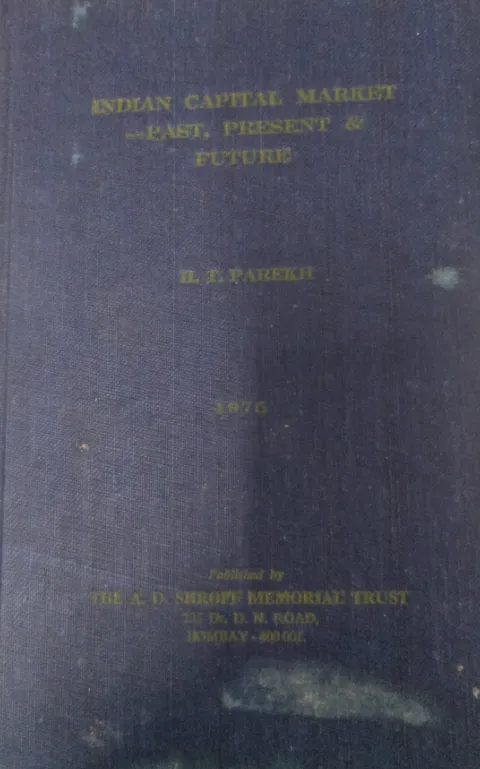
Indian Capital Market — Past, Present & Future
By H. T. Parekh
Published by THE A. D. SHROFF MEMORIAL TRUST, 235 Dr. D. N. ROAD, BOMBAY - 400 001. · Bombay · 1975
33 pages
Part of A. D. Shroff Memorial Lecture
Summary
H. T. Parekh’s 1975 A. D. Shroff Memorial Lecture surveys the Indian capital market in three movements — past (up to Independence), present (the quarter-century from 1947 to 1974), and future (the next quarter-century). The opening pages frame the address as a personal homage: Parekh, then chairman of the Industrial Credit and Investment Corporation of India, regards A. D. Shroff as his ‘Guru’ and credits him as the moving spirit behind ICICI itself. He pauses to honour the Forum of Free Enterprise as a continuing instrument of public economic education.
The historical narrative argues that India was unusually well prepared for a modern capital market. Hundies, bills of acceptance and the credit standing of nagarseths familiarised ordinary people with financial instruments long before joint-stock companies arrived; the Bombay Stock Exchange, formally constituted in 1875 as the ‘Native Share and Stock Brokers’ Association’, was the first stock exchange opened in Asia. Parekh sketches 1860–1947 through the textile mills of Bombay and Ahmedabad, Scottish-controlled jute and tea capital in Calcutta, the floatation of Tata hydro shares in 1920, and the watershed Tata Iron and Steel issue of 1911 — when Indian investors’ confidence in the Tata name rescued an issue that the London money market had refused. Through the war booms and slumps of 1936-37, 1939-40 and 1943-46, Tata Deferred became, in his words, the ‘king of the capital market’.
The ‘present’ section dates the qualitative break to the post-1947 institutionalisation of finance — IFCI in 1948, the SFCs in 1952-53, ICICI in 1955, UTI and IDBI in 1964 — and to the steady assertion of Government control over organised savings. Parekh observes that roughly 90 per cent of the investment of organised savings is now owned or controlled, directly or indirectly, by Government; that outstanding marketable Government loans have risen from about Rs. 2,000 crores in 1951 to about Rs. 7,500 crores; and that the nationalisations of life insurance (1955), the major banks (1969) and the Reserve Bank (1949), alongside the statutory finance corporations, have made the state the dominant force in long-term finance. He defends institutional finance as a ‘blessing to industry’ while worrying that easy institutional access has eroded the personal sense of obligation that earlier entrepreneurs such as Kirloskar and Seshasayee felt toward their financiers.
The rendered chunk closes mid-argument on the contemporary period, with Parekh praising the broadening of the investor base since the 1957-58 foreign exchange crisis, the upsurge of new issues across engineering, chemicals, fertilisers, petro-chemicals, automobiles and ball bearings, and the role of the Unit Trust of India under chairmen R. S. Bhatt and J. S. Raj in mobilising small savings. The ‘future’ section announced at the start of the lecture is not yet reached in these pages.
Key points
-
Lecture is the 1975 A. D. Shroff Memorial Trust annual address, delivered by H. T. Parekh, chairman of ICICI, on 10 June 1975 in Bombay.
-
Parekh structures his argument around three periods: the past (pre-1947), the present (1947-1974), and the future (the next 25 years).
-
He insists that Indians were already conversant with financial instruments — hundies, bills of acceptance, deposits with nagarseths — long before joint-stock companies appeared.
-
Bombay Stock Exchange (formally opened 1875 as the ‘Native Share and Stock Brokers’ Association’) was the first stock exchange in Asia; the Calcutta exchange dominated jute/tea/coal but the centre of financial gravity shifted to Bombay over the 20th century.
-
The 1911 Tata Iron and Steel issue is identified as the moment ‘the capital market, as an institution, had established itself in India’ — Indian investors absorbed an issue that the London market had rejected.
-
Post-1947 ‘qualitative change’: institutionalisation of finance (IFCI 1948, SFCs 1952-53, ICICI 1955, UTI and IDBI 1964) and predominance of Government control over organised finance.
-
Roughly 90 per cent of the investment of organised savings is now owned or controlled, directly or indirectly, by Government; outstanding marketable Government loans rose from c. Rs. 2,000 crores (1951) to c. Rs. 7,500 crores.
-
Parekh worries that easy institutional finance has weakened entrepreneurs’ personal sense of obligation that earlier figures like Kirloskar and Seshasayee felt toward their financiers.
Metadata and summary are AI-extracted from the source PDF and reviewed for editorial accuracy. The original work is available via the Read PDF tab above (where present); paragraph-level citation inside the PDF is deferred to a future engagement.