speech · memorial lecture
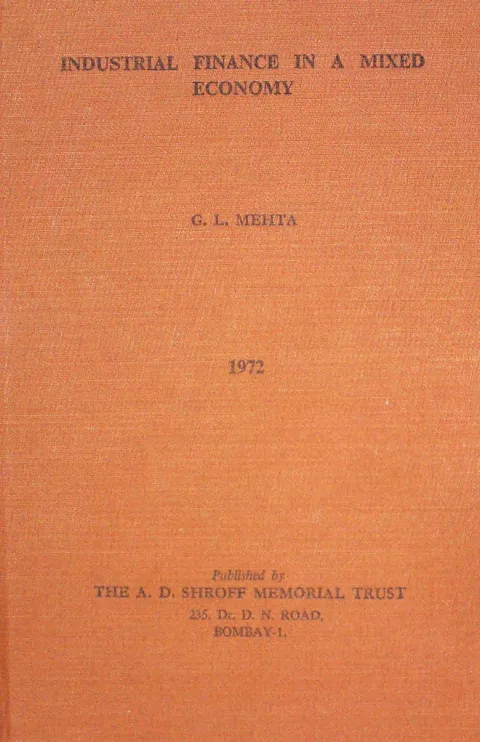
INDUSTRIAL FINANCE IN A MIXED ECONOMY
By G. L. Mehta
Published by THE A. D. SHROFF MEMORIAL TRUST, 235 Dr. D. N. Road, BOMBAY-1. · Bombay · 1972
28 pages
Part of A. D. Shroff Memorial Lecture
Summary
“Industrial Finance in a Mixed Economy” is the inaugural A. D. Shroff Memorial Address, delivered by G. L. Mehta in Bombay on 14 March 1972 and published the following month by the A. D. Shroff Memorial Trust under N. A. Palkhivala’s chairmanship. Mehta — then Special Adviser to ICICI and its former Chairman — opens with a personal tribute to Shroff, his contemporary at Elphinstone College and the London School of Economics, recalling Shroff’s role in the Bretton Woods delegation of 1944 (led by Sir Jeremy Raisman, with Chintaman Deshmukh and Shanmukham Chetty), the 1953 Reserve Bank enquiry into private-industry finance, the Bombay Plan and the founding Steering Committee of ICICI.
The substantive lecture takes the “mixed economy” as a settled Indian policy — reaffirmed in the Prime Minister’s election speeches the previous year — and asks how industrial finance must be organised within it. Mehta cites Twentieth Century Socialism to the effect that even a socialist economy needs a private sector because socialists value individual freedom, and then surveys the institutional architecture India has built since independence: the Industrial Development Bank of India (IDBI) at the apex, modelled on a Canadian precedent and constituted as a wholly owned subsidiary of the Reserve Bank; the IFCI and ICICI at the all-India level; State Finance Corporations and State Industrial Development Corporations at the state level, with SICOM as a Maharashtra pioneer in spreading industry beyond the Bombay–Poona belt; the NSIC and Reserve Bank guarantee schemes for small industry; and the Life Insurance Corporation and Unit Trust of India as institutional investors in the capital market.
Mehta concedes that the consequence of this expansion is that almost all sources of long-term industrial finance now lie with the Government or under Government control, yet he reads the system as workable rather than monolithic, because the diversity of Central and State-level institutions creates competing pulls that ‘wind up in a working and workable system.’ He defends the still-undefined “joint sector” as a via media for cooperation between Government, private enterprise and the public, naming Oil India, Indian Explosives and Gujarat State Fertilizer Corporation as successful joint ventures.
In the closing rendered pages, Mehta turns to medium-and-large industry — the “73 large houses” and those likely to join their ranks. He notes that Government ambivalence has slowed the most dynamic element of the economy in the preceding three or four years, even though monopoly-control legislation has shown that this sector cannot continue on its existing organisational pattern. His prescription is to diversify the ownership base through wider public participation in share capital and through convertibility of loans from finance institutions, so that growth can resume within the mixed-economy framework. He also concedes that, with current tax rates and ceilings on wealth, the main sources of finance must remain with the Government, since corporate and private savings alone cannot fund the industrial growth ahead. The rendered chunk ends at printed page 15 of a 28-page booklet; the lecture’s concluding pages were not seen.
Key points
-
Inaugural A. D. Shroff Memorial Address, delivered by G. L. Mehta on 14 March 1972 in Bombay and published by the A. D. Shroff Memorial Trust on 14 April 1972 with an introduction by N. A. Palkhivala.
-
Mehta accepts the “mixed economy” as settled Indian policy and cites Twentieth Century Socialism to argue that even socialist economies require a private sector because socialists value individual freedom.
-
Tribute to A. D. Shroff covers his role in the Bretton Woods delegation of 1944, the Reserve Bank’s 1953 enquiry into private-industry finance, the Bombay Plan, and the founding Steering Committee of ICICI; Mehta notes Shroff’s later turn into a strong critic of Government planning.
-
Survey of India’s industrial-finance architecture: IDBI at the apex (constituted as a wholly owned RBI subsidiary on the Canadian precedent), IFCI and ICICI at the all-India level, State Finance Corporations and SIDCs at state level, SICOM as Maharashtra’s regional pioneer, NSIC and RBI guarantee schemes for small industry, plus LIC and the Unit Trust of India as institutional investors.
-
Mehta concedes that almost all organisations mobilising or distributing finance are now Government-owned or Government-controlled, but argues that diversity of Central and State institutions creates competing pulls that produce a workable system rather than a monolith.
-
He defends the still-undefined “joint sector” as a via media for cooperation between Government, private enterprise and the public, citing Oil India, Indian Explosives and Gujarat State Fertilizer Corporation as successful joint ventures.
-
Government policy is ambivalent toward the medium-and-large sector — the so-called “73 large houses” — even though it has been the most dynamic element of the economy; the way out is diversification of ownership through wider public participation in share capital and convertibility of finance-institution loans into shares.
-
Given current tax rates and ceilings on wealth, Mehta accepts that the main sources of industrial finance must remain with the Government, since private and corporate savings cannot keep pace with the growth the economy needs.
Metadata and summary are AI-extracted from the source PDF and reviewed for editorial accuracy. The original work is available via the Read PDF tab above (where present); paragraph-level citation inside the PDF is deferred to a future engagement.