speech · memorial lecture
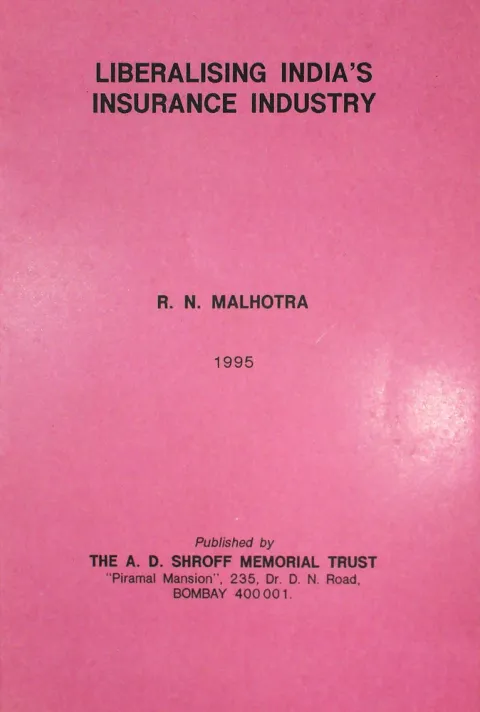
LIBERALISING INDIA'S INSURANCE INDUSTRY
Published by THE A. D. SHROFF MEMORIAL TRUST, "Piramal Mansion", 235, Dr. D. N. Road, BOMBAY 400 001. (Colophon, p.4: "Published by M. R. Pai on behalf of the A. D. Shroff Memorial Trust, 235, Dr. Dadabhai Naoroji Road, Bombay 400001, and Printed by S. V. Limaye at the India Printing Works, India Printing House, 42, G. D. Ambekar Marg, Wadala, Bombay 400031.") · Bombay · 1995
38 pages
Summary
Delivered as the 1995 Annual Public Lecture under the A. D. Shroff Memorial Trust, R. N. Malhotra — former Governor of the Reserve Bank of India and Chairman of the Government of India Committee on Reforms in the Insurance Sector — argues that India’s state-monopoly insurance industry must be opened to competition. He situates the case within the broader liberalisation programme begun in 1991: trade liberalisation, de-licensing, capital-market deepening, foreign-investment inflows, and reform of the banking and financial sectors have, in his telling, produced strong balance-of-payments, growth, and consumer-welfare gains without the dire consequences predicted by critics. Against that record he asks why insurance alone should be exempted from competition.
The lecture surveys the structure of the Life Insurance Corporation (245 firms nationalised in 1956) and the General Insurance Corporation with its four subsidiaries (107 non-life insurers nationalised in 1973), describing their sprawling networks but also a culture of complacency: poor customer responsiveness, high costs, over-staffing, restrictive staff practices, lapsation of life policies, and an atrophied regulatory function. Malhotra summarises his Committee’s diagnosis and its conclusion that competition would lift service quality, accelerate insurance penetration, and bring discipline that the public monopoly has lost.
To answer sceptics, the lecture works through concrete precedents inside India where monopolies have been opened up — mutual funds after 1987 and especially 1993 (UTI’s investible base actually grew even as new entrants captured market share), civil aviation (private carriers reduced waiting lists, raised standards, and even improved Indian Airlines’ own image), and telecommunications (bids of over Rs. 1,11,000 crore in licence fees revealed the scale of pent-up demand). Malhotra closes the rendered portion by refuting the “natural monopoly” and fiduciary-obligation defences of state ownership, noting that most insurance worldwide is run by the private sector and that fiduciary relationships are common to banks, mutual funds, and other intermediaries that operate competitively under regulatory oversight.
Key points
-
The lecture is the 1995 Annual Public Lecture of the A. D. Shroff Memorial Trust, delivered on 13 September 1995 by R. N. Malhotra (former RBI Governor and Chairman of the Government Committee on Reforms in the Insurance Sector).
-
Malhotra frames insurance reform as the logical next step of the 1991 liberalisation programme — pointing to gains in the external sector, capital markets, industry de-licensing, banking, and the financial sector as evidence that further reform carries low risk.
-
He details the size and reach of LIC (1906 branches, Rs. 49,400 crore life fund) and the four GIC subsidiaries (3151 branch offices, Rs. 4,427 crore net premium in 1993-94) while diagnosing complacency, high costs, over-staffing, and atrophied regulation.
-
The Government Committee on Reforms in the Insurance Sector (1993), which he chaired, consulted opinion leaders and commissioned a MARG survey before recommending that the sector be opened to private competition.
-
He cites the mutual funds story (UTI’s share fell to 80% but its absolute investible base grew massively as the industry expanded to Rs. 74,000 crore by 1995) to rebut fears that competition destroys incumbents.
-
Civil aviation and telecommunications are presented as further proof that private entry into former monopolies improves consumer welfare, employment, and even the public incumbent’s performance.
-
He rejects the claim that insurance is a “natural state monopoly” requiring state ownership for fiduciary trust, noting that most of world insurance is private and that fiduciary trust is sustained elsewhere by mutual trust and effective regulation.
-
The rendered chunk also reproduces the Trust’s objectives, a tribute to A. D. Shroff (1899-1965), and N. A. Palkhivala’s chairman’s introduction commending the lecture to policy-makers.
Metadata and summary are AI-extracted from the source PDF and reviewed for editorial accuracy. The original work is available via the Read PDF tab above (where present); paragraph-level citation inside the PDF is deferred to a future engagement.