
speech · memorial lecture
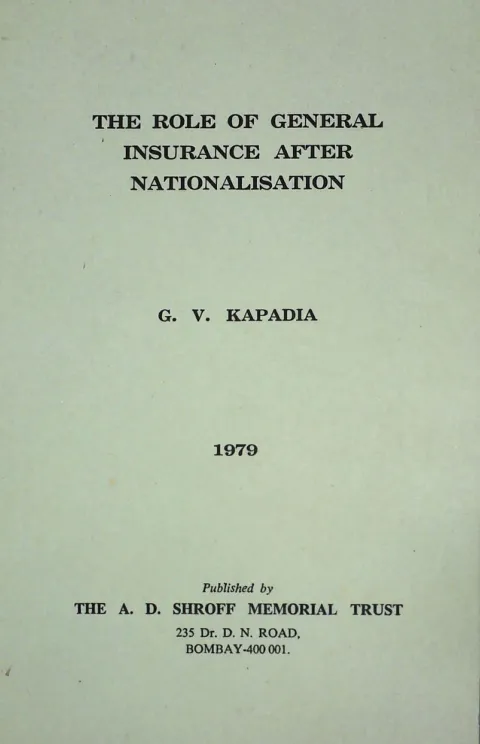
The Role of General Insurance After Nationalisation
Published by M. R. Pai on behalf of The A. D. Shroff Memorial Trust, 235, Dr. Dadabhai Naoroji Road, Bombay 400 001, and Printed by B. D. Nadirshaw at The Bombay Chronicle Press, Horniman Circle, Bombay 400 001. · Bombay · 1979
31 pages
Part of A. D. Shroff Memorial Lecture
Summary
Delivered as the A. D. Shroff Memorial Trust’s annual public lecture in Bombay on 14 February 1979 and published the same year, G. V. Kapadia’s address provides an authoritative insider’s account of general insurance in India seven years after nationalisation. Kapadia, then Chairman of the General Insurance Corporation of India (GIC), opens with an extended tribute to A. D. Shroff’s role in building New India Assurance Co. from 1946 until his death in 1965 — growing its share of new life insurance from 9.5 per cent (1950) to 19.1 per cent (1955), and of general insurance premium income from 7 per cent (1955) to 17 per cent (1971). He also credits Shroff with founding the India Reinsurance Corporation in 1956 and, through the Shroff Committee (1953), providing the intellectual foundations for ICICI, IDBI and UTI.
Kapadia then surveys the industry’s post-nationalisation performance with considerable candour. The Government took over 107 companies and merged them into four competing subsidiaries — National Insurance, New India, Oriental, and United India — under the GIC holding company. Premium income grew from Rs. 147.5 crores in 1971 to over Rs. 340 crores in 1978, a growth of 130 per cent, achieved without increases in premium rates despite rising claims and costs. The GIC paid dividends of 25 per cent on equity capital to the Government for 1976 and 1977, up from 12 per cent in 1974. Total investible funds reached over Rs. 615 crores by end-1977, deployed across government securities (31 per cent), corporate debentures and shares (32 per cent), bank deposits (31 per cent), and housing loans (6 per cent).
The lecture’s more forward-looking sections address the two major unmet challenges: rural penetration and risk management culture. India’s per capita general insurance premium stands at Rs. 5.2, against Rs. 2,600 in the USA and Rs. 800 in the UK; general insurance premiums represent just 0.4 per cent of GNP versus 4.6 per cent in the USA. Kapadia argues that the rural sector — which contributes half of national income and supports three-quarters of the population — has been almost entirely overlooked. Cattle insurance, Janata Personal Accident policies (1.7 million sold in nine months in 1976, though renewal proved difficult), agricultural pumpset insurance and a new crop insurance scheme requiring state government co-participation are described as early forays. He closes by outlining a four-part model of professional service: risk management advice, accurate documentation, loss prevention, and prompt claims settlement.
Key points
-
General insurance premium income grew from Rs. 147.5 crores (1971) to over Rs. 340 crores (1978), a 130 per cent increase achieved without any increase in premium rates despite rising claims costs.
-
The GIC paid dividends of 25 per cent on equity capital to the Government for 1976 and 1977 (up from 12 per cent in 1974), and the gross profit before tax of the four subsidiary companies was approximately Rs. 106 crores in 1977.
-
India’s per capita general insurance premium of Rs. 5.2 compared with Rs. 2,600 in the USA, Rs. 800 in the UK and Rs. 540 in Japan; general insurance premiums were 0.4 per cent of GNP against 4.6 per cent in the USA, indicating enormous unrealised potential.
-
107 pre-nationalisation insurers were merged into four competing subsidiaries (National Insurance, New India, Oriental, United India) under the GIC holding company, creating a network of over 870 branch and divisional offices and a workforce exceeding 31,200.
-
The GIC pioneered loss prevention infrastructure, including the Loss Prevention Association of India (January 1978) and Cargo Loss Minimisation Cells in Bombay, Calcutta and Madras; between August 1977 and October 1978, Bombay’s cell supervised 2,000 consignments and traced 11,180 missing packages.
-
A scheme to screen tramp vessel operators lifting cargo from Bombay port — 234 vessels approved between August 1977 and October 1978 with no subsequent cargo problems — was introduced without legal authority, using premium surcharges as the only lever.
-
Total investible funds of the GIC and subsidiaries exceeded Rs. 615 crores at end-1977; investment policy was reoriented post-nationalisation toward government securities, housing loans and industrial equity, with growing emphasis on mortgage insurance and secondary mortgage markets.
-
Rural penetration remained the central unfinished task: cattle insurance covered over one million heads in 1978, Janata Personal Accident policies sold 1.7 million in nine months of 1976 but lapsed at renewal, and a crop insurance scheme requiring state co-participation was under development.
Metadata and summary are AI-extracted from the source PDF and reviewed for editorial accuracy. The original work is available via the Read PDF tab above (where present); paragraph-level citation inside the PDF is deferred to a future engagement.
People in this work
Related across the archive
 Primary workNew Horizons in the General Insurance Industry
 Primary workNATIONALISED INSURANCE
 Primary workLIBERALISING INDIA'S INSURANCE INDUSTRY
 ThePrintBank nationalisation will be a blow to India’s mixed economy, lead to totalitarianism: Phiroze Shroff
 ExcerptEconomic Reforms In India: Where Are We And Where Do We Go?