
speech · memorial lecture
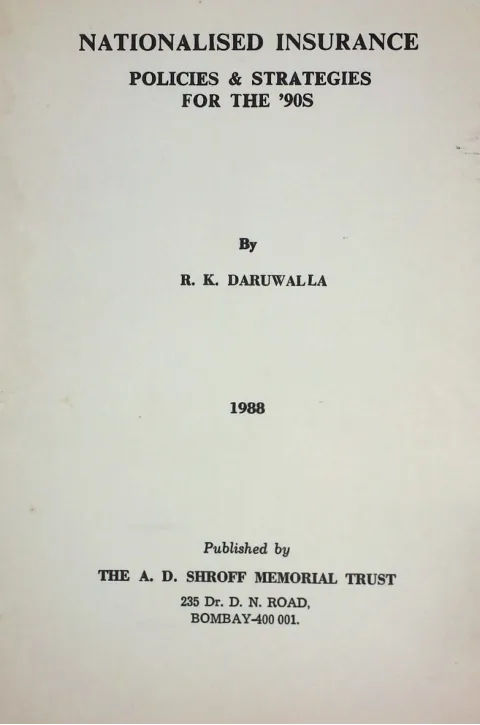
NATIONALISED INSURANCE
POLICIES & STRATEGIES FOR THE '90S
Published by THE A. D. SHROFF MEMORIAL TRUST, 235 Dr. D. N. ROAD, BOMBAY-400 001. · Bombay · 1988
49 pages
Part of A. D. Shroff Memorial Lecture
Summary
Delivered on 28 April 1988 as the annual A. D. Shroff Memorial Trust lecture and published as a booklet by the Trust two months later, R. K. Daruwalla — a former Chairman of the General Insurance Corporation of India who had spent over forty-five years in the insurance industry — uses the platform to argue that the nationalised insurance industry, having matured since the takeovers of 1956 (life) and 1971/72 (general), now needs a structural rethink before the 1990s. His framing is striking for an insider: rather than relitigate the merits of nationalisation, he treats consolidation as its single most significant gain, then turns to why the existing GIC structure — four subsidiaries each writing every class of business — is no longer fit for the decade ahead.
The rendered pages cover the booklet’s front matter (Trust trustees, Palkhivala’s introduction, the biographical tribute to A. D. Shroff) and the first half of the lecture proper, focusing on general insurance. Daruwalla sets out the scale of the industry — gross direct premium of Rs. 184 crores in 1973 rising to roughly Rs. 1,535 crores by 1987, with profits before tax of Rs. 318 crores, 60,000 employees and nearly 3,000 offices — and projects that premiums could approach Rs. 4,000 crores by the mid-1990s. Against that backdrop he segments the clientele into commercial/industrial, trading and small business, urban personal lines, rural and agricultural, and government, and contends that each segment requires its own organisational vehicle.
The core policy recommendation in the rendered pages is to carve specialised companies out of the GIC umbrella: four subsidiaries dedicated to rural and agricultural business (each with a defined territory, drawing on the Vayudoot precedent of a feeder-airline spin-off from Indian Airlines), and a new urban personal-lines company operating from branch offices in residential areas through full-time commission agents rather than salaried development staff. He argues that small-premium personal business, mass rural covers, and high-technology industrial risks each demand different expertise, marketing models and cost structures, and that lumping them together strains the existing companies and dilutes technical depth. The chunk closes by opening the question of whether the GIC itself should absorb specialised classes such as marine hull, off-shore oil, satellite and nuclear risks, and by surveying how the industry has already responded to the Bhopal disaster, terrorist-damage cover, product liability for Indian exporters, and the demand for simpler ‘All Risks’ policies on the Western model.
Key points
-
Daruwalla, writing as a former GIC Chairman, treats the question of nationalisation itself as settled and instead focuses on restructuring the four-subsidiary model the GIC inherited in 1973.
-
He names consolidation of business and people as the single greatest gain of nationalisation — it gave the industry favourable reinsurance terms abroad and the capacity to retain large risks domestically.
-
Industry scale figures: gross direct premium of Rs. 184 crores (1973) to Rs. 1,535 crores (1987); investment income Rs. 20 crores to Rs. 289 crores; profits before tax Rs. 35 crores to Rs. 318 crores; ~60,000 employees and ~3,000 offices.
-
He projects gross direct premium of roughly Rs. 4,000 crores by the mid-1990s, driven by industrial growth, exports, mass rural covers and rising urban personal-insurance awareness.
-
He segments the market into five clienteles — commercial/industrial, trading and small business, urban personal lines, rural and agricultural, and government — and argues each needs its own organisational structure.
-
Specific proposal: four new GIC subsidiaries each with a defined territory to handle rural and agricultural business, on the Vayudoot precedent, capitalised so that investment income offsets any underwriting losses.
-
Specific proposal: a new dedicated urban personal-lines company operating from residential-area branch offices through full-time commission agents, starting in metro cities, to compete alongside (not replace) the existing four companies.
-
He flags Bhopal, the DCM judgment, export-driven product liability, terrorist-damage cover and the appeal of Western-style ‘All Risks’ policies as evidence that the industry must move toward simpler, more flexible, consumer-responsive cover wordings.
Metadata and summary are AI-extracted from the source PDF and reviewed for editorial accuracy. The original work is available via the Read PDF tab above (where present); paragraph-level citation inside the PDF is deferred to a future engagement.
People in this work
Related across the archive
 Primary workNew Horizons in the General Insurance Industry
 Primary workThe Role of General Insurance After Nationalisation
 Primary workGENERAL INSURANCE AS A FINANCIAL SERVICE IN THE CONTEXT OF LIBERALISATION
 ExcerptEconomic Reforms In India: Where Are We And Where Do We Go?
 ExcerptThe Budget Versus The People