speech · memorial lecture
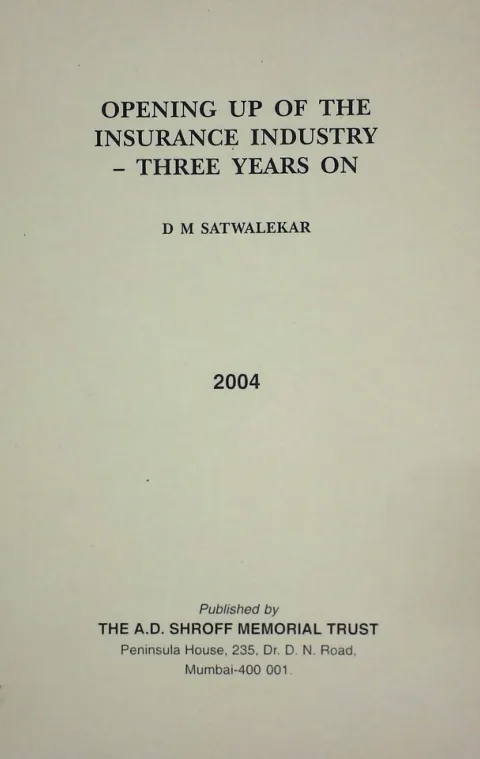
OPENING UP OF THE INSURANCE INDUSTRY – THREE YEARS ON
Published by THE A.D. SHROFF MEMORIAL TRUST, Peninsula House, 235, Dr. D. N. Road, Mumbai-400 001. · Mumbai · 2004
29 pages
Part of A. D. Shroff Memorial Lecture
OPENING UP OF THE INSURANCE INDUSTRY – THREE YEARS ON
By D M SATWALEKAR
Summary
Delivered on 10 February 2004 as the A. D. Shroff Memorial Trust’s annual public lecture in Mumbai, Deepak M. Satwalekar’s address takes stock of the Indian life insurance industry three years after it was opened to private participation by the IRDA Bill of December 1999. Speaking as Managing Director and CEO of HDFC Standard Life Insurance Co. Ltd., Satwalekar frames liberalisation as a continuation of the spirit of A. D. Shroff and the Forum of Free Enterprise, insisting that ‘competition is not — and has never been — a zero sum game’ and that private entry has, in three years, captured 12.78% of new life business while mobilising Rs. 1,666.3 crores in premium income.
The central section reports three positive developments since liberalisation: product innovation (unbundled riders, unit-linked plans), the evolution of distribution channels (bancassurance, brokers, the internet alongside the traditional tied-agency model), and a stronger emphasis on consumer awareness underwritten by a partnership between insurers and a media-active regulator. He credits the IRDA with building a ‘truly world class’ regulatory framework but argues the next phase must be one of stringent enforcement rather than additional rule-making that strangulates compliant players. Throughout, he insists that earlier nationalisation in 1956 was driven by short-cuts and unethical practices that today’s private insurers must consciously shun if they are to retain consumer confidence.
Looking ahead, Satwalekar lays out a five-part agenda for policy makers: convergence and consistency of regulation across a blurring financial-services landscape; consolidation of the Insurance Act 1938, the IRDA Act 1999, the LIC Act 1956, the General Insurance Business Nationalisation Act 1971 and several adjacent statutes into a single flexible principal legislation; sharper risk-management tools (including a Mortality and Morbidity Investigation Bureau being set up with the Actuarial Society of India) as Indian insurers gain exposure to overseas markets and cross-country risk; serious commercial engagement with the rural market, which he argues is a profitable but segmented opportunity rather than a regulatory obligation, drawing the ‘sachet’ analogy from FMCG; and urgent pension reform to address the gap between non-contributory defined-benefit government schemes and the defined-contribution reality faced by most Indians as life expectancy rises towards 80 by 2020.
The booklet opens with a brief profile of A. D. Shroff and an introduction by M. R. Shroff dated 2 April 2004, and closes with statistical annexures, one of which (on Employees’ Provident Fund coverage and contributions as of March 2003) falls within the rendered pages. The lecture itself reads as a practitioner’s brief for measured, enforcement-led liberalisation and consumer-centric reform, written from inside one of the new private players that the 1999 opening made possible.
Key points
-
Frames the 1999 IRDA Bill as the long-delayed liberalisation of a sector that had been untouched while the rest of the Indian economy opened up; the Malhotra Committee reported in 1994 but reform took five years to enact.
-
Reports that private life insurers captured 12.78% of new business and Rs. 1,666.3 crores in premium income within three years, treating this share as a ‘vote of confidence from customers’.
-
Identifies three positive post-liberalisation developments: product innovation (unbundled riders, unit-linked plans), new distribution channels (bancassurance, brokers, internet alongside tied agency), and stronger consumer awareness via insurer-regulator-consumer partnership.
-
Praises the IRDA for a ‘truly world class’ framework but argues the next priority is stringent enforcement against violators rather than fresh regulations that ‘strangulate’ compliant players.
-
Calls for consolidating the Insurance Act 1938, IRDA Act 1999, LIC Act 1956, General Insurance Business Nationalisation Act 1971, Marine Insurance Act 1965, Insurance Rules 1939 and Ombudsman Rules 1998 into a single flexible principal legislation, with detail moved to subordinate regulation.
-
Argues rural insurance is ‘a myth’ as an unprofitable segment — rural India is heterogeneous, more than half of rural GDP is non-agricultural, and the FMCG ‘sachet’ model shows commercial-only design works better than regulatory compulsion.
-
Frames pension reform as urgent given rising life expectancy (projected 80 years by 2020), the limits of defined-contribution PPF/annuity arrangements, and the need for a level playing field across pension providers.
-
Recurring ethical argument: nationalisation in 1956 came after short-cuts and unethical practices; private insurers must adopt strong business ethics to avoid a repeat and to earn customer goodwill.
Generated by the v1.5 extraction pipeline. Awaiting editorial review.
Metadata and summary are AI-extracted from the source PDF and reviewed for editorial accuracy. The original work is available via the Read PDF tab above (where present); paragraph-level citation inside the PDF is deferred to a future engagement.