speech · memorial lecture
GENERAL INSURANCE AS A FINANCIAL SERVICE IN THE CONTEXT OF LIBERALISATION
Published by THE A. D. SHROFF MEMORIAL TRUST, "Piramal Mansion", 235, Dr. D. N. Road, BOMBAY - 400 001. Colophon (p. 4): "Published by M. R. Pai on behalf of the A. D. Shroff Memorial Trust, 235, Dr. Dadabhai Naoroji Road, Bombay 400001, and Printed by S. V. Limaye at the India Printing Works, 42, G. D. Ambekar Marg, Wadala, Bombay 400031." · Bombay · 1992
50 pages
Part of A. D. Shroff Memorial Lecture
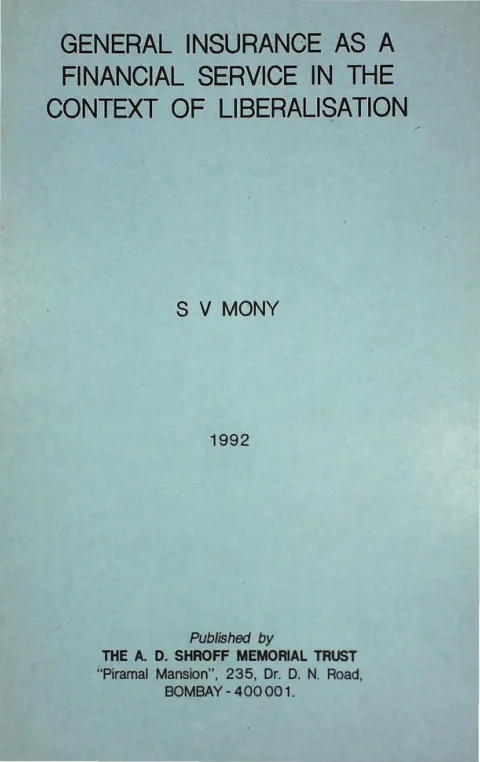
GENERAL INSURANCE AS A FINANCIAL SERVICE IN THE CONTEXT OF LIBERALISATION
By S V MONY
Summary
Delivered as the A. D. Shroff Memorial Trust’s 1992 annual lecture on insurance, S. V. Mony — then Chairman of the General Insurance Corporation of India — uses the moment of India’s 1991 structural adjustment to argue that liberalisation is the right direction for the country’s financial services, but that financial-sector liberalisation must not be confused with deregulation. In the rendered pages he situates the reform turn against the planned-development model, citing the Finance Minister’s 1992-93 budget speech and the Statement of Industrial Policy of 24th July 1991 to acknowledge that the public sector’s ‘commanding heights’ role has produced poor productivity, overmanning and a low return on capital, making some public enterprises ‘a burden rather than an asset to the government.’
Mony then builds the conceptual frame for the rest of the lecture: services as a catalyst of socio-economic development, the rapid rise of services to 41% of India’s GDP, and financial services — banking, insurance, leasing, securities, asset management — as the connective tissue of a modern economy. He defends general insurance specifically as a ‘financial service’ on two grounds: it closes the production-cycle breach caused by fire, flood or breakdown, and the float between premium and claim makes insurers among the largest institutional investors in any economy.
The regulatory portion of the rendered text insists that opening up cross-border insurance and reinsurance trade actually requires stricter, not looser, supervision — citing the Uruguay Round talks, the U.S. Financial Services Group’s position statement, and the watchdog functions (solvency, fair trade, probity, domestic-market strengthening) that supervisory authorities must perform. Mony surveys global insurance-market structure (state monopolies in many developing countries, concentration of reinsurance in six countries) before turning to India, where his historical sketch is unsparing about the pre-1973 private market — ‘reckless competition in rates and terms, fictitious appointments… lack of safeguards in investments, excessive reinsurance abroad’ — while crediting a handful of enlightened firms, notably the ‘New India’ under A. D. Shroff’s chairmanship, with building the discipline that survived nationalisation.
The rendered pages end with the social objectives the nationalised industry was directed to pursue under the Five Year Plans — rural cover, crop insurance, social-security-linked products, balanced regional reach, channelling investible funds to socially oriented sectors — and open a section on the post-1972 performance of the four GIC subsidiaries, which continues past the chunk.
Key points
-
Frames the 1991-92 reforms as a structural adjustment that began with a balance-of-payments crisis, double-digit inflation, and the Finance Minister’s stated need to ‘arrest the slide and restore India’s credibility’ both at home and abroad.
-
Argues that public-sector enterprises, after the ‘initial exuberance’ of entering new industrial and technical areas, now show poor productivity, overmanning, weak project management and inadequate R&D — and a very low rate of return on invested capital.
-
Distinguishes liberalisation in goods from liberalisation in services: in financial services, opening domestic and international competition demands stricter regulation, not deregulation.
-
Positions services (41% of Indian GDP by the late seventies) as the country’s largest sectoral contributor to GDP, with general insurance acting as a financial service through risk transfer, production-cycle restoration, and institutional investment.
-
Surveys global insurance structure: state monopolies dominate many developing-country markets; the U.S. alone accounted for 46% of world non-life and 30% of life premiums in 1987; six countries concentrate the bulk of world reinsurance premium.
-
Reviews the pre-1973 Indian private insurance market as plagued by reckless rate-cutting, fictitious appointments, weak investment safeguards, and inadequate capitalisation — with a small group of ‘enlightened companies’ such as ‘New India’ under A. D. Shroff as honourable exceptions.
-
Lays out the five social objectives the nationalised general-insurance industry was directed to pursue under the Five Year Plans: rural cover, crop insurance, social-security-linked products, balanced regional marketing, and channelling investible funds to socially oriented sectors.
Generated by the v1.5 extraction pipeline. Awaiting editorial review.
Metadata and summary are AI-extracted from the source PDF and reviewed for editorial accuracy. The original work is available via the Read PDF tab above (where present); paragraph-level citation inside the PDF is deferred to a future engagement.