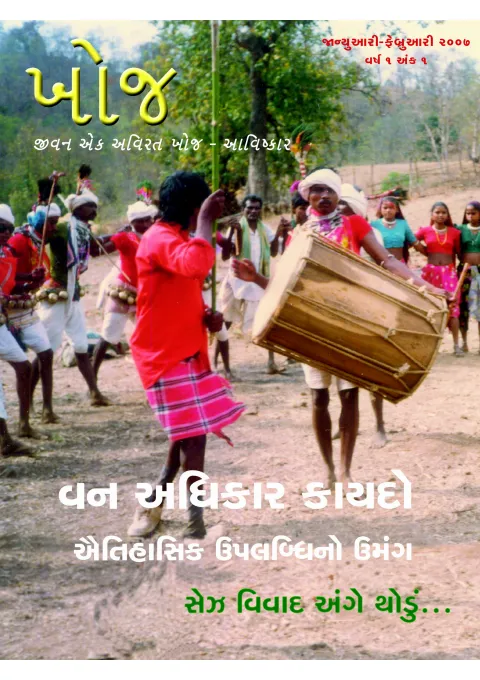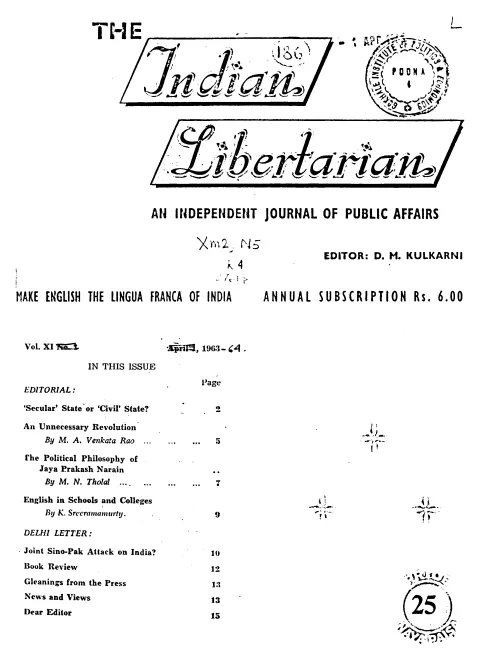
periodical issue
ખોજ
જીવન એક અવિરત ખોજ
ખોજ — જીવન એક અવિરત ખોજ
Khoj — Jivan Ek Avirat Khoj
By Rajesh Mishra, Ashwin Karia, Ismail Gandhi, Ambrish Mehta, Mukesh Adenwala, Ela Bhatt, Trupti Parekh
ખોજ — જીવન એક અવિરત ખોજ · Vadodara, Gujarat · 2009
68 pages
Summary
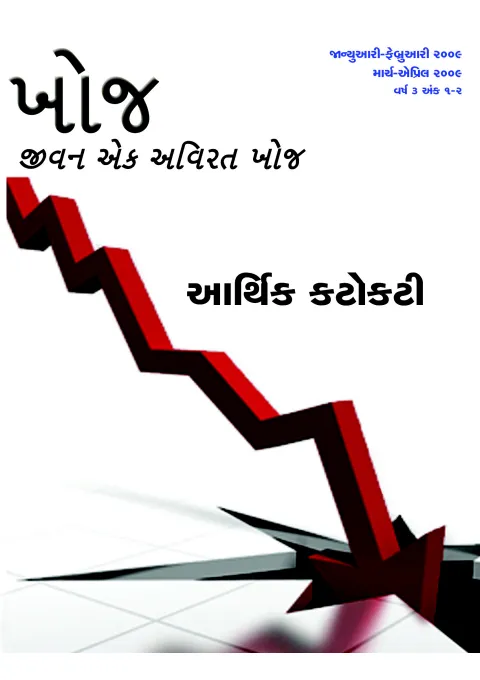
Khoj (ખોજ — જીવન એક અવિરત ખોજ), a Gujarati-language periodical published from Vadodara, presents this combined double issue (January–April 2009, Year 3, Issues 1–2) under the thematic banner ‘આર્થિક કટોકટી’ (Economic Crisis). In the rendered pages, the issue opens with an editorial by Ambrish Mehta that frames the 2008–09 global financial crisis as an occasion to revisit foundational questions about markets and state regulation, and previews contributions from economist John Taylor (via a Peter Robinson interview), Mukesh Adenwala, and Ela R. Bhatt. The letters section brings a polyphonic range of reader voices on communalism, Muslim identity, and the role of the periodical itself — including a 1942 Gujarati poem ‘The Prayer of Youth’ by Nathalal Dave of Bhavnagar. The five substantive articles visible in the rendered pages cover: a Hepatitis B outbreak in Modasa traced to unqualified practitioners (Rajesh Mishra); tribal women’s resistance to liquor in south Gujarat (Varsha Chaudhary); a critique of ‘moral policing’ in contemporary India referencing Gandhi, Nehru, and Tagore (Ashvinkumar Karia); a translated analysis of Taliban rule and human rights erosion in Pakistan’s Swat Valley (Murtaza Razvi, translated from Dawn by Trupti Parekh); an appeal for Hindu-Muslim communal harmony in the wake of Deoband fatwas (Ismail Gandhi); and a substantive essay on the state of the sadabhavana (goodwill) movement in Gujarat seven years after the 2002 riots (Rajesh Mishra). The thematic centre of gravity in the rendered pages lies at the intersection of civil society, communalism-secularism, and public health — with the economic-crisis frame announced on the cover and in the editorial but not yet developed in the articles falling within the first twenty pages.
Key points
-
Ambrish Mehta’s editorial frames the 2008-09 global financial crisis as an occasion to revisit foundational questions about markets and state regulation, citing economist John Taylor’s view that government intervention and regulatory failure were primary causes.
-
The editorial previews upcoming contributions on the crisis from John Taylor, via a Peter Robinson interview, Mukesh Adenwala, and Ela R. Bhatt, whose piece addresses poverty.
-
A 1942 Gujarati poem, “The Prayer of Youth” by Nathalal Dave of Bhavnagar, is reprinted in the letters section, addressing freedom of conscience and resistance to tyranny.
-
Reader Hakim Rangwala’s letter from Bhavnagar advocates Hindu-Muslim goodwill and calls on Muslim institutions to speak out clearly against terrorism following the November 2008 Mumbai attacks.
-
Rajesh Mishra’s investigative article documents a Hepatitis B outbreak in Modasa caused by unsafe injections from unqualified Rural Medical Practitioner doctors, citing IANS reports and virologist Dr. Vidya Acharkar.
-
Varsha Chaudhary’s article examines tribal women’s resistance to liquor in south Gujarat, one of five substantive articles anchoring the issue’s civil society and public health themes.
-
Ashvinkumar Karia’s essay offers a critique of “moral policing” in contemporary India, drawing on the legacies of Gandhi, Nehru, and Tagore to ground its argument historically.
-
Murtaza Razvi’s essay, translated from Dawn by Trupti Parekh, analyses Taliban rule and the erosion of human rights in Pakistan’s Swat Valley.
-
In a second essay, Mishra assesses the state of Gujarat’s sadabhavana, or goodwill, movement seven years after the 2002 communal riots.
Essays
સંપાદકીય
The editorial by Ambrish Mehta, written as the global financial crisis broke, situates the 2008–09 meltdown in the context of the perennial debate between ‘bazaar’ (market) and ‘sarkar’ (state). In the rendered pages the editor argues that most commentary reflexively blames free markets, but contends that a factual, evidence-based inquiry is needed. He cites economist John Taylor as having investigated the crisis systematically and concluded that excessive government intervention and regulatory failure — not unregulated markets — were among the primary causes. The editorial previews the issue’s multi-author approach to the crisis: Peter Robinson’s translated interview with John Taylor (from Hoover Institution), Mukesh Adenwala’s English article, and Ela R. Bhatt’s piece on poverty.
- Frames the 2008–09 crisis as reopening foundational questions about the respective roles of market and state in economic life.
- Argues against ideological reflex and for evidence-based analysis — citing John Taylor’s finding that government intervention, not free markets, was a primary cause.
- Previews contributions from Peter Robinson (John Taylor interview), Mukesh Adenwala (English essay on the crisis), and Ela R. Bhatt (poverty).
- Notes that the crisis slowed growth in India, China, and other emerging economies as well as the West.
- Establishes the issue’s central theme: understanding what actually happened and why, not scoring ideological points.
પત્રો
The letters section (pages 5–8) carries responses from multiple readers across Gujarat. In the rendered pages, letters engage with the previous issue’s articles on Islam and communal peace, criticise or praise the periodical’s editorial direction, and address the aftermath of the November 2008 Mumbai attacks. A standout contribution is a 1942 poem ‘The Prayer of Youth’ by Nathalal Dave of Bhavnagar — a verse about freedom of conscience and resistance to tyranny, reprinted in the Khoj letters column. Long letters from Hakim Rangwala (Bhavnagar) and others engage with Hindu-Muslim relations, the role of Muslim institutions in condemning terrorism, and the nature of secularism. Reader Surbhakant Parikh (Ahmedabad) makes a case for Khoj to expand its civic reach across Gujarat. The section is editorially interleaved with a subscription notice and subscription pricing information.
- Letters span communalism, Muslim identity, Hindu-Muslim relations post-26/11 (2008 Mumbai attacks), and the periodical’s editorial direction.
- Jyotibhai Desai (Dedkdi) praises a previous article on Islam and communal peace but urges the editorial board not to repeat the same contributors.
- A 1942 poem ‘The Prayer of Youth’ by Nathalal Dave (Bhavnagar) is reproduced — a statement of civic conscience and resistance to authoritarian suppression.
- Hakim Rangwala’s letter advocates Hindu-Muslim goodwill, critiquing communal violence and calling for Muslim institutions to speak clearly against terrorism.
- Reader Surbhakant Parikh connects Khoj’s mission to building a socially active readership in Gujarat.
મોડાસા હીપેટાઈટીસ બી ઘટના
By રાજેશ મિશ્રા
Rajesh Mishra’s investigative article ‘મોડાસા હીપેટાઈટીસ બી ઘટના ના અનુસંધાનમાં’ (pages 9–11) documents a public health crisis in Modasa town, Gujarat, in which large numbers of residents contracted Hepatitis B through unsafe injection practices by unqualified RMP (Rural Medical Practitioner) doctors. In the rendered pages the article details how the epidemic unfolded over several days, the role of district health officials and state administration in delaying response and suppressing information, and the failures of regulatory oversight. Mishra cites IANS press agency reports and the views of virologist Dr. Vidya Acharkar on transmission mechanisms, and notes that Hepatitis B had already been declared epidemic (endemic) in Modasa before this incident. The article argues that the state’s response was characterised by cover-up, bureaucratic paralysis, and political indifference, and calls for accountability and systemic reform of rural healthcare.
- Documents a Hepatitis B outbreak in Modasa, Gujarat, linked to unsafe injection practices by unqualified RMP doctors.
- Argues the state administration suppressed information and delayed response, while the laboratory and SGPT testing infrastructure failed.
- Cites Dr. Vidya Acharkar (virologist) and IANS reports as key sources on transmission mechanisms.
- Notes the wider Gujarat context: Hepatitis B already endemic in Modasa before this incident.
- Calls for systemic reform of rural healthcare regulation and accountability of private unqualified practitioners.
વિપદ સામેનો મરણિયો મોરચો
By વર્ષા ચૌધરી
Varsha Chaudhary’s article ‘વિપદ સામેનો મરણિયો મોરચો’ (pages 12–13) is a field report on the liquor problem in tribal communities of south Gujarat and the community resistance it has generated. In the rendered pages Chaudhary documents how women and community members organise to stop liquor supply routes and confront local officials, against a backdrop of state prohibition that is effectively unenforced in tribal and rural areas. She describes specific episodes — liquor stockpiles of 150–200 litres per village, police inaction, and the social destruction wrought by addiction. The article invokes Swami Anand’s book ‘Dharti nu Loon’ (Salt of the Earth) as a moral reference, and closes with a pointed numbered list of questions directed at political figures and state authorities about why the prohibition policy fails in practice.
- Documents community-level resistance by women in south Gujarat tribal areas to widespread liquor availability despite formal prohibition.
- Describes volumes of country liquor available daily in villages (150–200 litres), indicating the scale of prohibition failure.
- Critiques police inaction and political complicity in allowing liquor to flow despite official prohibition.
- Closes with rhetorical numbered questions to political figures: why is prohibition not enforced?
- Invokes Swami Anand’s ‘Dharti nu Loon’ as a moral-cultural reference for the stakes of the anti-liquor struggle.
નૈતિકતાના સૈનિકો, એક નઝર…
By અશ્વિન કારીઆ
Ashvinkumar N. Karia’s essay ‘નૈતિકતાના સૈનિકો, એક નઝર ઇસ ઔર ભી કીજિયે’ (p.14) critiques the phenomenon of moral policing in India. In the rendered pages Karia begins by noting how violence in the name of religion and morality — including the murder of Dipmal Swami in Orissa following the Christian-conversion controversies — has drawn international condemnation but minimal domestic accountability. He argues that ‘moral soldiers’ misuse the name of culture, religion, and tradition to attack individuals’ freedom of thought, dress, and behaviour. Karia draws on a tradition of Western and Indian thinkers — Aristotle, Plato, Raphael, Gandhi, Nehru, Tagore, Vivekananda — who oppose coercive moralism, and argues that true morality can only be cultivated through inner conscience, not external coercion. The article appeals to individuals and civil society to challenge the discourse of religious enforcement.
- Critiques moral policing in India — attacks on individuals in the name of religious or cultural ‘morality’.
- References the murder of Dipmal Swami in Orissa as a case of religiously motivated violence insufficiently condemned domestically.
- Invokes Aristotle, Plato, Raphael, Gandhi, Nehru, Tagore, and Vivekananda as a combined tradition opposing coercive moralism.
- Argues that genuine morality requires cultivation of inner conscience, not enforcement by vigilante groups or state agents.
- Calls on women’s colleges and civil institutions in Gujarat’s cities and towns to resist the discourse of moral policing.
સ્વાતના થીજી ગયેલા અધિકારો
By મુર્તઝા રઝવી
Murtaza Razvi’s article ‘સ્વાતના થીજી ગયેલા અધિકારો’ (pages 15–16) analyses the human rights crisis in Pakistan’s Swat Valley, translated from the Dawn newspaper (Indian Express, 18-2-08) by Trupti Parekh. In the rendered pages Razvi documents how the Pakistani government struck the Nizam-e-Adl deal with Sufi Mohammad’s Taliban-aligned faction, effectively ceding Swat to parallel Shariat governance. The article describes the destruction of girls’ schools, the coercion of women, the collapse of the regular judiciary, and the paralysis of local administration. Razvi raises the central question of whether a democratic state can tolerate two parallel legal orders — one constitutional, one Taliban-imposed — within its borders, and argues that the capitulation to the Taliban emboldens militancy while abandoning millions of civilians.
- Documents the Pakistani government’s capitulation to Taliban forces in Swat Valley via the Nizam-e-Adl agreement.
- Describes the destruction of girls’ schools, harassment of women, and erasure of civil rights under Taliban rule in Swat.
- Raises the central constitutional question: can a democratic state allow two parallel systems of justice within its borders?
- Argues that ceding Swat to Taliban governance sets a dangerous precedent, emboldening militancy across Pakistan.
- Article is translated from Dawn newspaper (Indian Express, 18-2-08) by Trupti Parekh.
મઝહબ નહીં સિખાતા…
By ઈસ્માઈલ ગાંધી
Ismail Gandhi’s essay ‘મઝહબ નહીં સિખાતા આપસ મેં બૈર રખના’ (p.17) — the title paraphrasing Allama Iqbal’s famous couplet — is an appeal for Hindu-Muslim communal peace. In the rendered pages Gandhi writes in the context of the Deoband–Bareilly theological debate following the 2008 Mumbai attacks, and argues that dominant media framing — which demands that Muslim institutions repeatedly prove their condemnation of terrorism — places an unfair burden on ordinary Muslims while obscuring the everyday reality of Hindu-Muslim coexistence. He argues that the real need is for institutional Muslim bodies to speak clearly against violence and for both communities to resist fringe provocations. The essay addresses an open letter to Muslim mosques and organisations in Gujarat, urging them to build programmes of dialogue and community service, and invokes the legacy of Gandhian institutions in Vadodara (Gandhibhavan, P.P. Vadilya Sansthan, Kareganj) as models.
- Responds to the Deoband–Bareilly fatwa controversy post-26/11, arguing that Muslim institutions bear an unfair burden of proving anti-terror credentials.
- Invokes Iqbal’s line ‘मज़हब नहीं सिखाता आपस में बैर रखना’ (religion does not teach enmity between us) as the normative frame.
- Argues everyday Hindu-Muslim coexistence is the norm, distorted by media attention to fringe voices.
- Addresses an open letter to Muslim organisations and mosques in Gujarat, urging programmes of dialogue and service.
- Invokes Gandhian institutions in Vadodara (Gandhibhavan, P.P. Vadilya Sansthan, Kareganj) as models of communal harmony work.
સમયનો તકાજો : સદ્ભાવનાને પણ શૂન્યાવકાશ નથી !
By રાજેશ મિશ્રા
Rajesh Mishra’s essay ‘સમયનો તકાજો : સદ્ભાવનાને પણ શૂન્યાવકાશ નથી!’ (pages 18–20) is a substantive reflection on the state of the sadabhavana (communal goodwill) movement in Gujarat, written in the run-up to the 2009 general elections. In the rendered pages Mishra reports on a series of sadabhavana events held at Mahuva in February 2008, including a gathering organised under the banner of ‘Manviya Ekta Sammelan’, where topics including terrorism, communal harmony, and civil society roles were discussed. He engages Javeed Anand’s commentary in Communalism Combat and analyses why sadabhavana events remain necessary but often fail to produce structural change. The essay argues that genuine communal harmony requires a commitment to rule of law and equal citizenship — not merely inter-faith social gatherings — and that the test is whether the state guarantees equal legal protection to every citizen regardless of faith. Mishra closes with an appeal to citizens of Vadodara district to hold parliamentary candidates accountable on these questions before the 2009 elections.
- Assesses the sadabhavana (communal goodwill) movement in Gujarat seven years after the 2002 riots.
- Reports on a Manviya Ekta Sammelan held at Mahuva in February 2008 with civil society participation.
- Argues that genuine communal harmony requires rule of law and equal citizenship — not performative inter-faith events.
- Engages Javeed Anand (Communalism Combat) as a commentator on Gujarat’s communal situation.
- Calls on voters in Vadodara district to hold 2009 parliamentary candidates accountable on communal justice.
Metadata and summary are AI-extracted from the source PDF and reviewed for editorial accuracy. The original work is available via the Read PDF tab above (where present); paragraph-level citation inside the PDF is deferred to a future engagement.