periodical issue
ખોજ
જીવન એક અવિરત ખોજ-આવિષ્કાર
ખોજ — જીવન એક અવિરત ખોજ-આવિષ્કાર
Khoj — Jīvan ek avirat khoj-āviṣkār
By Ambrish Mehta, Suresh Parikh, Trupti Parekh, Ashwin Karia, Rajesh Mishra, Himanshi Shelat, Dankesh Oza, Sauvik Chakraverti, Matt Ridley
પ્રથ 'ખોજ' ત્રૈમાસિકનો આ અંક 'આર્ઘ'ના 'પહેલ' કેન્દ (Initiative for Open Society), ફતેગંજ વડોદરા વતી અંબરીષ મહેતાએ પ્રકાશિત કર્યો. · વડોદરા (Vadodara) · 2007
52 pages
Summary
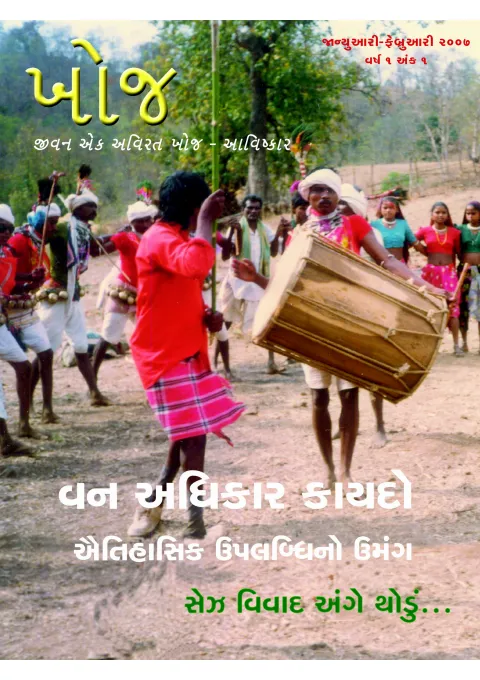
ખોજ (Khoj) — ‘જીવન એક અવિરત ખોજ-આવિષ્કાર’ — is the inaugural issue (Year 1, Issue 1, January–February 2007) of a Gujarati liberal periodical published from Vadodara by the Initiative for Open Society (Pahel Kendra), edited by Ambarish Mehta with an editorial board of Trushi Parekh, Anil Patel, and Rajesh Mishra. In the rendered pages (pp. 1–20), the issue announces itself as a forum for civil-society inquiry into questions of freedom, governance, law, and education. The opening quotes from the Rig Veda and Xenophanes establish an epistemological humility that frames the entire enterprise: truth is sought, not declared. The editorial situates the issue around two focal concerns — the passage of the Forest Rights Act 2006 (Van Adhikar Kanoon) and the SEZ controversy — presented as test cases for whether India’s liberal constitutional promises reach its most marginalised citizens. Letters from readers engage urban housing policy, zoning, city poverty, and judicial reform, giving the issue a lively public-correspondence character. The remaining articles in the rendered chunk cover education philosophy (two pieces), a Supreme Court ruling on the Ninth Schedule, temple-trust corruption in Kerala, a column on Dalit experience from the grassroots, society’s treatment of children, lessons from public life drawn from Swami Sahajanand’s Gujarat tour, and two short opinion pieces on religious intolerance — together composing a picture of a periodical committed to liberal constitutionalism, civil society watchfulness, and the interface between high policy and everyday injustice.
Key points
-
The inaugural issue of Khoj, dated January to February 2007, was published from Vadodara by the Initiative for Open Society, also known as Pahel Kendra, and edited by Ambarish Mehta.
-
Its editorial board comprised Trushi Parekh, Anil Patel, and Rajesh Mishra, and opening quotations from the Rig Veda and Xenophanes frame the periodical’s stance of epistemological humility, treating truth as sought rather than declared.
-
The editorial centres on the passage of the Forest Rights Act 2006 and the SEZ controversy, treating both as tests of whether India’s constitutional promises reach its most marginalised citizens.
-
Reader letters engage urban housing policy, zoning, city poverty, and judicial reform, giving the inaugural issue a lively character of public correspondence between readers and editors.
-
Suresh Parikh argues for a Socratic, midwife-like model of teaching that draws out a student’s innate capacity rather than moulding a passive recipient of instruction.
-
Kardam Modi’s philosophical essay on adolescent education argues that values emerge from intergenerational encounter rather than from top-down transmission by teachers or curricula.
-
Trushi Parekh analyses the Supreme Court’s January 2007 nine-judge ruling that subjected post-1973 Ninth Schedule laws to review under the fundamental rights of the Constitution.
-
Ashwin Karia documents corruption and unaccountable management in the Travancore Devaswom Board and the Sabarimala shrine, framing temple-trust governance as a rule-of-law issue.
-
Himanshi Shelat writes on missing children and the systemic indifference of police and child-welfare institutions in Gujarat, while an unsigned piece takes up religious-veto censorship of the film Parzania.
Essays
સંપાદકીય
By અંબરીષ મહેતા
The editorial by Ambarish Mehta introduces the first issue of Khoj by situating it around two landmark events: the passage of the Van Adhikar (Forest Rights) Act 2006, which he describes as an historic recognition of adivasi and forest-dwelling communities’ long-standing claims, and the SEZ controversy, which he frames as a test of whether free-market and liberalisation policies are being pursued with genuine respect for property rights and democratic accountability. Mehta signals the magazine’s intent to provide substantive analysis of such issues rather than partisan cheerleading, and invites reader participation — including new subscriptions, corrections, and contributed articles — as the publication finds its feet.
- Frames Van Adhikar Kanoon as historic justice for adivasis and forest communities after decades of struggle
- SEZ policy is critiqued for inconsistency with free-market and liberalisation principles
- Announces Khoj as a platform for civil-society inquiry, not ideological propaganda
- Invites reader letters, articles, and subscriptions as the magazine launches
- References upcoming long-form pieces by Trushi Parekh on Van Adhikar and by Ambarish Mehta on SEZ
પત્રો
The letters section (પત્રો / પ્રતિભાવો) spans pages 6–8 and contains substantial reader correspondence engaging with urban planning, housing, city poverty, and judicial reform. One letter by Pravinchandra Thakar of Ankleshwar critiques town-planning and zoning frameworks as instruments of elite capture that dispossess the poor; he questions whether NURM (National Urban Renewal Mission) can deliver genuine housing justice. A second letter from Chirantan Y. Bhogilal, Bhogilpura, Vadodara critiques zoning laws as benefiting real-estate and commercial interests over working-class residents. A third reader, Nishant Patel of Ahmedabad, cites a statistic that urban land values in India are US $6,380 per sq. ft. in some localities compared to US $2,600 per sq. ft. in rural areas. Another letter (Anjana Desai, Ahmedabad) covers the SEZ debate, linking it to the Narmada displacement and arguing that Special Economic Zones replicate patterns of land dispossession. The final letter on page 8 (Anjana Desai) also responds to a previous Khoj piece on judicial reform by Kirit Panwala, engaging his argument about 250–300 frivolous personal cases clogging Mumbai courts.
- Multiple readers critique urban zoning and town-planning as instruments that disadvantage the urban poor
- NURM scheme discussed as a potential but insufficient response to city housing failures
- Statistical claim offered: urban land prices at US $6,380 per sq. ft. vs US $2,600 in rural areas
- SEZ critique linked to Narmada-era displacement patterns
- Judicial reform debate engaged — Kirit Panwala’s earlier series prompts reader responses
શિક્ષકનું કાર્ય - દાયણનું
By સુરેશ પરીખ
Suresh Parikh’s piece ‘શિક્ષકનું કાર્ય — કુંભારનું નહીં, દાયણનું’ (The Teacher’s Work — Not the Potter’s, but the Midwife’s) argues for a Socratic, facilitative model of teaching over the dominant ‘potter’ model in which the teacher moulds a passive student. Drawing on five questions a writer must answer before writing (What, Why, How, When, Where, How Much), Parikh argues that good teaching is the art of drawing out what the student already carries within — midwifery rather than manufacture. He critiques the school system’s fixation on content delivery and measurable outputs, and calls for value-based education, reserving sharp criticism for the current curriculum’s inability to form autonomous moral judgment. A reference to Mahendra Jotvadiyano’s forthcoming piece on ‘moolya-shikshan’ (value education) in Khoj July–August 2007 signals the magazine’s serialised engagement with the theme.
- Contrasts ‘potter’ model of education (moulding students) with ‘midwife’ model (drawing out innate capacity)
- Uses five editorial questions (What/Why/How/When/Where/How Much) as heuristic for good teaching
- Argues that value education cannot be reduced to content — it requires moral environment, not curriculum
- Critiques government schools’ administrative burden and the divorce between teaching and learning goals
- References a forthcoming Khoj piece by Mahendra Jotvadiyano on value education
તરુણ શિક્ષણ - ક્યો સમાસ ?
By કર્દમ મોડી
Kardam Modi’s ‘તરુણ શિક્ષણ — ક્યો સમાસ?’ (Youth Education — What Compound?) is a philosophical essay on adolescent education that asks whether ‘youth education’ is a genitive compound (education OF youth) or an instrumental one (education FOR youth, or education THROUGH youth). Modi argues that adolescents (ages 13–19) are in a formative phase during which the family, school, and peer community must cooperate rather than work at cross-purposes. He invokes the image of generations: just as the 1901 generation coexisted with the 2001 generation and had to learn from each other, today’s adults must not dismiss adolescent values as mere rebellion. The essay argues that ‘moolya’ (values) are not static gifts passed down from a potter-parent but emergent properties of intergenerational encounter — and that schools are failing to create the conditions for such encounter.
- Poses the grammatical ambiguity of ‘youth education’ (tatpurusha vs. bahuvrihi compound) as a substantive philosophical question
- Argues that adolescents aged 13–19 form a distinct social stratum requiring a distinct educational philosophy
- Values are not transmitted top-down but emerge from intergenerational encounter
- Critiques the 1901/2001 generational gap as evidence that each era must negotiate its own moral vocabulary
- Ends by distinguishing three levels of the youth-education problem: first-, second-, and third-order tatpurusha
નવમા પરિશિષ્ટ પરનો ચુકાદો
By તૃષિ પારેખ
Trushi Parekh’s ‘નવમા પરિશિષ્ટ પરનો સુપ્રીમનો શક્તવર્તી ચુકાદો’ (The Supreme Court’s Powerful Ruling on the Ninth Schedule) covers the Supreme Court’s nine-judge constitutional bench ruling of 11 January 2007 that subjected Ninth Schedule laws to fundamental-rights review. Parekh explains the historical context: the Ninth Schedule was inserted in 1951 to protect land-reform laws from judicial invalidation, and was subsequently used to shield an ever-expanding corpus of laws from Article 13 scrutiny. The ruling — that all laws inserted after 24 April 1973 (the Kesavananda Bharati date) are justiciable — is presented as a milestone for constitutional liberalism and separation of powers. Parekh notes, however, that the practical implications are uncertain: courts will need to assess each law, and the government retains the power to re-enact struck-down provisions in modified form. The piece is balanced — it does not celebrate the ruling uncritically — and raises the question of whether ‘rule of law’ or ‘rule of lawyers’ will prevail.
- Supreme Court nine-judge bench on 11 January 2007 ruled Ninth Schedule laws post-1973 subject to fundamental-rights review
- Historical background: Ninth Schedule created in 1951 to protect land reforms from Article 13 challenges
- Kesavananda Bharati (1973) is the constitutional watershed — post-1973 insertions are now judicially reviewable
- Ruling seen as a victory for separation of powers and constitutional supremacy over legislative immunity
- Parekh raises the practical question of whether courts will act as genuine guardians or merely formal reviewers
ઈશ્વરના પોતાના જ ધામમાં કૌભાંડ
By અશ્વિન કારીઆ
Ashwin Karia’s ‘ઈશ્વરના પોતાના જ ધામમાં કૌભાંડ!’ (Scandal in God’s Own Abode!) examines the governance failure of the Travancore Devaswom Board — the state agency that administers over 1,200 temples in Kerala — and the systemic corruption and mismanagement of temple trusts across India. Karia documents how the Board, which controls enormous financial flows (he cites annual turnover of crores of rupees, with Sabarimala alone generating hundreds of crores), operates without proper accountability, with reports of rampant pilferage of offerings, discrimination in service, and opaque internal appointments. The piece focuses on a specific investigation into the Sabarimala shrine’s management, the role of the tantri (hereditary priest) families, and the failure of parliamentary and judicial oversight. It closes with a sharp question: if the state administers these temples on behalf of the devotee public, why is the devotee public the last to know how the money is spent?
- Travancore Devaswom Board manages 1,200+ temples in Kerala with very large annual revenues
- Sabarimala shrine generates hundreds of crores annually; mismanagement and pilferage are documented
- Tantri (hereditary priest) families wield unaccountable power over temple administration
- State administration of temples does not translate into public accountability to devotees
- Article frames temple-trust corruption as a civil-liberties and rule-of-law issue, not a religious one
તળિયેથી…
By રાજેશ મિશ્રા
Rajesh Mishra’s column ‘તળિયેથી…’ (From the Bottom…) is a dialogic, documentary piece presenting an encounter at a conference (‘Summit of Powerless’) in Delhi, at which Mishra — identified as a Gujarati who works on adivasi issues — meets Dalit activists, women from rural Rajasthan, and grassroots voices from Bihar and Gujarat. The column is composed largely as reported dialogue: conversations on caste discrimination, the limits of constitutional promises, dowry harassment, police violence against Dalits, and the experience of being invisible to mainstream society. The piece works as testimony journalism, capturing the emotional register of the marginalized alongside Mishra’s reflective voice as interlocutor. A memorable exchange about a mobile phone conversation between Mishra and a Dalit woman during a train journey anchors the column’s second half and functions as a metaphor for the gap between connectivity and genuine social solidarity.
- Dialogic column drawing on encounters at a grassroots Delhi conference of marginalised communities
- Voices of Dalit women, adivasi activists, and rural poor foregrounded through direct reported speech
- Themes: caste discrimination, police violence, dowry harassment, constitutional promise vs. lived reality
- Mobile phone exchange on a Vadodara train as a parable of false connectivity between social classes
- Column embodies the magazine’s commitment to witness journalism from the grassroots
બાળકો સાથે સમાજનો અક્ષમ્ય વ્યવહાર
By હિમાંશી શેલત
Himanshi Shelat’s ‘બાળકો સાથે સમાજનો અક્ષમ્ય વ્યવહાર’ (Society’s Unpardonable Treatment of Children) is a short but urgent essay on child neglect and abuse in Gujarat — drawing on news reports of missing children, custodial violence, and the failure of state institutions to protect minors. Shelat documents a specific period in which thousands of children went missing in Gujarat and examines the systemic indifference of police, courts, and child welfare institutions. The piece asks why Indian society tolerates such treatment and draws a connection between the social invisibility of children and broader failures of public accountability. It calls for child-rights mechanisms with real enforcement power.
- Documents large numbers of missing children in Gujarat over recent years
- Police and child welfare institutions shown to be systemically indifferent
- Connects child neglect to broader public-accountability failures
- Calls for enforceable child-rights mechanisms rather than advisory bodies
- Tone is advocacy journalism: specific, evidence-based, and morally urgent
જાહેર જીવનના પદાર્થપાઠ ક્યારે ?
By ડંકેશ ઓઝા
Dankesh Oza’s ‘જાહેર જીવનના પદાર્થપાઠ ક્યારે?’ (When Will We Learn the Lessons of Public Life?) uses Swami Sahajanand’s Gujarat tour as a case study in the failure of contemporary public figures to engage meaningfully with civic life. Oza observes that Swami Sahajanand, whose autobiography ‘Mara Anubhavo’ is referenced, encountered the complexity of Gujarati social conditions in his travels; by contrast, today’s public figures treat Gujarat tours as media events. The piece draws on several encounters: a meeting with a cow-protection zealot, an exchange with a secular intellectual on religious tolerance, and a reflection on how the media’s appetite for spectacle crowds out substantive civic discourse. Oza argues that public figures have a duty to model ‘public life’ — accountable, engaged, and non-sectarian — and that the current media environment makes this almost impossible.
- Swami Sahajanand’s Gujarat autobiography used as touchstone for genuine civic engagement
- Contrasts authentic public-life witness with contemporary media-driven spectacle
- Critiques religious intolerance — cow-protection vigilantism specifically — as a corruption of public life
- Draws on Gandhian and secular-reformist tradition without naming Gandhi directly
- Calls for public figures who model non-sectarian accountability rather than performing identity politics
હરખ હવે તું હિન્દુસ્તાન
By તૃષિ પારેખ
Trushi Parekh’s short piece ‘હરખ હવે તું હિન્દુસ્તાન’ (Rejoice Now, Hindustan) is a brief celebratory note — likely an editorial comment — noting positive signals for India’s democratic health in the period: the Forest Rights Act’s passage, the Supreme Court’s Ninth Schedule ruling, and a broader sense that civil society institutions are finding their voice after years of impasse. The tone is cautiously optimistic and functions as an interlude between the more analytical pieces.
- Short celebratory piece noting two civic-legal milestones: Van Adhikar Act and Ninth Schedule ruling
- Cautiously optimistic about civil society momentum
- Functions as editorial commentary rather than analytical article
આ અસહિષ્ણતા અટકશે ખરી ?
The short unsigned piece ‘આ અસહિષ્ણતા અટકશે ખરી?’ (Will This Intolerance Stop?) on page 20 responds to a specific incident of religious intolerance in Gujarat — the blocking of a film’s screening because its content was deemed offensive by a religious group — and draws a broader argument about the creeping normalisation of veto power by sectarian groups over cultural expression. The piece names the film industry’s self-censorship under communal pressure and questions whether the state is fulfilling its constitutional duty to protect freedom of expression. A reference to the film ‘Parzania’ (a 2006 Gujarati film about the 2002 riots) places the argument in the context of post-2002 Gujarat’s contested public culture.
- Documents a specific act of sectarian veto over film screening in Gujarat
- Critiques film industry’s self-censorship under communal pressure
- References ‘Parzania’ (2006) as a case where state complicity in censorship was evident
- Argues that constitutional freedom of expression requires active state protection, not passive non-interference
- Connects cultural intolerance to the broader post-2002 Gujarat civic environment
Metadata and summary are AI-extracted from the source PDF and reviewed for editorial accuracy. The original work is available via the Read PDF tab above (where present); paragraph-level citation inside the PDF is deferred to a future engagement.