essay
IS SOCIALISM THE RIGHT PATH?
By SH Batlivala
THE FORUM OF FREE ENTERPRISE, "Sohrab House", 235, Dr. Dadabhai Naoroji Road, BOMBAY 1. · Bombay · 1956
4 pages
Summary
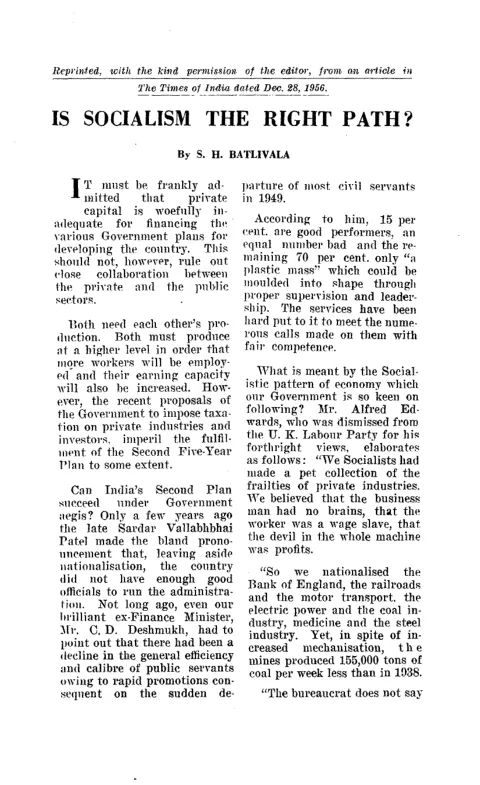
Reprinted from The Times of India of 28 December 1956, S. H. Batlivala’s short polemic — issued as a Forum of Free Enterprise pamphlet — argues that India’s drift toward a “Socialistic pattern of economy” misreads the country’s actual development needs. Batlivala opens by conceding that private capital alone cannot finance the Government’s plans, but he insists that this is a case for collaboration between the private and public sectors, not for taxation that would imperil the Second Five-Year Plan. He marshals testimony from Sardar Vallabhbhai Patel and former Finance Minister C. D. Deshmukh to argue that the Indian civil service lacks the depth to run nationalised industries, and asks whether the Second Plan can succeed when administered by a thinned-out bureaucracy.
The heart of the piece is a sustained attack on British and Indian planning by analogy. Batlivala quotes Alfred Edwards, a defector from the U.K. Labour Party, on how nationalising the Bank of England, the coal mines, transport, power and steel left British industry with weaker output than before: coal production was 155,000 tons per week below 1938 levels despite mechanisation. A satirical “Form of Daily Service for Use in Govt. Depts.” from the New Statesman dramatises the paralysis of civil servants caught between committees and circulars. He ridicules “the Labour idea of planning” as installing London School of Economics theorists over industries they have never built, and amplifies the point with a now-famous comparison: the Ten Commandments run to 297 words, Lincoln’s Gettysburg address to 266, the Declaration of Independence to 300, while the U.S. Office of Price Stabilisation’s order regulating cabbage prices runs to 26,911.
On the income-ceiling proposal then circulating inside the Congress, Batlivala marshals data to show its futility — even Hugh Gaitskell warned that the British equivalent would yield only £53 million, and Soviet wage data shows widening inequality between top managers and the 400-rouble minimum. American examples (a 23-cents-on-the-dollar real take from a $25,000 income; Harlow Curtice’s voluntary $200,000 pay cut at General Motors) are deployed to argue that punitive taxation does not redistribute, it merely demoralises producers. The pamphlet closes with the imprint of the Forum of Free Enterprise at Sohrab House, Bombay, and a back-cover quotation from Jawaharlal Nehru affirming that material progress must not come “at the expense of the spirit of man” — turned, by placement, into an implicit rebuke of the very planning enthusiasm Nehru himself led.
Key points
-
Batlivala concedes private capital cannot alone finance the Second Five-Year Plan, but argues that imposing fresh taxation on private industry and investors will imperil the Plan rather than save it.
-
He cites Patel and ex-Finance Minister C. D. Deshmukh to show that the Indian civil service is too thin to run nationalised industries, of whom only fifteen per cent are good performers by Patel’s own count.
-
Britain’s nationalisation programme is treated as a cautionary case: under the National Coal Board, weekly coal output fell 155,000 tons below 1938 despite mechanisation, and Alfred Edwards is quoted recanting the socialist’s caricature of business.
-
A New Statesman “Form of Daily Service for Use in Govt. Depts.” is reprinted to satirise bureaucratic paralysis, indecision, and worship of committees over common sense.
-
Batlivala’s signature comparison contrasts the brevity of the Ten Commandments (297 words), Lincoln’s Gettysburg Address (266) and the Declaration of Independence (300) with a 26,911-word U.S. Office of Price Stabilisation order regulating cabbage prices, as evidence that controls breed verbosity.
-
Against Congress proposals for an income ceiling, he marshals Hugh Gaitskell’s own warning that taxing the wealthy would raise only £53 million, alongside Soviet wage data showing socialist inequality widening between officials and the 400-rouble minimum.
-
American comparisons — a $25,000 income net-of-tax of about $4,650, and Harlow Curtice’s voluntary $200,000 pay cut at General Motors after a strike-driven slump — are used to claim that high marginal taxation neither redistributes meaningfully nor produces social equality.
-
The pamphlet closes with the Forum of Free Enterprise imprint and a Nehru epigraph on the back leaf insisting material progress must not be bought at the expense of “the spirit of man” — positioned to enlist Nehru against the planning regime he himself champions.
Metadata and summary are AI-extracted from the source PDF and reviewed for editorial accuracy. The original work is available via the Read PDF tab above (where present); paragraph-level citation inside the PDF is deferred to a future engagement.