pamphlet · position paper
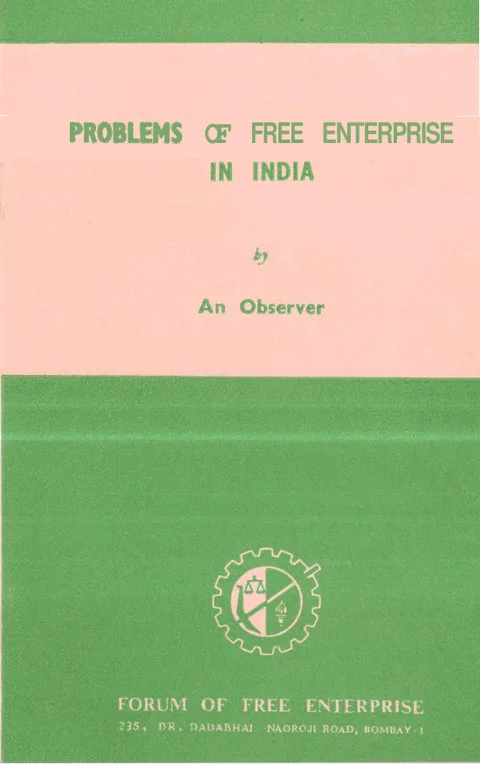
Problems of Free Enterprise in India
FORUM OF FREE ENTERPRISE, 235, DR. DADABHAI NAOROJI ROAD, BOMBAY-1 · Bombay · 1957
15 pages
Problems of Free Enterprise in India
By An Observer
Summary
Written pseudonymously by “An Observer” for the Forum of Free Enterprise shortly after the launch of India’s Second Five-Year Plan, this pamphlet argues that the country’s accelerating drift toward State control threatens both the productive capacity and the political liberty that free enterprise has historically secured. The author opens by recalling that, despite the hostility of colonial-era competitors, Indian businessmen — Jamshedji Tata’s steel venture is the emblem — built cotton, sugar, cement, chemicals, banking and insurance, lifting India to become Asia’s second-most industrialised country. The Second Plan’s stated commitment to a “mixed economy” and a “comradeship” of the two sectors is, in the author’s view, contradicted in practice by the 1956 Industrial Policy Resolution, which reserves seventeen industries exclusively to the State (Schedule A) and twelve more for primary State initiative (Schedule B), confining free enterprise to whatever is left over.
The pamphlet then catalogues the policy actions that have rattled the “enterprising community”: the nationalisation of life insurance and air transport; expansion of the State Trading Corporation; the Industries (Development and Regulation) Act; restrictions in the Companies Act on managing agencies and inter-company investment; capital gains tax, higher dividend taxes, and the new compulsory deposit scheme; and — most consequentially — the Constitution (Fourth Amendment) Act of 1955, which curbs judicial review over compensation for property acquired by the State. The author marshals quotations from Nehru, Dr. John Matthai, World Bank president Eugene Black, the American economist Harry Robinson, and British Labour figures Hugh Gaitskell and C. A. R. Crosland to argue that even sympathetic socialist opinion abroad now doubts the equation of wholesale nationalisation with social progress.
The concluding pages press a constitutional case: a country whose economy is dominated by the State cannot preserve the basic principles of democracy. The “enterprising class” is not a handful of big-business men but extends to the cultivator, craftsman and village trader; all have a stake in liberty. Misbehaviour by particular firms should be “firmly dealt with,” but the tendency to “run down and revile free enterprise as a whole” must be deprecated. Borrowing Professor Westlake’s image of a ship’s crew under “the categorical imperative of the captain,” the author closes with a plea for a real comradeship between public and private sectors against the common enemies of poverty and suffering.
Key points
-
Frames free enterprise as the engine of India’s pre- and post-Independence industrial growth — from Tata steel through cotton, cement, chemicals and banking — and warns that its capacity is being squandered.
-
Reads the 1956 Industrial Policy Resolution as a sharp tightening of State jurisdiction: seventeen industries reserved exclusively to government, twelve more in which the State takes the initiative, and a vague residual space for private enterprise.
-
Argues that official rhetoric of a “mixed economy” and “comradeship” between sectors is undercut by nationalisation of life insurance and air transport, State Trading Corporation expansion, and a steady drift toward socialism.
-
Cites Eugene Black (World Bank) and the American economist Harry Robinson alongside Dr. John Matthai to show that even friendly observers find the policy framework discouraging to investors, especially foreign ones.
-
Treats the Constitution (Fourth Amendment) Act, 1955 as the most worrying step — removing meaningful judicial review over compensation when property is acquired, and thereby endangering property rights and savings.
-
Catalogues fiscal disincentives: capital gains tax, higher taxation on dividends in excess of six per cent, and the new compulsory deposit scheme — all judged likely to dry up savings rather than feed the Plan.
-
Notes that even British socialists (Hugh Gaitskell, C. A. R. Crosland) now question the simple identification of socialism with nationalisation — a comparative argument the author uses to embarrass Indian planners.
-
Concludes that political democracy cannot survive in an economy dominated by the State; the “enterprising class” includes the cultivator and craftsman and has a vital stake in safeguarding free enterprise.
Generated by the v1.5 extraction pipeline. Awaiting editorial review.
Metadata and summary are AI-extracted from the source PDF and reviewed for editorial accuracy. The original work is available via the Read PDF tab above (where present); paragraph-level citation inside the PDF is deferred to a future engagement.