pamphlet
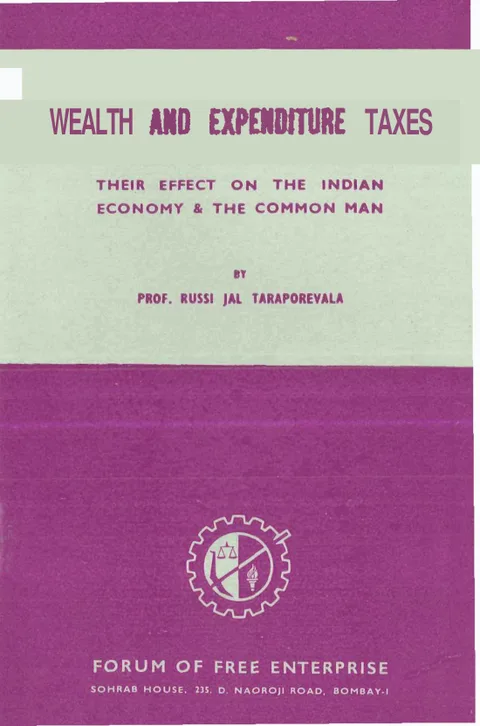
DANGERS OF WEALTH TAX
By SH Batlivala
FORUM OF FREE ENTERPRISE, "Sohrab House", 235, Dr. Dadabhai Naoroji Road, Bombay-1 · Bombay · 1957
2 pages
Summary
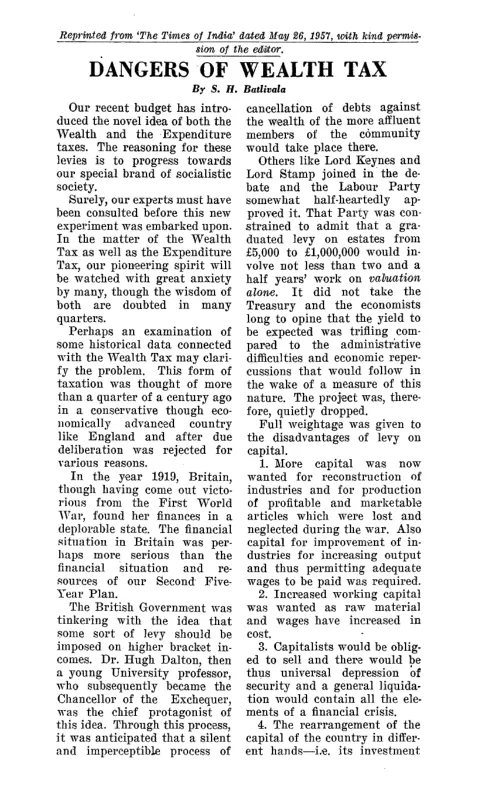
S. H. Batlivala’s short polemic, reprinted from The Times of India of 26 May 1957 by the Forum of Free Enterprise, attacks the Wealth Tax and Expenditure Tax that India’s recent budget had introduced as instruments to move the country towards ‘our special brand of socialistic society.’ Batlivala argues that experts were not properly consulted before this experiment was launched, and that a glance at recent economic history would have shown the dangers. He notes that the very same form of taxation was contemplated more than a quarter-century earlier in conservative, economically advanced Britain — and rejected after due deliberation.
The bulk of the piece is a historical case study of the 1919 British debate on a capital levy proposed to reconstruct industry and reduce war debt after the First World War. He recounts that Dr. Hugh Dalton championed the idea, Lord Keynes and Lord Stamp engaged it in debate, and the Labour Party endorsed it only half-heartedly with a graduated levy on estates above £5,000. The Treasury and the economists, he says, ultimately concluded that the yield would be trifling compared to the administrative difficulties and economic damage. He enumerates six dangers raised against capital levies — including capital flight, the depression of security values, forced asset sales depressing market prices, and an unfair burden on widows and spendthrift-affected families.
Batlivala then turns to the 1951 revival of the levy proposal in the U.K. by S. P. Chambers, a former British Civil Service member, and to Chambers’s verdict that ‘a tax which cannot be collected until 1955 is not much good for financing the expenditure of 1951.’ Closing with rhetorical flourish, he warns that if the Indian Finance Minister persists in ‘confiscatory methods aided and abetted by Ordinances,’ the situation may be described in Disraeli’s words uttered against Gladstone’s Cabinet in 1872 — a picture of exhausted volcanoes, ministerial extravagance, and ‘the dark rumblings of the sea.‘
Key points
-
Frames the 1957 Wealth Tax and Expenditure Tax as steps toward a ‘special brand of socialistic society’ and faults the government for not consulting economic experts before adopting them.
-
Argues from historical analogy: Britain considered and rejected a capital levy in 1919 after rigorous Treasury and economist scrutiny.
-
Identifies Dr. Hugh Dalton as the chief protagonist of the 1919 British capital-levy idea, with Lord Keynes and Lord Stamp also entering the debate.
-
Lists six concrete dangers of a capital levy: insufficient capital for industrial reconstruction, higher working capital and wage costs, forced universal liquidation of British securities, capital flight, depressed market prices for government and industrial shares, and a heavy fall in security values.
-
Notes that Mr. S. P. Chambers, reviving the proposal in the U.K. in 1951, conceded it was administratively useless because ‘a tax which cannot be collected until 1955 is not much good for financing the expenditure of 1951.’
-
Warns that confiscatory levies, especially those imposed by ordinance, will produce the ‘extravagance for energy’ that Disraeli ascribed to Gladstone’s late ministry in 1872.
-
Published as a Forum of Free Enterprise pamphlet from ‘Sohrab House’, 235 Dr. Dadabhai Naoroji Road, Bombay-1.
Metadata and summary are AI-extracted from the source PDF and reviewed for editorial accuracy. The original work is available via the Read PDF tab above (where present); paragraph-level citation inside the PDF is deferred to a future engagement.