pamphlet · collected works
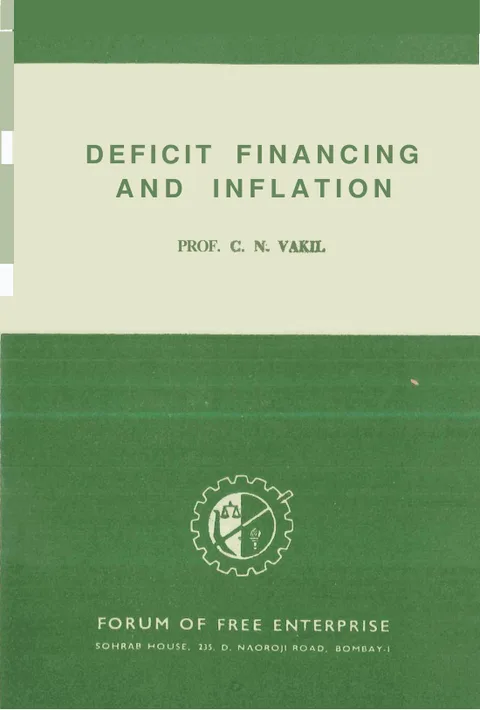
Deficit Financing and Inflation
FORUM OF FREE ENTERPRISE, SOHRAB HOUSE, 235, D. NAOROJI ROAD, BOMBAY-1 · Bombay · 1967
15 pages
Summary
Prof. C. N. Vakil’s pamphlet collects a five-part series of articles, originally published in the Free Press Journal (Bombay, 15–20 March 1967) and reissued by the Forum of Free Enterprise in May 1967, that diagnoses India’s continuously rising prices as the product of deliberate government action rather than impersonal market forces. Writing just after the formation of new governments at the Centre and in the States, Vakil opens with a historical detour through the British experience after the First World War, the unmasking of currency inflation by Sir Edwin Cannan, and the wartime Indian campaign led by Kumarappa’s Harijan articles and a 30-economist manifesto of 1943 — used as a parable for how administrations characteristically deny inflation, prosecute their critics, and blame symptoms (hoarders, profiteers, black-marketeers) rather than the root cause.
The analytic core of the booklet identifies that root cause as deficit financing: public expenditure ‘greatly in excess of genuine resources,’ funded by ad hoc treasury bills drawn on the Reserve Bank. Vakil traces how this creates artificial purchasing power, drives a wholesale-price index that rose from 125 in 1962 to 203.8 by late February 1967, hollows out small savings, pushes capital into land and gold, and reproduces itself through fresh dearness-allowance demands by organised trade unions and government commissions of enquiry — a circle he describes as a ‘go-slow’ on prices. He attacks inflation as ‘a form of regressive taxation,’ a hidden levy that falls hardest on the poor and middle classes, aggravates inequality, and creates the social and political instability that benefits parties promising the moon.
The remedial chapters press for strict economy in public expenditure (Plan and non-Plan), revision of the tax structure to lighten essential consumption while extending agricultural income tax, removal of surplus government staff, a firm ‘no more deficit financing’ rule, freezing of all incomes and profits for a transition year with trade-union and political-party co-operation, and a unified Centre–States policy on prices, food-grain distribution and production. Vakil closes with a warning that without such a co-ordinated, statesmanlike response the country drifts toward ‘unknown disasters,’ and that the task before the Union Cabinet and the Union Finance Minister is ‘unenviable.‘
Key points
-
Diagnoses India’s 1967 inflation as a problem of policy choice — deficit financing through ad hoc treasury bills on the Reserve Bank — rather than of natural scarcity or external pressure.
-
Uses historical parallels (Britain post-1918, India 1943–44 under Kumarappa and 30 economists) to argue that governments habitually conceal inflation, prosecute critics, and scapegoat hoarders and profiteers.
-
Cites a wholesale-price index rising from 125 (1962) to 184 (June 1966 devaluation) to 203.8 by 25 February 1967, projecting 250 by the next agricultural season.
-
Treats inflation as ‘regressive taxation’ that erodes small savings, pauperises middle and poor classes, encourages flight into land, gold and foreign exchange, and creates artificial scarcity through hoarding.
-
Critiques the wage–price spiral driven by dearness-allowance commissions, trade-union go-slows and election-time promises of more rewards without more work.
-
Recommends strict economy in Centre and State expenditure, a firm ‘no deficit financing’ commitment, revision of the tax structure to extend agricultural income tax, removal of surplus government staff, and freezing of all incomes for about a year.
-
Argues that inflation control requires a unified, statesmanlike Centre–State policy on prices, food-grain distribution and production; isolated state action cannot work.
-
Frames the booklet within the Forum of Free Enterprise’s stance — citing Eugene Black and A. D. Shroff in sidebar quotations — that private enterprise is an affirmative good, not a necessary evil.
Metadata and summary are AI-extracted from the source PDF and reviewed for editorial accuracy. The original work is available via the Read PDF tab above (where present); paragraph-level citation inside the PDF is deferred to a future engagement.