
speech
CRISIS OF CONTROLS
Published by M. R. Pai, for Forum of Free Enterprise, "Sohrab House," 235, Dr. Dadabhai Naoroji Road, Bombay 1, and printed by S. Krishnamoorthy at Western Printers & Publishers (Prop. K. S. Mistry), 15/23, Hamam Street, Bombay 1. · Bombay · 1960
14 pages
Summary
Delivered as a public address under the auspices of the Forum of Free Enterprise in Bombay on 18 September 1960 and published as a pamphlet on 8 December 1960, Murarji J. Vaidya’s “Crisis of Controls” takes the form of a direct argumentative lecture aimed at business and civic audiences in post-independence India. Opening with the observation that India is simultaneously afflicted by a “crisis of character” (as diagnosed by Vice-President Radhakrishnan), a “crisis of development,” and a “dilemma of development” in foreign exchange, Vaidya contends that the worst of these crises is the Crisis of Controls — a creeping, totalising bureaucratic regimentation that has spread from the Planning Commission down to the lowest inspector in every corner of the country.
Vaidya traces the pathology historically: controls imposed during the Second World War (from 1939 onward) persisted after Independence in 1947 when they should, as in West Germany, Japan, and the United Kingdom, have been systematically dismantled. Instead, India became what he argues is the only free and democratic country in the world still suffering from extensive peacetime controls. He catalogues their reach in granular Bombay terms — milk rationed by booth cards, housing blocked by rent control and building-material permits, exporters stymied by the 305 (out of 375) items still requiring export licences, and industrialists unable to start even a theoretically licence-free small-scale unit (capital up to Rs. 5 lakhs) without separate permits for accommodation, building materials, machinery, and raw materials.
The essay draws on Hayek (“economic control is the control of the means for all our ends”) and Hilaire Belloc to argue that economic controls inevitably compound, demoralise citizenry, and corrode liberty. The Ludwig Erhard miracle in West Germany — where removing foreign-exchange controls caused shortages to vanish almost overnight — is held up as the proof of concept. Vaidya concludes with a call for the Planning Commission and Parliament to formally adopt a policy of progressively fewer controls, arguing that national development can only advance when individuals are free to deploy their honesty, initiative, and enterprise without fear of inspectors or permit offices.
Key points
-
Delivered under Forum of Free Enterprise auspices in Bombay, September 1960; published December 1960.
-
Central thesis: India suffers a “Crisis of Controls” — the most damaging of several concurrent crises — stemming from wartime-era regulations retained and extended after Independence.
-
Controls span every layer of daily economic life: milk distribution, food pricing, housing, building materials, import-export licences, and industrial permits — even small-scale industries notionally exempt from licensing still require multiple separate permits.
-
Of 375 export items previously under control, only 70 had been freed by the time of the address, leaving 305 still requiring permits — a direct contradiction of the government’s stated export-promotion policy.
-
Cites West Germany under Ludwig Erhard as the counter-model: removing foreign-exchange controls rapidly eliminated shortages, demonstrating that scarcity and hoarding are themselves products of control psychology.
-
Quotes Hayek and Hilaire Belloc to argue that economic control is inseparable from control over human life itself, and that extensive controls produce all-round demoralisation in both citizens and government servants.
-
The Forum of Free Enterprise explicitly accepts planning as legitimate but draws the line at control that deteriorates into near-regimentation, which it characterises as totalitarian rather than democratic.
-
Policy prescription: the Planning Commission must formally adopt a direction of progressively fewer controls, releasing individual initiative as the engine of genuine planned development.
Metadata and summary are AI-extracted from the source PDF and reviewed for editorial accuracy. The original work is available via the Read PDF tab above (where present); paragraph-level citation inside the PDF is deferred to a future engagement.
People in this work
Related across the archive
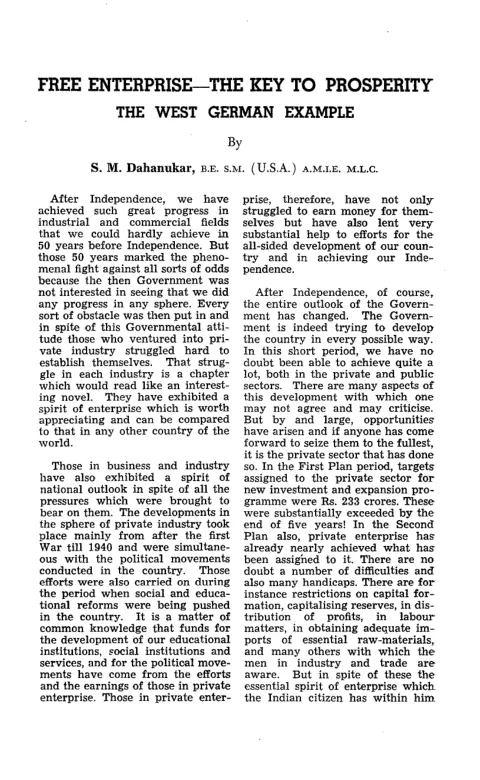 Primary workFREE ENTERPRISE—THE KEY TO PROSPERITY
 Primary workThree Essays on Controls in a Planned Economy
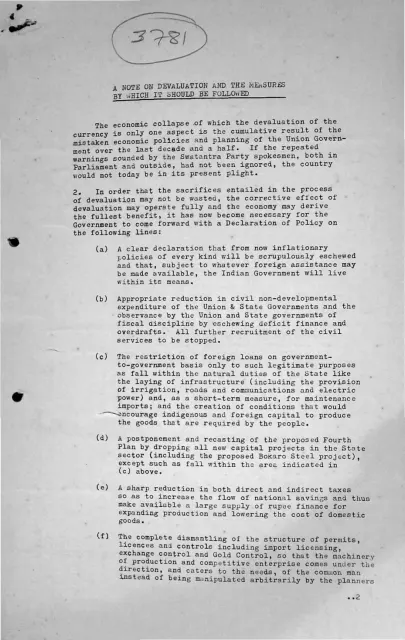 Primary workA NOTE ON DEVALUATION AND THE MEASURES BY WHICH IT SHOULD BE FOLLOWED
 ExcerptB.R. Shenoy on Economic Growth with Social Justice
 ThePrintA shame-faced modesty pervades 1991 reforms. This is strange and inappropriate: Ashok Desai