pamphlet
FREE ENTERPRISE—THE KEY TO PROSPERITY
THE WEST GERMAN EXAMPLE
Published by M. R. Pai for Forum of Free Enterprise, "Sohrab House", 235 Dr. Dadabhai Naoroji Road, Bombay 1, and printed by P. A. Raman at Inland Printers, 55 Gamdevi Road, Bombay 7. · Bombay
4 pages
Summary
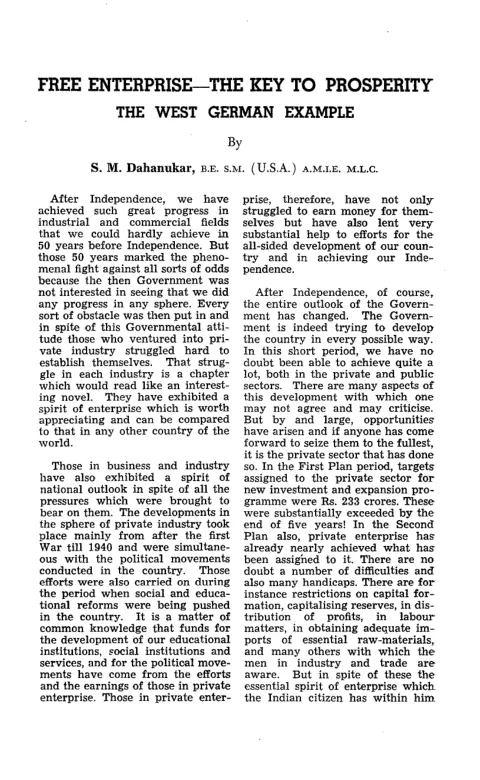
In this Forum of Free Enterprise leaflet, S. M. Dahanukar argues that India’s post-Independence industrial and commercial progress — achieved against an initially hostile Governmental attitude — has come overwhelmingly from the spirit of enterprise of the private sector, and that the country’s future development requires the Government to give private initiative still more room to operate. He concedes that the official outlook has begun to change since the First Plan and that the Second Plan set targets for the private sector worth Rs. 233 crores, but warns that adequate imports, finance, raw materials, and freedom to expand still need to be assured if private enterprise is to flourish.
The heart of the pamphlet is an extended West German parable. Dahanukar describes Berlin in 1947, with sixty per cent of the city in rubble, and credits Ludwig Erhard’s bold decision to remove controls — taken in the face of predicted chaos — with unleashing the individual initiative that produced the so-called German economic miracle. He quotes Erhard at length, including the latter’s insistence that what happened in Germany was not a miracle at all but the result of an economic policy based on the principles of freedom that made human labour valuable and useful again. By 1958 West Germany had risen, in Dahanukar’s telling, to lead Europe and overtake victorious England.
Dahanukar then transposes the lesson onto India. He cites Erhard’s 1958 New Delhi address to argue that fully-fledged economic planning misreads basic human nature, that economic life is shaped not at the draft-board but by human beings, and that the individual must be conscious of the value of his work and entitled to enjoy the fruits of his own success. The leaflet closes by posing the choice — free enterprise or planned development through a controlled public sector — and answering it through the West German results, expressing the hope that the Planning Commission and Government will take note while finalising the Third Five-Year Plan.
Key points
-
Frames post-Independence Indian industrial progress as the achievement of the private sector working against, and only later with, Government attitudes.
-
Notes that the Second Five-Year Plan allocated Rs. 233 crores in targets to the private sector but argues that imports, finance, raw materials, and room to expand remain inadequately assured.
-
Uses West Germany after 1947 — Berlin sixty per cent rubble, no porter, no taxi, no cigarette — as the central case study for what economic freedom can rebuild.
-
Credits Ludwig Erhard’s decision to scrap controls (against predictions of chaos) with releasing individual initiative that produced the ‘German economic miracle’.
-
Quotes Erhard at length to argue that the so-called miracle was not a miracle but a deliberate policy based on the principles of freedom that restored the value of human labour.
-
Reports that by 1958 West Germany had become the leading nation of Europe and surpassed victorious England in foreign exchange reserves, with a standard of living twice that of England.
-
Invokes Erhard’s 1958 New Delhi address to attack imitative planning, insisting that economic life is shaped ‘not at the draft-board, but by human beings’ and that individuals must enjoy the fruits of their own success.
-
Closes by posing the choice between free enterprise and controlled public-sector development and addresses the Planning Commission directly as it considers the Third Five-Year Plan.
Metadata and summary are AI-extracted from the source PDF and reviewed for editorial accuracy. The original work is available via the Read PDF tab above (where present); paragraph-level citation inside the PDF is deferred to a future engagement.