speech
CONTROLS AND FREEDOM
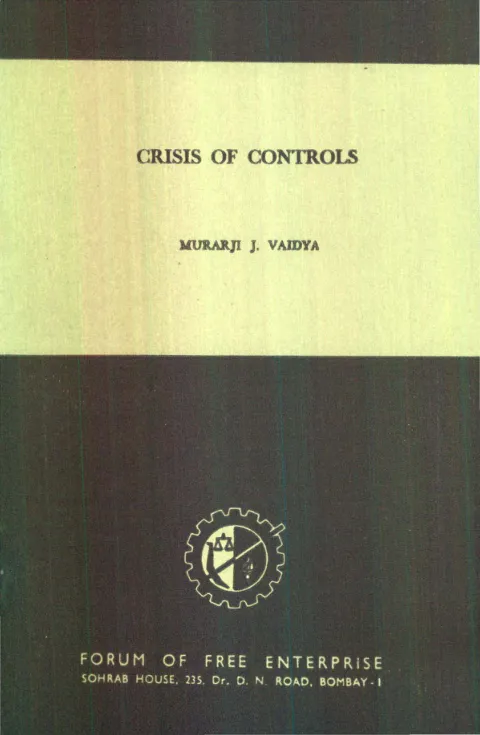
FORUM OF FREE ENTERPRISE, SOHRAB HOUSE, 235, D. NAOROJI ROAD, BOMBAY-1 · Bombay · 1960
8 pages
Summary
Delivered as a Forum of Free Enterprise lecture in Bombay on 18 August 1960, M. A. Sreenivasan’s pamphlet argues that controls and freedom are not antitheses — disciplined, self-imposed and rule-bound controls are in fact necessary for genuine liberty, while the proliferating peacetime controls of independent India have become its enemy. Drawing on his own experience as Minister for Food and Civil Supplies in princely Mysore, Sreenivasan recalls administering a ‘bewildering maze of controls and permits and licences — a veritable Queutopia’ during the war, and warns that the post-Independence state has multiplied such restrictions far beyond anything the colonial Defence of India Act ever imposed, until controls now reach into industry, agriculture, banking, transport, prices and even morals through Prohibition.
The heart of the polemic is a sustained contrast between wartime and peacetime controls. Wartime controls, he writes, were ‘plain, obvious and unsophisticated’, justified by genuine emergency and self-limiting in scope. Independent India’s controls, by contrast, are ‘subtler, more refined, more pervading and less obvious… not ugly coils of barbed wire’ but ‘high-walled prisons of polished marble’, sanctified by the language of planning and the Five-Year Plans, breeding hardship, evasion, the black market and corruption in turn. Sreenivasan invokes Gandhiji’s preference for Swadharma over ‘the violence of the State’, Rajaji’s lifting of food rationing in Madras, and Bertrand Russell on the absurdities Government can persuade citizens to swallow, to argue that the country’s planners have lost faith in the capacity of ordinary Indians to raise their living standards through free enterprise.
The closing pages frame a half-serious ‘remedial’ programme: further controls — but only on deficit financing, currency printing, the imposition of new controls, and political speech-making — as a satirical mirror of the regulatory mentality. The pamphlet ends with an exhortation to await the ‘end of Control-Raj and the attainment of Swaraj’, echoing the Forum of Free Enterprise’s broader insistence that private initiative, hedged by minimal and impartial rules of the road, is the only durable basis for a free society.
Key points
-
Frames controls and freedom as complementary rather than opposed: a free economy needs rules that ‘regulate and safeguard’ like traffic regulation, not ‘road blocks’ that regiment and emasculate.
-
Draws on the author’s own service as Minister for Food and Civil Supplies in princely Mysore to describe the wartime control bureaucracy as a ‘Queutopia’ of permits, licences and rationing — and treats it as freer than independent India in 1960.
-
Argues that post-Independence controls have outgrown their wartime ancestors in reach and subtlety, extending to industry, agriculture, banking, foreign exchange, transport, the price of bread and personal morals (Prohibition).
-
Identifies a behavioural chain — control begetting hardship, resentment, evasion, black-marketing and corruption — as the predictable economic consequence of pervasive regulation.
-
Reads the planners’ faith in controls as a loss of confidence in citizens: the State assumes the role of provider and educator while denying that ordinary Indians can improve their condition through free enterprise.
-
Invokes Gandhiji’s Swadharma and his warning against ‘the violence of the State’ to argue that the only fully legitimate controls are self-imposed ones rooted in conscience and Dharma.
-
Cites Rajaji’s abolition of food controls in Madras as a concrete demonstration that Indian leaders capable of dismantling the apparatus do exist, and praises ‘lovers of freedom’ who would ‘not hanker for power’.
-
Closes with a satirical four-point counter-programme of ‘antidotes’ — controls on deficit financing, currency printing, the creation of new controls, and political speech-making — as a polemical mirror of the regulatory mind.
Metadata and summary are AI-extracted from the source PDF and reviewed for editorial accuracy. The original work is available via the Read PDF tab above (where present); paragraph-level citation inside the PDF is deferred to a future engagement.