essay
MILESTONES & MILLSTONES OF PLANNING
Published by M. R. PAI for Forum of Free Enterprise, "Sohrab House", 235 Dr. Dadabhai Naoroji Road, Bombay 1, and printed by B. G. DHAWALE at KARNATAK PRINTING PRESS, Chira Bazar, Bombay 2 · Bombay · 1963
8 pages
Summary
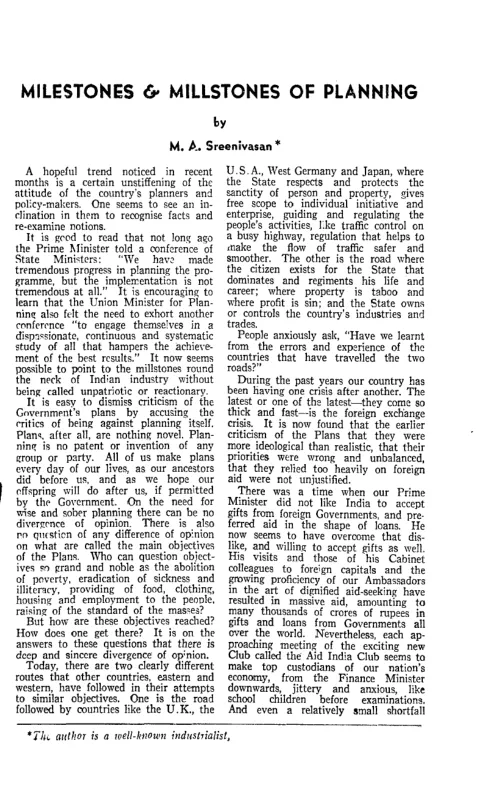
M. A. Sreenivasan’s pamphlet, reproduced by the Forum of Free Enterprise from his October 1962 articles in the Economic Times, takes its title from the recognition that Indian planning has yielded as many “millstones” as milestones. Sreenivasan opens on a cautiously hopeful note: the Prime Minister has finally summoned the State Chief Ministers to a conference “to engage themselves in a dispassionate, continuous and systematic study of all that hampers the achievement of best results”—an admission, he argues, that the country’s planners and policy-makers can no longer pretend the Plans are working as advertised. Citing Mahatma Gandhi’s readiness to admit “a blunder, even if Himalayan,” he insists that retracing steps is no failure but a precondition for honest course-correction.
The heart of the pamphlet is an inventory of concrete planning pathologies. Coal piles unsold at one colliery while factories in the same state shut down for want of fuel; the copper crisis closes a hundred cable factories and shrinks oxygen-cylinder output to one-fifth of need; Postal, Telegraph and Telephone services have decayed into “a national institution for Communications coolly admit in Parliament that something like a hundred thousand telegrams were being sent by post every day.” Railways meanwhile divert capacity to ferry VIPs on “Yathras” with private secretaries and Public Works officers in attendance. Concentration of economic decision-making, licence-permit gatekeeping, and the multiplication of controls have, in Sreenivasan’s reading, bred corruption, evasion, black-marketing and a steadily lowered “standard of misery.”
From this diagnosis he draws four Plan priorities: (1) revise the priorities themselves, dropping anything not “essential to keep existing industries alive and working to capacity”; (2) reduce the heavy dependence on foreign loans; (3) concentrate on the infrastructure of progress—railways, posts and telegraphs, but also education and agriculture; and (4) arrest further inflation, treating monetary stability as the precondition for every other reform. Above these sits a fifth, almost constitutional, injunction—“Halt and reverse the drift towards authoritarianism and excessive concentration of power in the hands of the State.” The pamphlet closes with a polemical question that has become a Forum signature: a Government that styles itself the world’s keenest advocate of unilateral disarmament has armed itself “ceaselessly, unilaterally, against the people—people who placed it in power, instead of placing faith in them and setting them free to work and to prosper.”
Key points
-
Welcomes the Prime Minister’s conference with State Chief Ministers as a long-overdue admission that planning needs dispassionate review, and uses Gandhi’s example of admitting blunders to defend retracing steps as statesmanship rather than weakness.
-
Catalogues concrete planning failures: 90,000 tons of coal stockpiled at one colliery while factories in the same state shut down for lack of fuel; a copper shortage closing roughly a hundred cable factories; oxygen cylinder output at a fifth of need.
-
Indicts the deterioration of Postal, Telegraph and Telephone services—telegrams travelling by post, trunk calls left unanswered for hours—as a routine, scaled-up cost of state monopoly in communications.
-
Attacks the apparatus of permits, licences and quotas as the spring of corruption, evasion, black-marketing and “the raising of the standard of misery to the people.”
-
Notes the diversion of scarce rail capacity to ministerial and VIP “Yathras” (pilgrimages) accompanied by retinues of secretaries and officers, as a symptom of misplaced priorities.
-
Proposes four operational Plan priorities—revise priorities to protect existing industry, reduce foreign-loan dependence, concentrate on infrastructure (transport, communications, education, agriculture), and arrest inflation—plus a constitutional injunction to reverse authoritarian drift.
-
Argues against any further “engine of taxation or control,” warning that constant threats of new measures have produced “a crisis of confidence” and disinvestment from agriculture and plantations alike.
-
Closes by inverting the Government’s pacifist rhetoric: a state that preaches unilateral disarmament should not be arming itself unilaterally against the citizens who elected it.
Metadata and summary are AI-extracted from the source PDF and reviewed for editorial accuracy. The original work is available via the Read PDF tab above (where present); paragraph-level citation inside the PDF is deferred to a future engagement.