essay
PUZZLES AND CLUES
FORUM OF FREE ENTERPRISE, 235, DR. DADABHAI NAOROJI ROAD, BOMBAY-1 · Bombay · 1958
9 pages
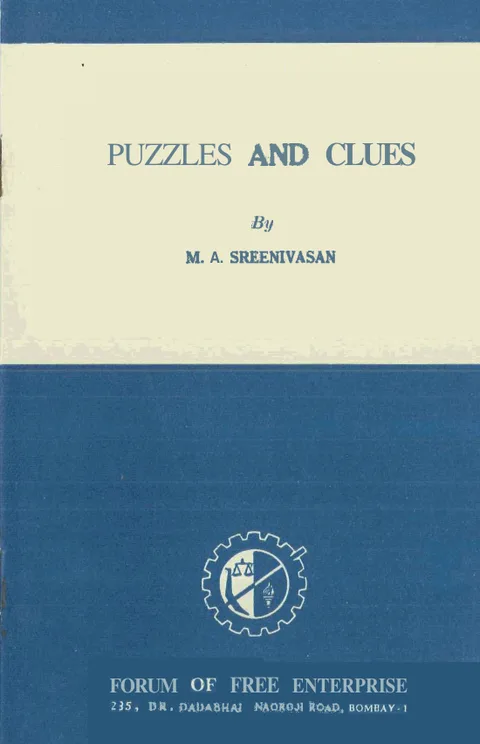
PUZZLES AND CLUES
By MA Sreenivasan
Summary
Published by the Forum of Free Enterprise in 1957 (reprinted from the Commerce Annual of that year), M. A. Sreenivasan’s pamphlet diagnoses India’s malaise at the end of the first decade of independence. Sreenivasan opens by conceding the period’s impressive monuments — dams, hydro-electric installations, government factories, research laboratories — only to insist that real poverty, unemployment, and a rising cost of living remain untouched, and that the socialist pattern of society has further degraded middle-class life. The trouble, he argues, is a Government-made confusion: contradictory ministerial pronouncements on food control, taxation, deficit financing, and the place of the State leave the ordinary citizen bewildered, while a ‘cocksureness’ and ‘unhealthy superiority complex’ among rulers fresh to high office breed habits of idolatry and kowtowing.
The pamphlet’s argumentative core is a libertarian-leaning warning against the intoxication of power. Sreenivasan recalls serving under autocratic maharajas and viceroys and judges that no viceroy or maharaja ever wielded as much unbridled authority as the present heads of the Central and State Governments. He attacks the second Five-Year Plan as unrealistic, citing eminent economists ignored when they warned that deficit financing would generate uncontrollable inflation; he ridicules the search for development models in Belgrade and Peking when Western democracies have already lifted their people; and he reads the Communist drift of ministerial rhetoric as a self-deception that converts even sane listeners through repetition.
The pamphlet closes with five plain prescriptions addressed to the Government: give up the thirst for power and stop encroaching on citizens’ liberties and the courts’ jurisdiction; stop lecturing the world about Korea, Syria, Vietnam, Egypt, and China and mind India’s own business; slash the colossal defence budget given the country’s profession of Panch Shila; scrap Prohibition, which the nation can ill afford in lost revenue and enforcement cost and which has corroded respect for law; and, finally, ‘don’t overdo it’ — ‘Too little and too late’ undid the British Empire, but ‘Too much and too soon’ must not be allowed to undo independent India. A. D. Shroff’s epigraph on the back cover — ‘Free Enterprise was born with man and shall survive as long as man survives’ — locates the tract squarely within the Forum’s classical-liberal programme.
Key points
-
Treats 1957 as ‘a year of hardship and disenchantment’ that has belied even modest expectations a decade after independence.
-
Concedes physical achievements (dams, factories, laboratories) but insists poverty, unemployment, and inflation remain untouched and have downgraded the middle class.
-
Blames a Government-made ‘confusion’ produced by contradictory ministerial pronouncements on food control, taxation, deficit financing, and the proper role of the State.
-
Identifies the intoxication of power as the deepest problem, arguing today’s Central and State Governments wield more unbridled authority than viceroys or maharajas ever did.
-
Attacks the second Five-Year Plan as unrealistic, citing economists who warned that deficit financing would generate uncontrollable inflation and were ignored.
-
Mocks the search for development models in Belgrade and Peking when the U.S.A., U.K., Canada, Sweden, and West Germany have already raised their living standards.
-
Prescribes five remedies: surrender the thirst for power; stop hectoring the world about Korea, Syria, Vietnam, Egypt, and China; slash the defence budget given Panch Shila; scrap Prohibition; and ‘don’t overdo it’.
-
Frames the tract as a classical-liberal intervention via the Forum of Free Enterprise, with A. D. Shroff’s epigraph on free enterprise as its closing signature.
Generated by the v1.5 extraction pipeline. Awaiting editorial review.
Metadata and summary are AI-extracted from the source PDF and reviewed for editorial accuracy. The original work is available via the Read PDF tab above (where present); paragraph-level citation inside the PDF is deferred to a future engagement.