periodical issue
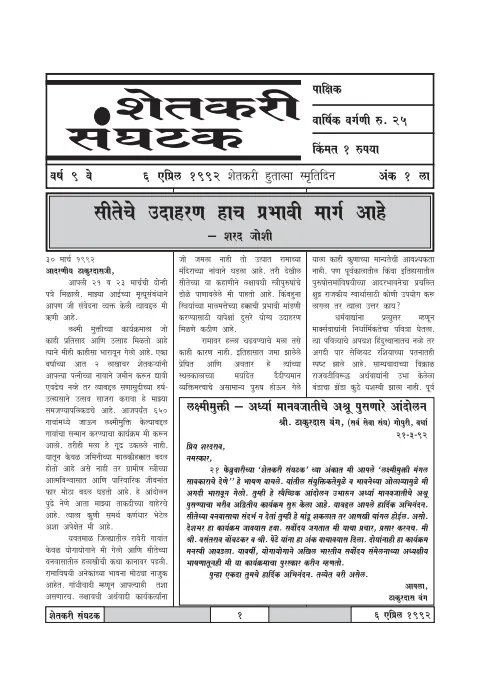
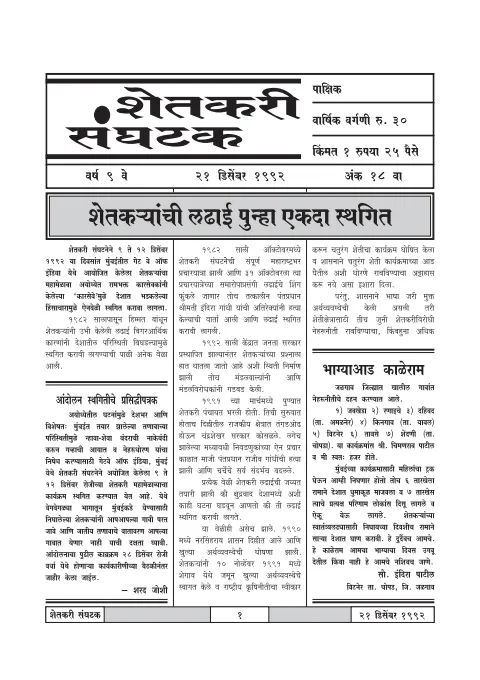
शेतकरी संघटक
Shetkari Sanghatak
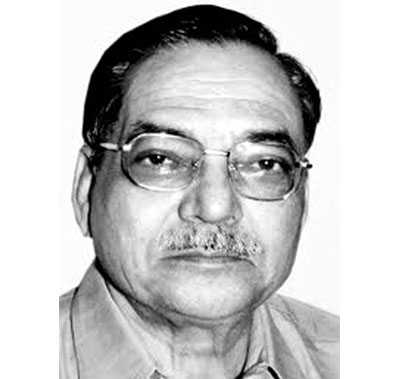
By Sharad Joshi
संपादक, मुद्रक, प्रकाशक: सुरेशचंद्र स्वारे; मालक – मोहन विठ्ठलराव पवडेवी; मुद्रण स्थळ – वाकण प्रिंटिंग प्रेस, वाकण · वाकण (Wakon), Maharashtra · 1992
8 pages
Summary
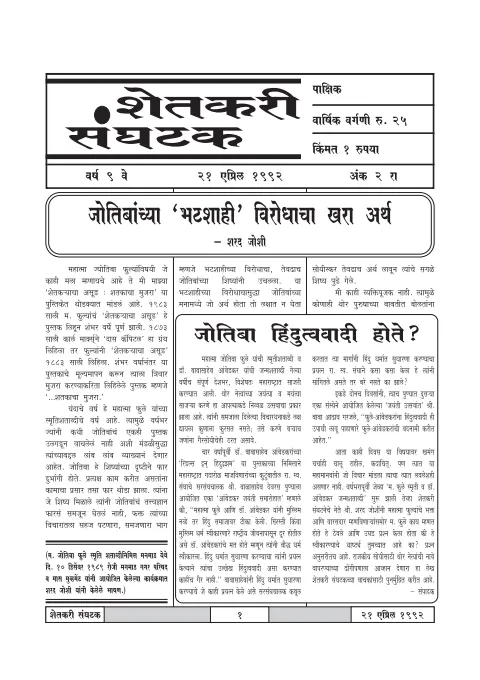
This issue of Shetkari Sanghatak (Year 9, Issue 2, 21 April 1992), the Marathi fortnightly organ of the Shetkari Sanghatana farmers’ movement, is anchored by a major polemical essay by Sharad Joshi titled ‘जोतिबांच्या भटशाही विरोधाचा खरा अर्थ’ (The True Meaning of Jotiba’s Opposition to Brahmin Domination). Joshi argues that the 19th-century reformer Jyotiba Phule’s anti-Brahmin campaign was fundamentally a defence of productive labour and the exploited peasantry — not a Hindu-communalist project, and not a Muslim-sympathising one either — and recruits Phule for the Shetkari Sanghatana’s agrarian-liberal critique of the Indian state and urban rentier class. A sidebar box addresses the claim ‘Was Jotiba a Hindu nationalist?’ and rebuts it on historical grounds. The remaining pages carry shorter contributions: a policy manifesto by Shyamsundar Vasare proposing non-agricultural sector taxation to fund farm liberation, a first-person ‘If I were Finance Minister’ statement by Ratrao Lahanu Savre outlining ten points of agrarian fiscal policy, and three news items — the Supreme Court permitting collective withdrawal of debt-relief petitions, an announcement of a Rs 21 bonus for sugarcane to Central mills, and a report on farmers burning grain and cotton at Delhi’s Boat Club on Shetkari Hutatma Din.
Key points
-
Sharad Joshi’s lead essay ‘जोतिबांच्या भटशाही विरोधाचा खरा अर्थ’ argues that Jyotiba Phule’s nineteenth-century anti-Brahmin campaign targeted the exploiting non-productive class rather than Brahmin caste or Hinduism itself.
-
Joshi rebuts both Rashtriya Swayamsevak Sangh attempts to claim Phule as a proto-Hindu-nationalist figure and readings that cast Phule’s solidarity with Muslims as anti-Hindu communalism.
-
The essay engages B. R. Ambedkar’s later reinterpretation of Phule and positions the contemporary Shetkari Sanghatana farmers’ movement as the authentic heir of Phule’s anti-exploitation project.
-
Shyamsundar Vasare’s manifesto ‘बिगरशेतीक्षेत्राला बेसण घालून शेतीला स्वतंत्र करीन’ proposes taxing the entire non-agricultural sector to fund farmers’ debt relief and free agricultural inputs.
-
Ratrao Lahanu Savre’s ‘मी अर्थमंत्री असतो तर’ outlines ten fiscal planks as a hypothetical finance minister, including abolishing land revenue and cancelling all agricultural loan obligations.
-
A news item reports the Supreme Court permitting Shetkari Sanghatana to collectively withdraw debt-relief petitions filed on behalf of farmers across Maharashtra.
-
The issue also notes a Rs 21 bonus announced for sugarcane delivered to Central mills and farmers burning grain and cotton at Delhi’s Boat Club on Shetkari Hutatma Din.
Essays
जोतिबांच्या ‘भटशाही’ विरोधाचा खरा अर्थ
By Sharad Joshi
Joshi opens by referencing a passage from his own earlier book ‘Shetkaryacha Asud’ (Plough of the Farmer) in which he recalled Mahatma Phule’s anti-Brahmin critique. In 1983, Joshi had written the foreword to a book about Phule. Now he reclaims Phule’s legacy against two distortions: right-wing Hindu nationalists who try to annex Phule as a proto-Hindutva figure, and those who interpret Phule’s solidarity with Muslims and lower castes as evidence of communal anti-Hinduism. Joshi’s core argument is that Phule’s ‘Bhat-shahi’ (Brahminical rule) stands for the exploiting, non-productive class — urbanised, priestly, bureaucratic — and that Phule’s true enemy was economic exploitation of the toiling peasant, not Brahmin caste as such. The essay engages extensively with B. R. Ambedkar’s later interpretations of Phule, noting that Ambedkar eventually framed Phule’s anti-caste work in a different register; Joshi insists Phule was not anti-Hindu but anti-exploiter. The article also contests the Rashtriya Swayamsevak Sangh’s recent attempts to appropriate Phule’s legacy for Hindutva, and challenges the claim that Phule’s ‘Satya Shodak’ organisations were aligned with Muslim political interests. Joshi closes by arguing that Shetkari Sanghatana’s contemporary struggle for farmers’ autonomy is the authentic heir of Phule’s project.
- Phule’s ‘Bhat-shahi’ should be understood as opposition to the exploitative non-productive urban class, not as caste hatred or anti-Hindu sentiment.
- Joshi rebuts RSS/Hindutva attempts to appropriate Phule as a proto-Hindu nationalist, citing Phule’s own writings and organisations.
- The essay also rejects the mirror-image reading that Phule was pro-Muslim or anti-Hindu in a communal sense.
- Ambedkar’s later reinterpretation of Phule is noted and partly distinguished from Joshi’s own reading.
- Shetkari Sanghatana’s agrarian movement is presented as the true contemporary continuation of Phule’s anti-exploitation project.
बिगरशेतीक्षेत्राला बेसण घालून शेतीला स्वतंत्र करीन
By श्यामसुंदर वसैरे
Shyamsundar Vasare, writing from Jalgaon district, proposes a policy platform titled ‘I will liberate agriculture by taxing the non-agricultural sector.’ The piece is structured as a ten-point manifesto: Vasare argues that the Indian state systematically extracts value from agriculture to subsidise industry and urban services, and that the only corrective is to levy a comprehensive tax on all non-agricultural income and use the proceeds to write off farmers’ debts, provide free inputs, and eliminate state procurement at below-market prices. The tone is combative, echoing Shetkari Sanghatana’s standard framing of a town-versus-village surplus transfer.
- Non-agricultural sector taxation proposed as the primary instrument to fund agrarian relief.
- Demands cancellation of all farmer debt and free provision of seeds, fertiliser, and water.
- Frames state procurement policy as systematic extraction from the farming class.
- Aligns with Shetkari Sanghatana’s core town-versus-village economic argument.
मी अर्थमंत्री असतो तर – माझे नीतिविषयक धोरण असे राहील
By श्री. रताराव लहाणु सावरे, काम्पन सीक्यू ति. क. अव्हर, नाशिक
Ratrao Lahanu Savre of Nashik contributes a first-person ‘If I were Finance Minister’ piece outlining ten planks of agrarian fiscal policy. The proposals include: abolishing land revenue, cancelling all agricultural loans, ensuring remunerative price support, eliminating input taxes on seeds, fertilisers, and electricity for irrigation, and redirecting defence and urban infrastructure spending to rural development. The piece is a reader-contribution genre common in Shetkari Sanghatana publications, translating movement demands into finance-ministry language.
- Ten-point agrarian fiscal manifesto framed as a Finance Minister’s policy statement.
- Calls for abolition of land revenue and all agricultural loan obligations.
- Demands input-tax exemptions across seeds, fertilisers, electricity, and water.
- Redirects state expenditure from defence and urban infrastructure to rural uplift.
कर्जमुक्ती अर्ज एकत्रितपणे मागे घेण्यास सुप्रीम कोर्टाची अनुमती
A short news item reporting that the Supreme Court of India has granted permission to Shetkari Sanghatana to collectively withdraw debt-relief petitions filed by farmers across Maharashtra. The report notes that Shetkari Sanghatana had coordinated the joint filing of these petitions and that the court’s permission enables their en-masse withdrawal — a tactical move consistent with the organisation’s strategy of pressuring the state through collective action rather than individual legal remedy.
- Supreme Court permits collective withdrawal of Shetkari Sanghatana’s coordinated debt-relief petitions.
- Movement frames the withdrawal as a tactical organisational decision, not a concession.
राजा झाला उदार! केंद्रासाठन मड्डाळा २१ रु. बोनस देणार
A brief news item headlined ‘The King Has Become Generous!’ (राजा झाला उदार!) reports that the central government has announced a bonus of Rs 21 per quintal for sugarcane delivered to central mills (केंद्रासाठन मड्डाळा २१ रु. बोनस देणार). The item is framed ironically — the movement regularly demands far higher support prices — and notes that the announcement comes ahead of elections. It briefly reports Shetkari Sanghatana’s sceptical response.
- Centre announces Rs 21 per quintal bonus for sugarcane to central mills.
- Shetkari Sanghatana frames the announcement as tokenistic and electorally motivated.
- Ironic headline ‘The King Has Become Generous!’ signals movement’s dismissive stance.
शेतकरी हुतात्मादिनी दिल्ली बोट क्लबवर धान्य व कापूस यांची होळी
The back-page lead reports on the Shetkari Hutatma Din (Farmers’ Martyrs’ Day) rally held at Delhi’s Boat Club on 6 April 1992, at which Shetkari Sanghatana members from across India burnt grain and cotton as a symbolic protest against state pricing policy. The report lists state-wise delegations present — Punjab, Haryana, Gujarat, Maharashtra, UP, Rajasthan, Karnataka, Delhi, and others — and names several speakers including leaders from Kisan Samvay Samiti and allied farmer organisations. The action is framed as a national demonstration of the cross-regional solidarity of the agrarian movement and a challenge to the government’s agricultural pricing regime. The item also carries a brief notice about a Shetkari Mahila Aghadi (Farmers’ Women’s Front) event at Pune.
- Farmers from multiple states gathered at Delhi Boat Club on 6 April 1992 for Shetkari Hutatma Din.
- Grain and cotton were burnt as symbolic protest against government procurement prices.
- Multi-state delegations listed including Punjab, Haryana, Gujarat, Maharashtra, UP, Rajasthan, Karnataka.
- Event framed as demonstration of pan-India agrarian solidarity.
- Brief notice of Shetkari Mahila Aghadi event appended.
Metadata and summary are AI-extracted from the source PDF and reviewed for editorial accuracy. The original work is available via the Read PDF tab above (where present); paragraph-level citation inside the PDF is deferred to a future engagement.