
book · collected works
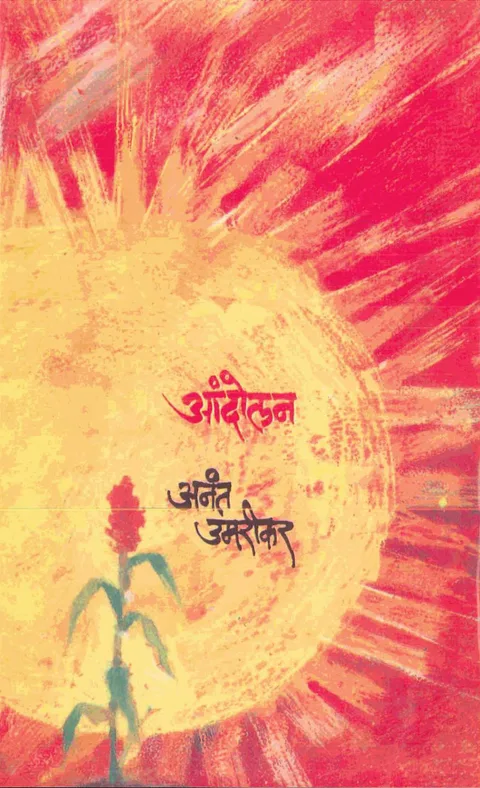
आंदोलन
Andolan
जनशक्ती बुक्स अँण्ड पब्लिकेशन प्रा. लि., जनशक्ती वाचक चळवळ, 'पिनाक', २४४, समर्थनगर, औरंगाबाद. ४३१ ००१ · औरंगाबाद · 1992
82 pages
Summary
आंदोलन (Andolan, ‘Agitation/Movement’) is a Marathi-language book of four long reportage essays by Anant Umrikar, a journalist and associate of Shetkari Sanghatana leader Sharad Joshi, first published on 9 August 1992 and revised for a third edition in 2008. The book is dedicated to Sharad Joshi. In the rendered pages (covering the preface, TOC, and the opening of the first two essays), Umrikar writes in a first-person eyewitness style, immersing readers in the lived texture of the farmers’ agitation movement in Maharashtra in the early 1990s.
The first essay, ‘पाउले चालती परभणीची वाट’ (‘Footsteps on the Parbhani Road’), documents a large Shetkari Sanghatana conference held in Parbhani. In the rendered pages, Umrikar describes arriving at the weekly market, meeting a local activist named Prasad, and then witnessing the extraordinary mobilisation of tens of thousands of farmers from across Maharashtra. Sharad Joshi himself arrives and addresses the crowd; folk songs (powadas) in praise of the movement and its leader are reproduced in the Marathi text. The essay captures not only the logistics and spectacle of mass organising but also the ideological conviction that the Shetkari Sanghatana’s advocacy of free-market agricultural economics represents a genuinely revolutionary idea, one the mainstream urban reader has yet to appreciate.
The second essay, ‘आंदोलन’ (‘Agitation’), begins with a train journey to Delhi for a Shetkari Sanghatana protest march. In the rendered pages, a large contingent of activists — including named organisers such as Vijay Jawandhia, Bhaskarrao, and Prahlad Patil, alongside many women workers — boards a train from Parbhani and travels north. Umrikar records snatches of conversation, the mood of anticipation and apprehension on the journey, and early scenes of the protest. The preface explicitly frames the book’s purpose: to carry the Shetkari Sanghatana’s free-market ideas beyond the rural base and into the urban Marathi reading public.
Key points
-
The book is dedicated to Sharad Joshi and is written entirely within the intellectual and organisational orbit of the Shetkari Sanghatana farmers’ movement.
-
In the rendered pages, Umrikar writes as a participant-observer, embedding himself in the crowd at the Parbhani conference and then in the Delhi-bound protest train.
-
The preface explicitly identifies the book’s political purpose: to popularise free-market (मुक्त अर्थव्यवस्था) agricultural ideas among urban Marathi readers who treat them as heretical.
-
Marathi folk songs (powadas) praising Sharad Joshi are reproduced verbatim in the first essay, signalling that the book blends journalism with movement literature.
-
Named activists appearing in the rendered pages include Prasad (Parbhani), Harshendra Deshkar, Anant Gore, Madhav Khandekar, Vijay Jawandhia, Bhaskarrao, and Prahlad Patil — indicating the thick network of Shetkari Sanghatana cadre across Vidarbha and Marathwada.
-
The Parbhani conference described in essay 1 drew participants from Gujarat, Andhra Pradesh, Karnataka, Madhya Pradesh, Rajasthan, and other states, marking the Shetkari Sanghatana as a supra-regional mobilisation.
-
The third edition (2008) incorporates pieces from an earlier Umrikar book ‘Vatchal’, expanding the original 1992 volume.
Metadata and summary are AI-extracted from the source PDF and reviewed for editorial accuracy. The original work is available via the Read PDF tab above (where present); paragraph-level citation inside the PDF is deferred to a future engagement.